Anthropic has turned an internal optimization experiment into a public reference repository. The useful artifact is not the largest speedup number. It is the collection of runnable kits and the assumptions attached to them.
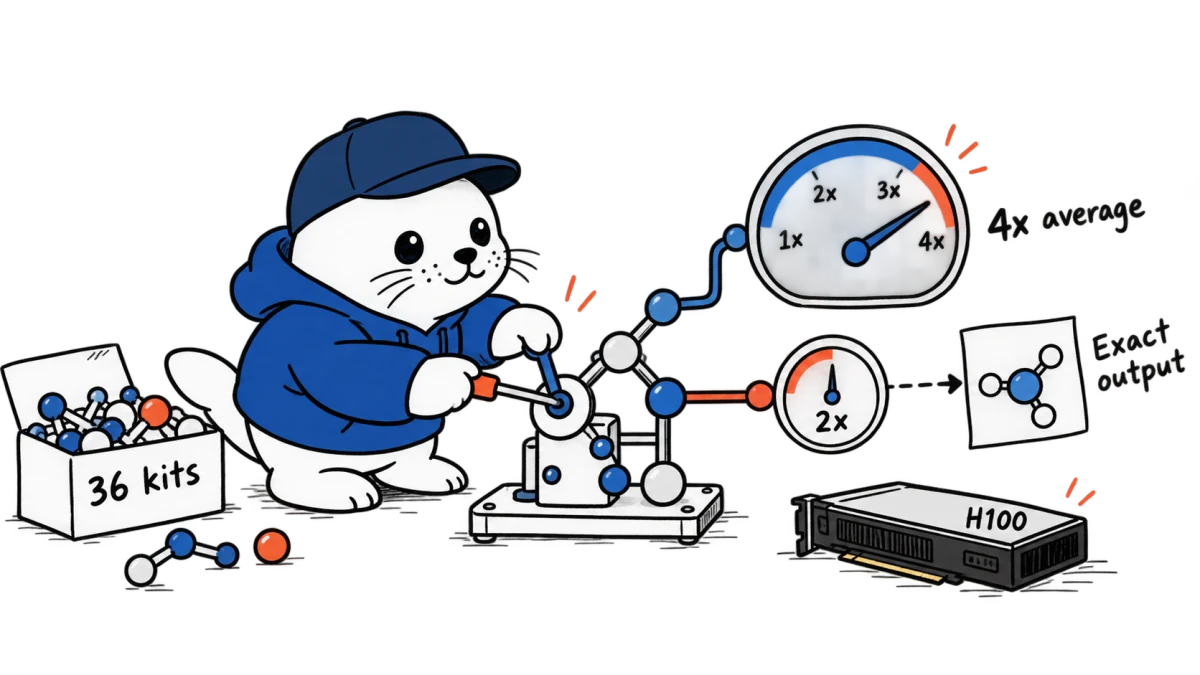
The new Anthropic biomolecular kits repository contains 36 optimization packages. Anthropic says an internal model optimized more than 30 biomolecular models in under four weeks, producing about a 4x average speedup with minimal precision loss and nearly 2x for exact-output cases. These are company-reported results, not an independent benchmark.
What Anthropic released
The GitHub repository is licensed under Apache 2.0 and pins upstream projects and licenses. Each kit is intended as a reference implementation for a specific model or workload. Anthropic labels the repository unmaintained and says it is not accepting contributions, so adopters own future compatibility work.
That status should change how teams consume it. Fork the exact commit, preserve upstream license notices and create an internal owner. Do not depend on the repository as if it were a supported package feed.
Read the speedup numbers by output class
| Reported result | Scope | Safe interpretation |
|---|---|---|
| About 4x average | Optimized model set with minimal precision loss | A broad company average, not a guarantee for one model or input. |
| Nearly 2x | Cases preserving identical outputs | Useful where exactness was achieved, but test your own paths. |
| 1.6x identical | Structure subset shown in Anthropic’s chart | A narrower exact-output result that should not be rounded into the broader claim. |
| 2.7x to 2.9x | FlashPairformer triangle attention | Kernel-level result under Anthropic’s tested conditions. |
| 1.7x to 3.2x | FlashPairformer multiplication | Range varies by operation and shape. |
Hardware can decide whether a kit helps
The repository documents Linux and NVIDIA H100 assumptions for several workloads. A kernel tuned for one GPU, driver, precision mode and tensor shape can regress elsewhere. Record the full software and hardware stack before comparing throughput.
Anthropic also describes a Big mode for inputs above 10,000 tokens on a single GPU node. The project notes more than 70,000 tokens on an eight-GPU B300 system, but warns that the run can collapse incorrectly. Capacity is not the same as validated scientific output.
A reproduction protocol
- Freeze the reference. Record kit commit, upstream commit, container, driver, CUDA and GPU model.
- Build a correctness corpus. Include typical, extreme and scientifically sensitive inputs.
- Compare outputs before speed. Separate bit-identical, numerically close and scientifically equivalent results.
- Warm and measure consistently. Report compilation, loading, latency, throughput, memory and energy separately.
- Publish failures. Keep out-of-memory, instability and incorrect-collapse cases in the report.
Security assumptions are part of the kit
The repository warns that examples assume trusted inputs, trusted model weights, a single user and container isolation. It also notes risks from hooks and Python pickle behavior. Those assumptions are reasonable for a controlled research workstation and unsafe for an untrusted multi-tenant service.
Before exposing a kit through an API, remove arbitrary hooks, avoid untrusted serialized weights, isolate jobs, restrict filesystem and network access and set memory and runtime limits. Optimization code often crosses into compiled kernels, so dependency and artifact provenance matter as much as Python review.
Scientific equivalence is domain-specific
A small numerical difference can be harmless for one downstream analysis and decisive for another. Teams should define acceptance thresholds with domain experts before looking at the optimized output. Include downstream tasks in validation, not only tensor-level similarity, and keep an unoptimized reference path available when a result falls near a scientific decision boundary.
Licenses need a per-kit record
Apache 2.0 covers Anthropic’s repository contribution, while upstream code and model weights can carry separate terms. A product team should build a bill of materials for every kit it adopts rather than assuming one top-level license resolves the complete chain.
Our analysis of Claude in scientific discovery separates model assistance from experimental proof. The Model Hardware Standard guide covers the next boundary: connecting model output to real lab equipment.
The bottom line
The 36 kits are valuable starting points because they expose implementation details that a speedup headline cannot. Their reference-only status, hardware assumptions and security warnings mean they should enter production through a fork, correctness suite and owned maintenance plan. Reproduce one workload before generalizing the 4x figure.
Read the primary record
Checked September 18, 2026. Product details and reported results come from the linked first-party sources. Interpretation, limitations and implementation advice are MustHave.ai analysis.