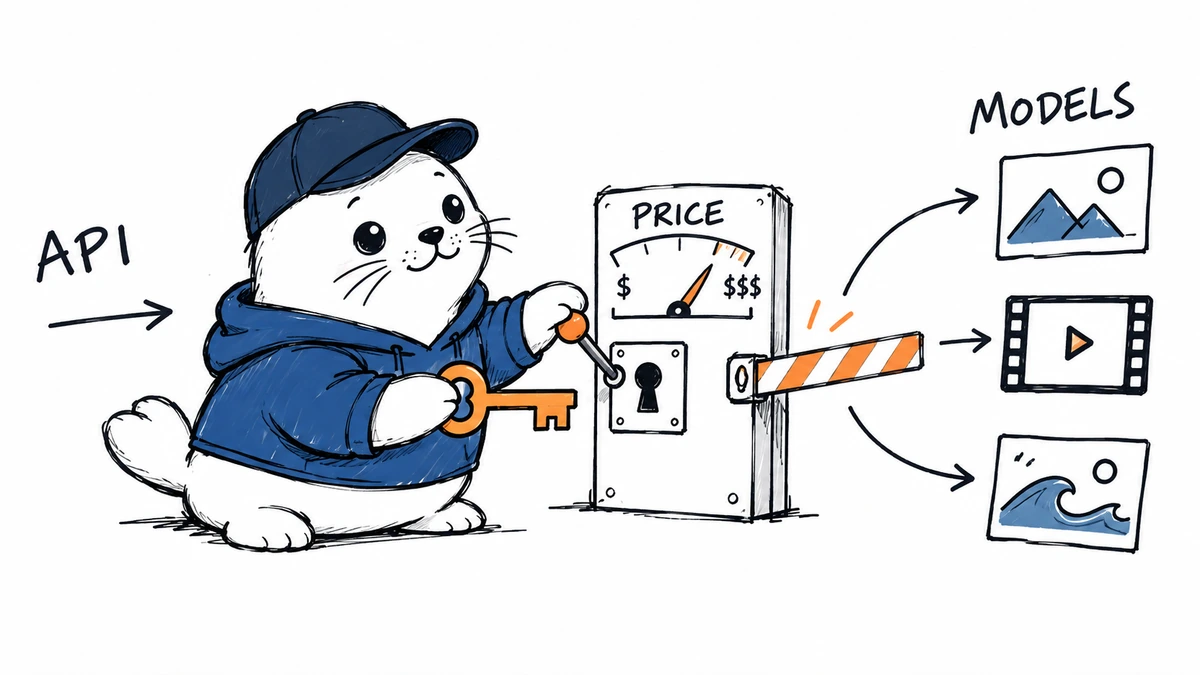
Higgsfield launched a self-serve API on September 16, 2026, offering one interface for more than 50 image and video models. The important details sit below the model count: API billing is separate from Higgsfield’s web plans, jobs run asynchronously, new keys begin with 20 concurrent requests, and generated files are guaranteed to remain available for only seven days.
For developers, the Higgsfield API is less a new foundation model than a curated gateway. A single authentication pattern can reach image generation, image editing, text-to-video, image-to-video, character animation and other creative workflows without integrating each upstream provider separately.
What the Higgsfield API actually launched
Higgsfield’s official launch page describes a catalog of more than 50 models accessed through REST or SDKs. The developer documentation presents an asynchronous workflow: submit a generation request, receive a request identifier, then poll for completion or configure a webhook.
The catalog is the product. It can change as models are added, removed or repriced. That means an integration should discover supported parameters from the current model page instead of assuming that every video model accepts the same duration, resolution, audio or reference-image options.
The API balance is separate from a Higgsfield web plan
Higgsfield states that its website subscription and API are separate products. Web-plan credits do not pay for API calls, and an API balance does not extend a web subscription. The API uses a prepaid US-dollar balance with no recurring subscription requirement.
- Deposited API funds expire one year after purchase.
- Failed generations are refunded to the API balance.
- A newly created API key begins with 20 concurrent requests.
- Concurrency can increase with additional top-up volume.
- Output files are guaranteed to remain available for at least seven days, so production systems should download them promptly.
This separation matters when comparing the API with creator subscriptions. A cheap monthly web plan does not imply the same unit economics for automation, and unused API funds are not permanent cash equivalents.
Launch prices show a wide cost range
The launch table published by Higgsfield included image generation from fractions of a cent and video models priced by generated second. Examples included Marketing Studio Image at $0.0059 per image, Soul 2 and Soul Cinema at $0.0032 per image, Kling 2.5 at $0.042 per second, Kling 2.6 at $0.07 per second, Seedance 2.5 at $0.0738 per second, Kling 3 at $0.112 per second and MiniMax H3 at $0.13 per second.
| Launch-table example | Published unit price | Illustrative output cost |
|---|---|---|
| Marketing Studio Image | $0.0059 per image | About $5.90 for 1,000 images |
| Kling 2.5 | $0.042 per second | About $0.42 for 10 seconds |
| Seedance 2.5 | $0.0738 per second | About $0.74 for 10 seconds |
| MiniMax H3 | $0.13 per second | About $1.30 for 10 seconds |
Why the live catalog may show a different number
The live model catalog can display different starting prices from the static launch article. Model configuration, resolution, duration, audio, promotional discounts and the date of access can all change the visible figure. On September 17, some live entries were advertised with promotional starting prices that did not match the launch table exactly.
The safe implementation is to treat the console price as a dated quote, not a permanent constant. Store the selected model, configuration, quoted unit, timestamp and final charged amount for every production run. Our broader AI video generator cost comparison explains why per-second prices alone often hide resolution, duration and retry costs.
How to estimate a real workload
A useful budget model separates successful output cost from operational waste. For video, multiply generated seconds by the selected configuration’s current per-second price, then add an allowance for human-rejected outputs. Failed API requests may be refunded, but a technically successful clip that a reviewer rejects still consumed generation budget.
- Choose one image model and one video model for the first test.
- Record the exact parameters and live quoted price before submitting.
- Generate a small fixed sample, such as 20 images and 10 short clips.
- Track API failures separately from completed outputs rejected for quality.
- Calculate cost per accepted asset, not merely cost per request.
- Download accepted files to durable storage before the seven-day window becomes a risk.
Concurrency helps throughput, not creative consistency
Twenty concurrent requests can shorten a batch, but it does not guarantee that outputs share a character, camera language or product appearance. A production queue should limit concurrency per campaign, preserve seeds and reference assets when models support them, and apply a review gate before downstream publishing.
Teams building agent-driven creative systems should also cap spend per workflow and per day. Our guide to AI agent cost controls covers the budget boundaries that become important when a planning agent can trigger many media generations automatically.
What developers should verify before production
The API removes integration work, but it also introduces a gateway dependency. Before committing a production workload, verify rate-limit behavior, webhook retry rules, idempotency strategy, cancellation behavior, model-version changes, content-policy handling and how quickly a completed file must be copied to your own storage.
Higgsfield’s strongest launch claim is convenience: one account and one request pattern across a large creative catalog. The key unanswered questions are longer-term price stability, model availability and whether its routing layer adds enough operational value to justify using a gateway instead of integrating a smaller set of providers directly.
Sources and methodology
- Higgsfield: API launch and pricing overview
- Higgsfield: developer guide to AI video generation
- Higgsfield API documentation
- Higgsfield live model catalog
Checked September 17, 2026. Prices are time-sensitive and may vary by model configuration or promotion. MustHave.ai used Higgsfield’s primary launch materials and live catalog, then calculated illustrative costs from the published unit prices.