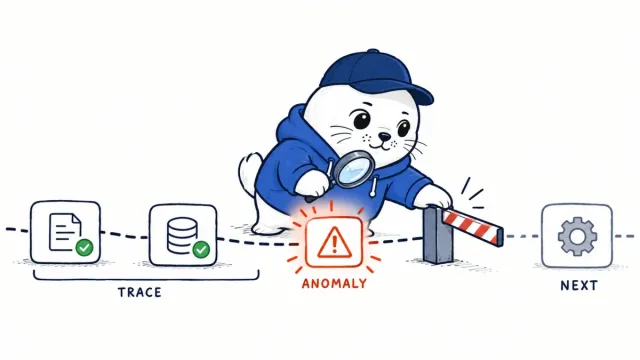


TypeSafe AI has emerged from stealth with a $40 million seed round and Jev, an early-access model built to return typed, probabilistic decisions instead of open-ended text. The design could make some automation faster and easier to validate, but its most dramatic performance claims still come from the company's own evaluation system.
DCVC confirmed that it led the unusually large seed investment. TypeSafe says Jev is the first of its “System One Models,” a category optimized for fast decisions inside software workflows. The pitch is narrower than replacing a general-purpose large language model: send unstructured state, define the permitted output types in advance, and receive a set of decisions with probabilities and confidence scores.
Jev changes the output contract
A conventional language model produces a sequence of tokens. Even when a developer requests JSON, the application normally has to parse the response, validate the schema and decide what to do when the output is malformed. Jev gives up free-form string generation and limits the answer to a predefined typed space.
| Design question | General-purpose LLM | TypeSafe Jev |
|---|---|---|
| Primary output | Generated text or structured text | Typed decisions defined by the application |
| Sampling | Sequential token generation | Parallel decision outputs |
| Uncertainty | Optional and prompt dependent | Probability and confidence included |
| Best fit | Writing, reasoning, coding and flexible interaction | Classification, routing, scoring and workflow branching |
| Main limitation | Malformed or unconstrained output is possible | No free-form string generation |
What “cannot hallucinate” actually means
TypeSafe says Jev cannot hallucinate because it cannot produce a value outside the declared type. That is a useful guarantee, but it is not the same as semantic correctness. A model can return a valid value from an allowed list and still choose the wrong value. The strongest defensible interpretation is that Jev prevents schema and type errors, while accuracy, calibration and business impact remain empirical questions.
The published speed and price claims
TypeSafe lists input pricing of $0.042 per million tokens and says output is too inexpensive to meter. It reports end-to-end latency between 70 and 500 milliseconds and a typical 40x to 200x speed advantage for similarly shaped decision tasks. Its workflow evaluation produced the larger headline figures of 193.6x faster and 444.6x cheaper.
Those numbers need boundaries. TypeSafe created the workflows, used the average of GPT-6 Astra and Fable 5.1 as reference probabilities, and says the largest gains may sit at the high end of real-world results. The company also states that long-term pricing sustainability is not yet proven. This is transparent disclosure, but it does not replace independent replication.
Why the $40 million seed matters
DCVC's investment thesis is that software will eventually make far more AI calls than people do. If that is right, the winning interface may look less like a chatbot and more like a dependable decision primitive. The funding gives TypeSafe room to build a new architecture, training method and serving stack instead of wrapping another model API.
The round does not prove product-market fit. Jev remains in early access, and TypeSafe has not published broad production adoption, retention or reliability data. For comparison, our Astra versus Fable coding guide examines general-purpose agent systems, while our production-systems analysis shows why application-level controls matter beyond model scores.
A five-part buyer test for typed AI decisions
- Define a decision where every permitted answer can be represented as an explicit type.
- Build a frozen evaluation set with costly edge cases and a real abstention option.
- Measure semantic accuracy and calibration, not only schema validity.
- Compare total workflow latency and cost, including retries, validation and fallbacks.
- Run a shadow deployment before allowing the model to trigger irreversible actions.
Where Jev could be genuinely useful
The strongest initial use cases are high-volume, low-latency decisions with a bounded answer space: lead routing, content moderation labels, fraud escalation, support triage, policy checks and selecting among known tools. Jev is less obviously suited to tasks whose value comes from creating new language, exploring an open-ended plan or explaining a nuanced conclusion.
The practical verdict
TypeSafe Jev is interesting because it questions whether text should be the default model-to-software interface. Its typed output contract can remove one failure class and its parallel design may be attractive for large decision graphs. The next proof point is not another striking multiple. It is independent evidence that Jev's probabilities stay calibrated and its decisions stay correct when real data shifts.
Primary sources
- TypeSafe AI: Introducing System One Models and Jev
- DCVC: TypeSafe emerges from stealth
- TypeSafe AI on GitHub
Checked September 16, 2026. Funding is confirmed by the lead investor. Performance, pricing and product claims are company reported and have not been independently audited by MustHave.ai.