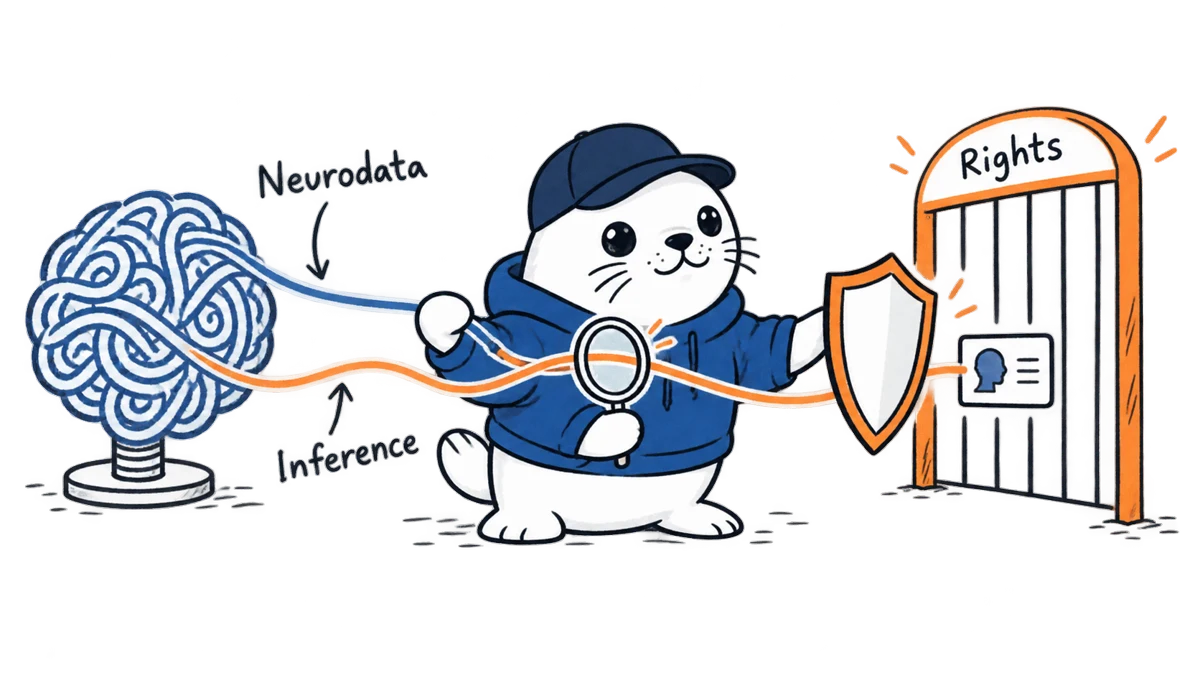
Neuro-AI governance is moving beyond the device on a person’s head. EU ethics advisers want policy to follow the infrastructure that collects brain-related data, derives new inferences and turns those inferences into decisions.
The European Group on Ethics in Science and New Technologies released its statement on September 8, 2026. It gives advice to the European Commission. It is not a regulation, a final Commission proposal or a newly applicable legal obligation.
What Neuro-AI infrastructure means
The statement describes interconnected systems through which neurodata are collected, processed and reused to create, deploy and manage AI-powered neurotechnology. That can include devices, datasets, model training, cloud systems, access controls and downstream applications.
The infrastructure view matters because a privacy notice at collection does not answer every later question. A model may infer a sensitive state that was never measured directly, or a dataset gathered for research may become training material for a different consequential use.
The five recommendations
| Recommendation | What the advisers are asking for | Status |
|---|---|---|
| Protect neurodata | Define and reinforce protection for recorded data and derived inferences | Policy recommendation |
| Develop Neuro-AI responsibly | Address brain foundation models and related infrastructure | Policy recommendation |
| Protect rights | Limit disproportionate control in consequential uses | Policy recommendation |
| Build governance capacity | Create public-interest capacity for infrastructure oversight | Policy recommendation |
| Run a fitness check | Assess whether the EU framework is adequate for Neuro-AI | Recommended future assessment |
Derived inferences are the harder data problem
A neurodata record may contain a measured signal. A derived inference is a conclusion produced from that signal, often after combining it with other data. The inference can be more sensitive than the original record because it may claim something about attention, emotion, health or behavior.
Teams should inventory both. A deletion request that removes raw data but leaves embeddings, scores and downstream labels may not achieve the intended protection. Contracts should also address whether a processor can reuse those derived artifacts for training or product improvement.
Brain foundation models raise shared-risk questions
A brain foundation model could be trained on large, diverse neurodata and adapted across tasks. The same reusable model can spread benefits and errors across many applications. That is why the statement links model development to infrastructure, sovereignty and public-interest oversight rather than evaluating one device at a time.
A model card should identify data provenance, excluded populations, intended uses, known failure modes and adaptation limits. It should not imply that performance on one dataset transfers to employment, education, insurance or clinical decisions.
What existing EU AI rules already tell teams
The EU already has data-protection and AI rules that may apply depending on the system and use. The EGE is asking whether those frameworks are fit for this domain and where stronger protections are needed. Our EU AI Act deadline guide separates existing obligations from dates that moved.
Content labeling is another separate question. Our Article 50 guide for creators should not be used as a substitute for a Neuro-AI data and rights assessment.
A Neuro-AI procurement register
- List every collected signal, derived feature, embedding, score and label.
- Record the original purpose, legal basis, retention period and reuse permissions for each layer.
- Name the model, version, training-data source and adaptation method.
- Identify decisions that could affect access to work, education, insurance, credit, healthcare or public services.
- Test subgroup performance and abstention behavior under the actual sensing conditions.
- Define how a person can contest a result and how all derived artifacts are corrected or deleted.
- Map processors, cloud regions, model providers and transfers so the infrastructure is visible.
The practical test I would run
Choose one proposed inference and trace it backward from decision to source. Ask which raw signals and models created it, which alternative explanations exist, who can access it and how it would be challenged. Then simulate a correction request and verify whether the change reaches caches, embeddings, reports and retrained systems.
If the team cannot complete the trace, it is not ready to claim meaningful control over the inference. This test does not determine legal compliance. It exposes governance gaps for counsel, ethics reviewers and technical owners to resolve.
My take: govern the reuse path, not only the sensor
The statement is valuable because it follows neurodata after collection. A consent screen can be precise while the later reuse path remains unclear. Infrastructure mapping makes that hidden path reviewable.
The next evidence to watch is whether the Commission begins the recommended fitness check, proposes legislation or funds the public-interest capacity described by the advisers. Until then, call this expert advice and prepare an inventory, not a new compliance deadline.
Primary source
Checked September 8, 2026. The five recommendations are confirmed by the Commission page. Legal effect and operational guidance are carefully separated.