

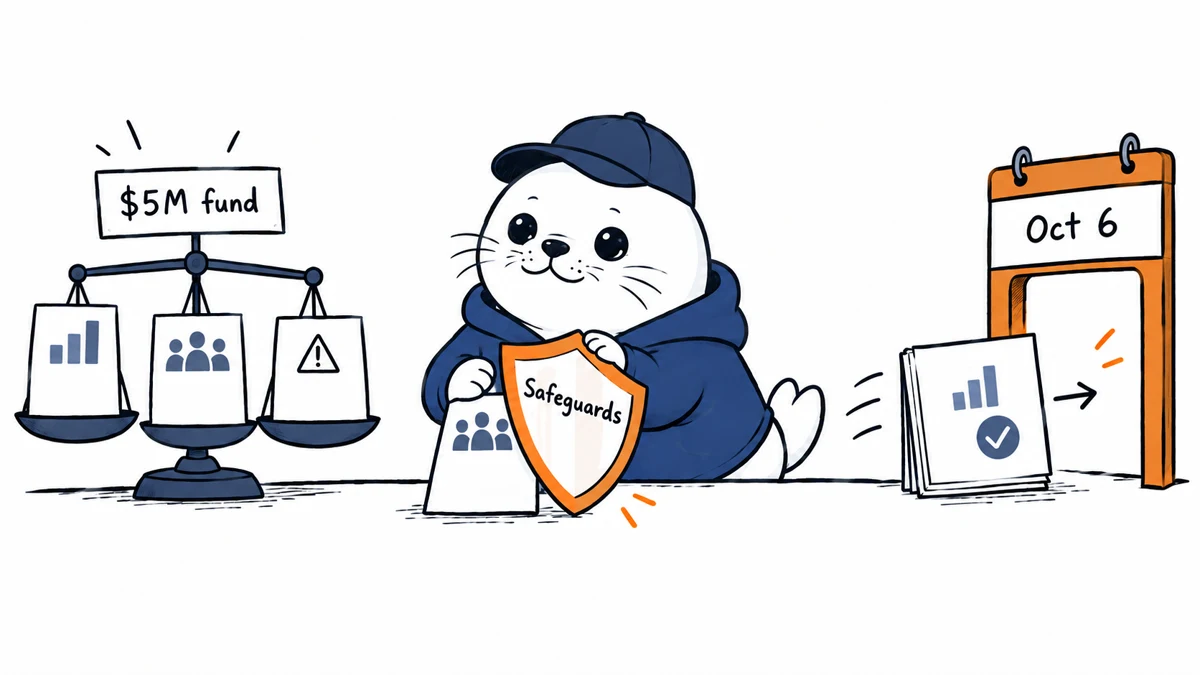
OpenAI has opened a $5 million grant program for research on how generative AI affects people ages 13 to 17. The deadline is close enough that a viable team should decide now whether it has the participant access, ethics process and methods to submit a credible study.
Applications opened September 8, 2026 and close October 6. OpenAI says selected proposals will be notified on or before November 13. Individual grants can reach $1 million, and no more than 10% of an award may cover overhead or indirect costs.
Who is eligible to apply
Applicants must be at least 18 and either affiliated with a research institution or organization, or have significant relevant experience. OpenAI says it is seeking research rather than for-profit initiatives and will not prioritize for-profit organizations at this time. Applications must be submitted in English, although the research itself may use any language.
The program welcomes applicants from any country and says it will prioritize countries with significant AI adoption. Preference may also go to interdisciplinary teams, research involving ChatGPT, underrepresented populations or regions, and work that can inform near-term or medium-term policy.
What OpenAI wants researchers to study
| Priority area | Example decision the research could inform | Evidence that would help |
|---|---|---|
| Emotional development | Which patterns of use support or undermine well-being? | Longitudinal measures plus context and confounders |
| Relationships | When does AI complement or displace human connection? | Usage patterns, qualitative interviews and comparison groups |
| Demographic variation | Which effects differ by age, culture, language or income? | Recruitment plan and subgroup analysis sized in advance |
| Safeguards and design | Which intervention changes behavior or outcomes? | Predefined endpoints, baseline and transparent failure cases |
Research involving minors has an extra gate
A study involving minors must explain the relevant ethics-review process, informed consent and age-appropriate assent, privacy and data protection, response to disclosures of harm or imminent risk, handling of sensitive information and the team’s safeguarding expertise. Parental consent must be addressed where appropriate.
Collecting sensitive information does not automatically make a proposal ineligible. It does raise the burden. The application should name who receives an escalation, how identifiers are separated, how long raw data is retained and what happens if a participant shares an immediate safety concern.
The application package is short but specific
- A project summary of less than one page.
- A research proposal of no more than three pages, excluding references.
- A project plan and timeline with milestones and completion date.
- A budget, justification, major cost categories and other committed support.
- Project dependencies and risks that could prevent completion.
- An ethics and safeguarding statement where minors, sensitive data or vulnerable populations are involved.
- Short bios or CVs plus an independence and conflicts disclosure.
OpenAI asks for a single-spaced Google document. The three-page limit means teams should not spend the first page restating that teen AI use is important. Put the research question, comparison, sample, outcome and analysis near the top.
How proposals will be reviewed
The published criteria include rigor, relevance, clarity, actionability, ethics, feasibility, team expertise, inclusion, complementarity and independence. A strong application should show how an unfavorable result would remain publishable and useful. The program is funded and administered by OpenAI Group PBC, so the conflicts statement and publication plan deserve explicit attention.
OpenAI encourages public release through a paper, preprint or report, but does not make publication a condition of funding. Applicants should clarify data access, review rights and the freedom to report negative or critical findings before accepting an award.
Expected outputs and timing
Funded teams must provide an interim progress update in the first quarter of 2027 and a final report covering the research question, methods, results, evidence, limitations, uncertainty and supported recommendations. A proposed timeline should reserve time for ethics review, recruitment and analysis rather than assuming enrollment starts immediately.
A one-day go or no-go checklist
- Can the team state one answerable question and one primary outcome?
- Is participant access realistic within the proposed timeline?
- Is the ethics and safeguarding review route named, with an owner?
- Can the analysis distinguish age, context and purpose of use rather than treating all AI use as one exposure?
- Will methods and negative results remain reportable?
- Does the budget fit the 10% overhead limit and include participant protection work?
How this differs from product age routing
This grant program is about building evidence, not announcing a new ChatGPT safeguard. Our ChatGPT for Teens routing analysis covers the separate product question of how age-based behavior is evaluated.
Researchers planning an agent-heavy study should also use our human-review framework for AI research assistants. Keep participant-facing decisions and interpretation under named human responsibility.
Primary source and application
Checked September 8, 2026. Funding, eligibility, requirements and dates come from OpenAI’s program page. Application advice is Musthave.ai analysis.