

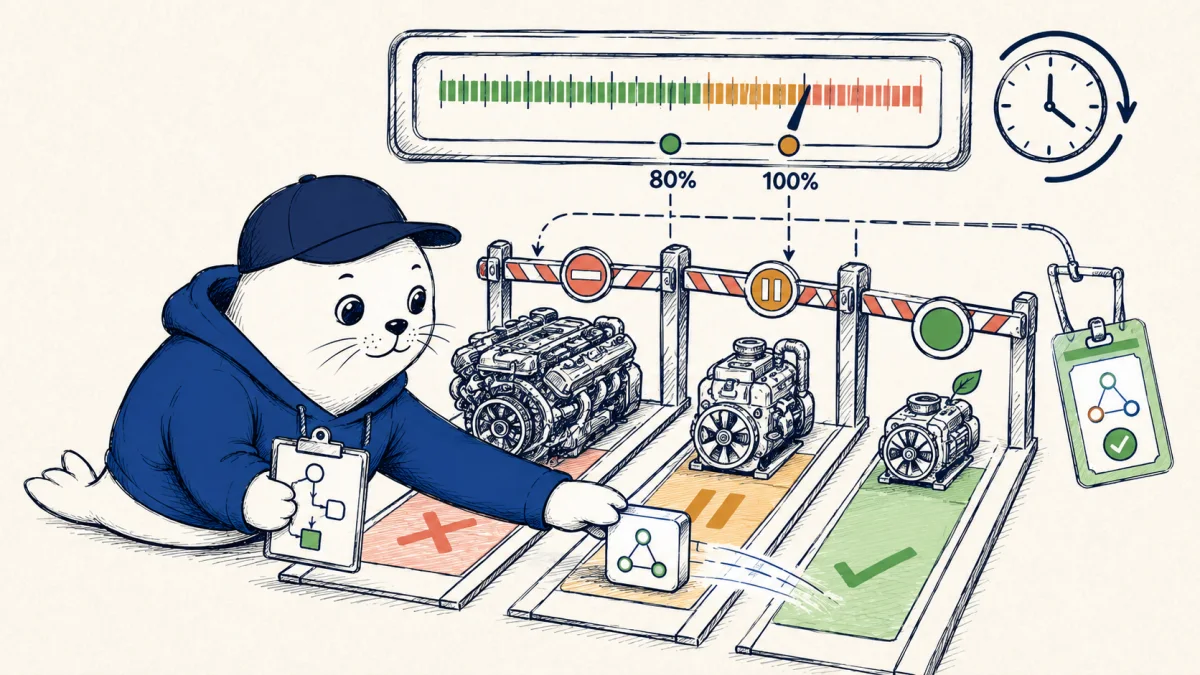
A budget alert arrives too late if an agent continues spending after it fires. Combine cost measurement with an explicit action at the limit.
October 20 update: a production review-cost example
In its October 19 engineering report, Cloudflare says average code-review cost fell from $2.43 to $0.77. It also reports median duration falling from 4 minutes 9 seconds to 1 minute 32 seconds.
These are Cloudflare’s measurements for its own reviewer. The article says its comparisons around configuration changes are not a statistically sound controlled experiment. The reported 68% saving is not a forecast for another system.
Inspect repeated context and unnecessary calls
Cloudflare describes stabilizing shared prompt prefixes, reducing unnecessary tool calls, changing models and effort, and stopping jobs that had been canceled. It also reviews the effect on findings.
Those mechanisms suggest a useful investigation order. Record calls and token categories before changing the default model. A high cache-hit percentage can still accompany an expensive workflow when the total context grows.
The internal standards reviewer called Codex in this case study is Cloudflare’s named component. Its name should not be read as proof that every reference describes the OpenAI product.
Define what the budget limit does
Choose a budget owner and an enforcement point. State whether the limit pauses new jobs, stops an expensive route, or requires an explicit exception. Verify the actual behavior in the application.
As an illustrative policy, an 80% threshold could warn the owner and a 100% threshold could pause new nonessential jobs. Those percentages are examples, not documented defaults for a particular provider.
- Count tool and infrastructure charges alongside model tokens.
- Set limits on retries and maximum work per job.
- Stop canceled jobs instead of letting them finish unnoticed.
- Keep exceptions time-limited and attributable.
- Check that a cheaper fallback still produces an acceptable result.
Compare cost per accepted task
Divide the evaluation’s full cost by the number of accepted tasks. Keep failures in the numerator. Record review and repair time beside the monetary total.
For a code reviewer, fewer findings may mean less noise or missed problems. Use labeled examples and a sample of human-reviewed patches to distinguish those outcomes before accepting a cheaper configuration.
Where practical, change one control at a time and keep a rollback. A lower invoice is useful when the workflow still meets its acceptance criteria.
The MiniMax pricing guide includes an explicitly scoped token-cost calculation. The HydraFusion guide covers evaluating a routed coding workflow.
Read the sources and plan your next step
What should your agent actually do when it reaches its budget limit?
Checked October 20, 2026. This is source-based reporting and analysis; proposed checks are not hands-on test results.