

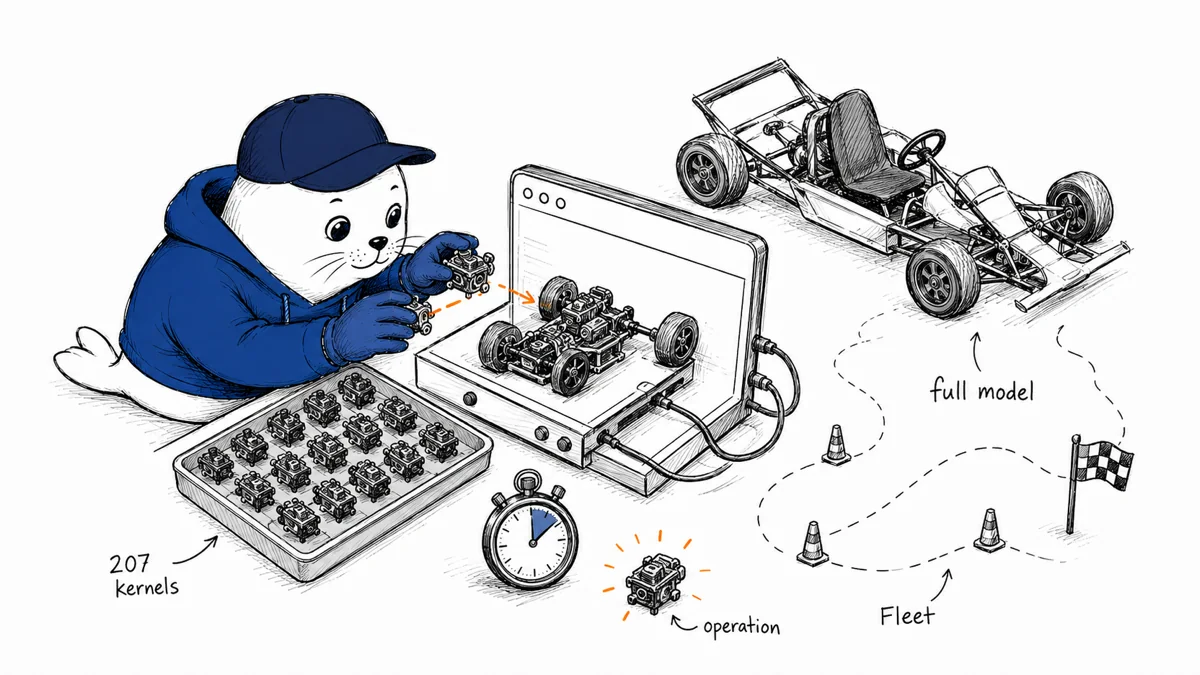
Hugging Face has put 207 optimized WebGPU operations on the Hub and reports a 2.57x geometric-mean speedup over ONNX Runtime Web in its test. That is an interesting systems result. It is not evidence that your browser model will suddenly run 2.57x faster.
The distinction is the whole story. Hugging Face timed individual GPU operations on one Apple M4 and left setup, shader compilation, data transfer, and output readback outside the measurement. A useful kernel can remove a bottleneck. A model still has many other costs.
Hugging Face introduced the WebGPU kernel collection on September 1, 2026, together with a preview JavaScript loader and an in-browser test system called Fleet.
Each kernel arrives with a contract and evidence
The collection covers 207 operations used across machine-learning architectures. Each operation lives in its own versioned Hub repository with a manifest, interface contract, WGSL shader templates, correctness cases, benchmark cases, and usage instructions.
The preview @huggingface/kernels package gives JavaScript applications one way to load a kernel by repository ID and contract version. The runtime can choose among implementation variants for a device and input shape without changing the application-facing call.
The benchmark excludes most of an application’s journey
| Benchmark detail | Hugging Face test | What a product test must add |
|---|---|---|
| Hardware | Apple M4 GPU | Your supported GPUs, browsers, OS versions, and drivers |
| Unit measured | Individual WebGPU operations | Complete model and user workflow |
| Cases | 809 matching, reliably timed cases from 1,756 attempted | Representative shapes and real traffic |
| Included time | GPU operation time | Load, upload, compilation, warmup, execution, and readback |
| Reported result | 2.57x geometric mean, 1.90x median | End-to-end latency, throughput, memory, correctness, and battery |
Hugging Face reports 629 wins, 176 losses, and four ties against ONNX Runtime Web 1.30.0-dev in the retained cases. It also shows extreme outliers, including an unusual Einsum case above 10,000x. The company explicitly warns that these cases are not normal expectations.
The median is more informative than the biggest win, but even the median remains an operation result. A model that spends little time in the improved kernels may barely move. A model dominated by one repaired slow path may improve a lot.
Fleet turns device diversity into a test surface
WebGPU behavior changes across browsers, operating systems, GPUs, and drivers. Fleet runs correctness and performance cases inside a browser so a user can see results on the device in front of them. With consent, the run contributes private evidence that can reveal wrong answers, very slow paths, and poor variant choices.
This is a stronger direction than publishing one hero number and moving on. The open question is coverage. A crowd benchmark becomes useful when it reports enough device, browser, driver, operation, shape, and correctness detail to expose weak combinations instead of averaging them away.
Remote kernels create a dependency you must pin
The loader fetches kernel packages from the Hugging Face Hub. The contract version separates the application interface from the implementation, but production teams should still pin revisions, verify artifacts, record licenses, cache approved packages, and define behavior when the network or Hub is unavailable.
Hugging Face’s broader native Kernels project warns that downloadable native kernels can run with the Python process’s privileges. WebGPU shaders have a different execution boundary, but remote code and artifact provenance still deserve review. Treat a kernel update like a dependency update, not a content refresh.
A browser benchmark should start cold and end with the user
- Choose two complete models and three representative input sizes.
- Test a cold load, first inference, and ten warm inferences.
- Record artifact download, shader compilation, data upload, execution, readback, total latency, memory, and output correctness.
- Repeat across the oldest and newest devices you support, including a no-WebGPU fallback.
- Measure browser responsiveness, battery use, and failure recovery during a real user action.
Local execution can reduce server cost and keep data on a device, but the hardware bill does not disappear. Our analysis of local AI agent economics explains why ownership, support, and utilization belong in the comparison. Our report on Hugging Face agent traffic also shows why activity counts need a quality measure beside them.
Correctness must survive the optimization
The launch comparison retained only cases where both implementations produced matching outputs and reliable timings. That is a reasonable benchmark filter, but a product cannot silently drop the cases that fail. Record unsupported shapes, numerical drift, shader compilation failures, browser crashes, and fallbacks as results.
Set tolerances by model behavior, not only tensor difference. A tiny numerical change may be harmless in one classifier and alter token selection in a generator. Run end-to-end output checks after the operation suite passes.
Fleet needs a representative fleet
Volunteer data can overrepresent enthusiasts with newer hardware. Before using Fleet results for a product decision, compare its device distribution with your own analytics. An optimization that wins on Apple silicon may not help a school Chromebook or an older Windows laptop.
Publish percentiles by device class when possible. A median across unlike systems can hide the exact users who need a fallback.
My verdict: the packaging may matter more than the headline speed
The important part of Hugging Face WebGPU kernels is not one Apple M4 average. It is the attempt to package operations with stable contracts, correctness cases, benchmarks, and a path to evidence from many devices.
Try the preview on one real model, pin everything, and measure the complete path from click to answer. If the result improves there, you have a product win. Until then, 2.57x belongs to the kernel benchmark.
Read the primary material
- Read the Hugging Face WebGPU kernels announcement.
- Inspect the published article source and benchmark details.
- Browse the WebGPU kernel repositories.
- Review Hugging Face’s broader kernel packaging and security notes.
Checked September 2, 2026. Kernel count, packaging details, benchmark setup, performance results, and Fleet behavior come from Hugging Face. Performance figures are company-reported. The product benchmark and deployment analysis are Musthave.ai work.