

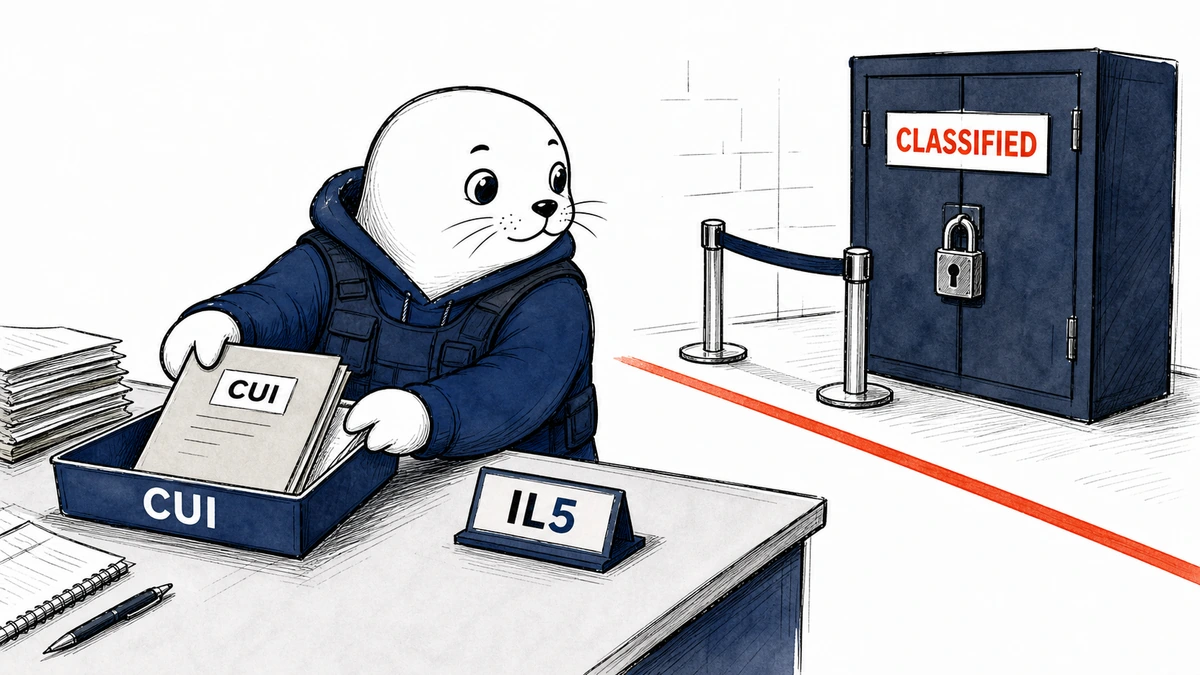
ChatGPT Mil can now handle Controlled Unclassified Information inside GenAI.mil. The word that matters is "unclassified." IL5 is a serious data boundary, not a permission slip for every military decision.
The U.S. Department of War launched ChatGPT Mil on August 31, 2026. The custom OpenAI product is accredited for Controlled Unclassified Information, or CUI, at Impact Level 5 and is intended to scale across more than three million military and civilian personnel.
The deployment matters because it moves ChatGPT from a promised integration into an operating government service. It also creates an easy misunderstanding: a secure chatbot is only one layer of a secure workflow. Data classification, identity, approval authority, logging, and human review still decide whether a task belongs there.
What launched on GenAI.mil
The Department says the initial experience centers on chat, files, projects, and custom GPTs, with more features planned over time. It names document-heavy planning, policy, logistics, and administration as early work areas.
OpenAI says the service runs in authorized government cloud infrastructure. It also says data processed on GenAI.mil remains isolated to the government environment and is not used to train or improve OpenAI’s public or commercial models. Those are meaningful platform commitments, but teams still need to configure who can see each project, file, and custom GPT.
| Work | Starting position | Why |
|---|---|---|
| Summarize CUI policy files | Potentially in scope | The service is accredited for CUI at IL5, subject to access and mission rules |
| Draft an unclassified logistics checklist | Potentially in scope | The Department names logistics and administration as target workflows |
| Upload classified intelligence | Out of scope by this announcement | IL5 CUI accreditation does not establish a classified-data authorization |
| Let a model approve a contract or operation | Out of scope without separate authority | Generation does not transfer legal, command, procurement, or safety accountability |
| Connect a custom GPT to an external system | Requires a separate review | Tool permissions and data egress create a new boundary beyond the chat interface |
IL5 is a data-handling level, not a quality certificate
Impact Level 5 tells operators what kind of Department information a system may be authorized to process and what security environment is required. It does not prove that every answer is accurate, that every custom GPT is safe, or that every connected source is current.
This distinction is familiar outside government. Our review of OpenAI’s private safety processing found that a privacy control and a model-quality control solve different problems. The same is true here: isolation can protect mission data while a generated summary still omits a clause or misreads an instruction.
Accreditation answers "where may this data be processed?" It does not answer "should this output be trusted?"
The control plane is the real product
GenAI.mil is a multi-model environment. That is useful because it avoids pretending one model is best for every task. It also makes routing and provenance more important. A user should be able to tell which model handled a request, what files were available, what tools ran, and what policy stopped an action.
- Identity: tie every project, file, and custom GPT to a named owner and access group.
- Data labels: block content whose classification exceeds the authorized environment before it reaches a prompt.
- Source records: preserve the documents, model version, instructions, and retrieval results behind consequential outputs.
- Tool gates: require separate approval before a model can message, publish, procure, alter records, or operate another system.
- Review: assign a human with the right subject-matter and decision authority, not merely someone available to click approve.
- Exit: make it possible to revoke a custom GPT, connector, credential, or model route without taking down the whole platform.
The lesson from the AISI cyber-evaluation incidents applies here: a sentence in a prompt is not a boundary if the network, identity, and tools permit something else.
Custom GPTs create a second governance problem
Custom GPTs can package instructions and files around a repeatable job. That makes them attractive for policy lookup, intake triage, compliance checks, and role-specific drafting. It also creates small applications that can quietly outlive their evidence.
Every internal GPT needs an owner, a stated audience, an approved data class, a source-update schedule, a tested refusal boundary, and an expiration or review date. A GPT trained around last quarter’s guidance can sound more confident as it becomes less correct.
A seven-question preflight for each workflow
- What is the highest classification of every input and retrieved source?
- Does the user have permission to see the source outside ChatGPT Mil?
- Which model, custom instructions, and tools will handle the request?
- Can any result leave GenAI.mil through copying, connectors, downloads, or messages?
- What factual error would create harm, delay, expense, or legal exposure?
- Who has the expertise and authority to review the result?
- What evidence will be retained so the decision can be reconstructed later?
This is more useful than a blanket "human in the loop" label. A reviewer cannot catch a hidden data leak they cannot see, and a junior operator cannot validate a specialist recommendation just because the interface asks for confirmation.
My verdict: start with reversible document work
ChatGPT Mil’s best first jobs are high-volume, document-heavy, and reversible: compare two policy versions, build a first-pass checklist, locate clauses, draft a briefing outline, or turn structured facts into a report that a qualified person reviews.
I would not begin with tasks where one plausible error becomes an operational action. Secure infrastructure is necessary. The higher-value achievement will be a control plane that keeps data, tools, models, and authority aligned as millions of people create their own workflows.
Read the primary sources
- Read the Department’s ChatGPT Mil launch release.
- Review OpenAI’s deployment and data-isolation description.
- Compare Defense One’s independent launch reporting.
- See how similar governance questions appear in federal public-health AI pilots.
Checked August 31, 2026. Product scope, accreditation, features, audience, and stated data treatment come from the Department and OpenAI. The task map and control checklist are Musthave.ai’s editorial analysis, not Department policy.