

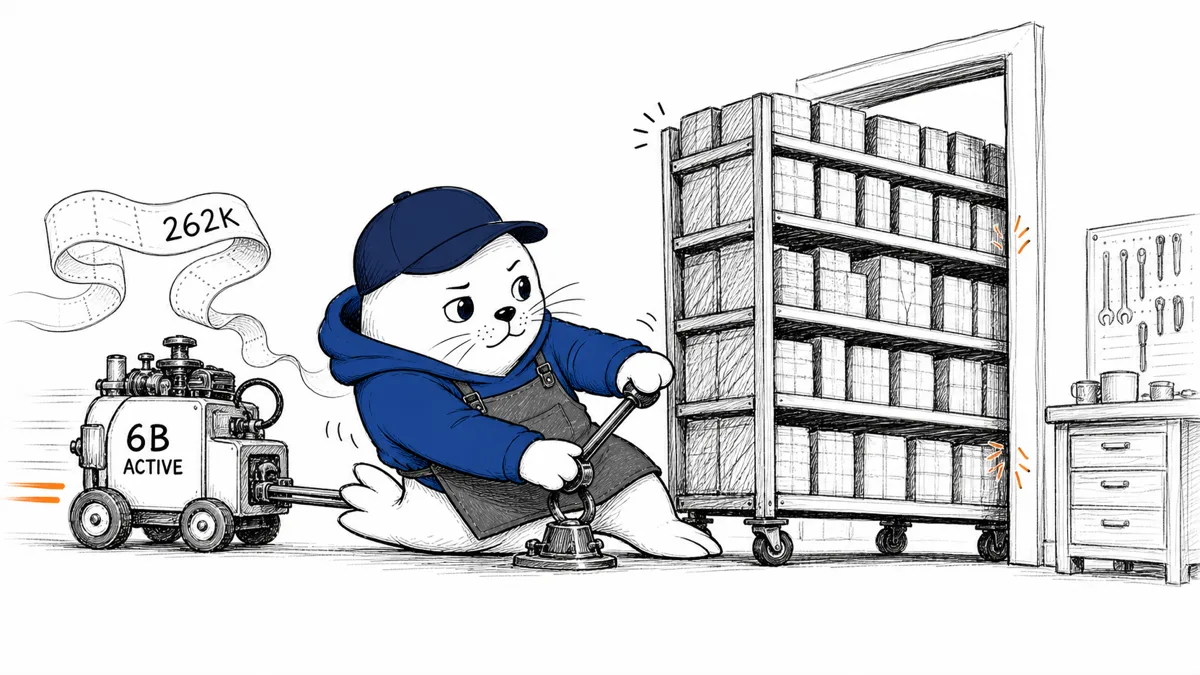
Qwen3.8-Flash-Next is not a small model. It is a large mixture-of-experts system designed to activate only part of itself for each token. That distinction changes the deployment question from "how many parameters?" to "what memory, throughput and serving stack does my workload actually need?"
Alibaba’s Qwen team released the model with weights, code and a model card on August 28. The published architecture combines 125 billion main-model parameters, a 51-billion-parameter n-gram component and a 4-billion-parameter multi-token predictor. Roughly 6 billion parameters are active per token.
The parameter headline needs four columns
| Component | Published size | What it changes |
|---|---|---|
| Main model | 125B parameters | Weight storage and total model capacity |
| N-gram component | 51B parameters | Additional draft or retrieval-like prediction path |
| Multi-token predictor | 4B parameters | Speculative token generation |
| Active per token | About 6B | Compute used for a token, not total weights loaded |
| Native context | 262,144 tokens | Prompt capacity before optional extension |
"Six billion active" does not mean the deployment behaves like a dense 6B model. The full weights still need storage and placement. Routing, expert communication, caches and long-context memory matter. The right benchmark includes cold start, peak memory and concurrent requests, not only generated tokens per second.
The one-million-token claim is an extension path
The model card lists a native context window of 262,144 tokens and describes extension to one million tokens. Treat those as different operating modes. A request fitting in a larger advertised window may still be too slow, too expensive or too distracted to be useful.
Build a long-context test from the documents your application retrieves. Place decisive evidence near the start, middle and end. Measure citation accuracy, contradiction handling, time to first token, memory use and total cost. Our review of Kimi K3’s memory-first design explains why context capacity and reliable retrieval are separate properties.
Serving support is unusually broad at launch
Qwen documents routes through Transformers, SGLang, vLLM, llama.cpp and MLX. That breadth is useful because teams can test the same weights across server and local environments. It does not guarantee identical kernels, quantization quality or feature support.
- Pin the exact model and serving-engine revision.
- Record quantization and tensor-parallel settings.
- Verify tool calling and structured output in the chosen runtime.
- Test maximum practical context under concurrent load.
- Keep the Qwen Community License 1.0 with the deployment review.
Independent numbers are promising, not portable
Artificial Analysis currently gives Qwen3.8-Flash-Next an Intelligence Index score of 56 and reports 77.3 output tokens per second through Alibaba’s API. It lists prices of $0.15 per million input tokens and $0.47 per million output tokens. Those are useful external measurements of a hosted route, not proof of self-hosted performance.
The same evaluator flags relatively verbose output. That matters because an inexpensive output token can still produce an expensive task if the model emits too many. Compare cost per accepted answer: input, output, retries, verification and latency.
A deployment test should separate five questions
- Can the weights fit the hardware and startup budget?
- Does the serving engine support the features the agent needs?
- Does longer context improve the task rather than only accept it?
- Does sparse activation deliver useful throughput at expected concurrency?
- Does the license fit the product and distribution model?
For coding or tool-using agents, add repository-specific tests and permission boundaries. The checklist in our AI agent security scorecard covers secrets, identity, logging and rollback.
Long context changes memory before it changes quality
A 262K prompt creates a large key-value cache even when only a fraction of model parameters is active. Under concurrency, cache memory can become the capacity limit before token compute does. Measure one request, then repeat at the number of simultaneous users the product expects. Record queue time, first-token latency and out-of-memory failures.
Do not fill the window because it exists. Retrieval that selects 20,000 relevant tokens may outperform a 200,000-token dump and cost less to rerun. Test distractor documents, duplicate facts and a late correction that contradicts earlier context. A model that accepts the prompt but cites the wrong passage has not solved long-context retrieval.
Quantization needs a task-level acceptance test
Local runtimes make lower-bit deployment attractive, but a smaller file is not a free copy of the original. Compare the unquantized reference with each candidate quantization on tool arguments, JSON validity, code tests, multilingual work and long-context recall. Track quality loss beside the memory saved and throughput gained.
For a first pilot, freeze 50 tasks, run three times per configuration and price only outputs that pass. The model with the highest raw speed can lose if it needs more retries or human correction. Publish the runtime, hardware, context length and quantization with every internal result so another team can reproduce it.
Keep hosted and self-hosted results in separate rows. They test different operating systems, kernels, quotas and network paths.
My verdict: benchmark the system, not the active count
Qwen3.8-Flash-Next combines a large total parameter pool, sparse activation, speculative prediction and a long native context window. That makes it a serious candidate for teams that can exploit the architecture. It does not make deployment equivalent to loading a dense 6B model.
Start with the official serving recipe closest to production, cap context to the workload’s evidence needs, and compare cost per accepted task against a smaller dense model and a hosted API.
Read the source record
- Read the Qwen launch post.
- Review the official model card and GitHub repository.
- Compare Artificial Analysis’s independent measurements.
Checked August 29, 2026. Architecture, context, runtime support and license come from Qwen. Hosted speed, price and index values are attributed to Artificial Analysis and can change.