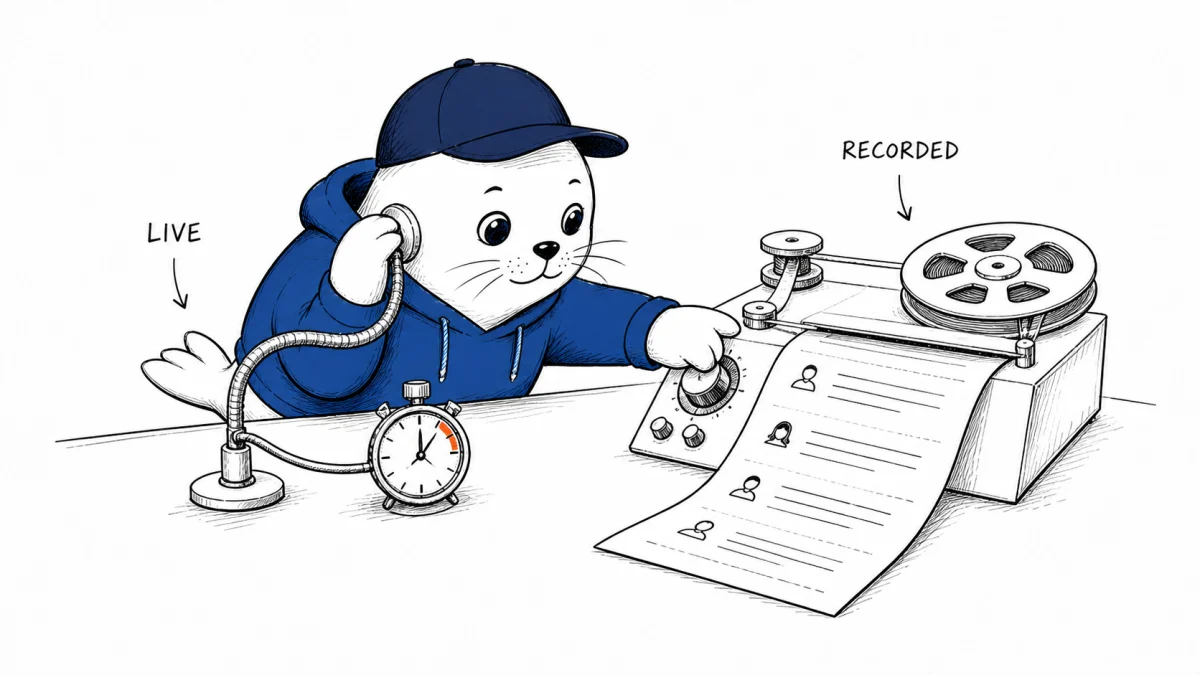
Google launched two transcription models under one name. Choose the wrong one and the benchmark number on the announcement page will tell you almost nothing about the product you are building.
Gemini 3.5 Transcribe is now in public preview as a recorded-audio model and a separate low-latency streaming model. The recorded API adds speaker attribution and word-level timestamps. The live API uses bidirectional WebSockets and targets sub-second delivery.
The tempting headline is accuracy. Artificial Analysis currently reports a 2.6% average word error rate for the prerecorded model. Google’s launch post cites 4.0% for streaming. Those are useful signals, but they are not a reason to pretend live captions and post-call transcripts are interchangeable workloads.
Live and recorded are different buying decisions
| Requirement | Live model | Recorded model |
|---|---|---|
| Model ID | gemini-3.5-transcribe-live | gemini-3.5-transcribe |
| Input | Streaming audio over WebSockets | Prerecorded audio |
| Main advantage | Sub-second responses | Lower reported WER and richer transcript structure |
| Speaker handling | Designed for live flow | Diarization for up to three speakers; more is experimental |
| Timing | Incremental transcript | Word-level timestamps |
| Estimated paid rate | About $0.009 per minute | About $0.005 per minute |
The pricing comes from Google’s current Gemini API pricing page. It estimates $0.005 per audio minute for recorded transcription and $0.009 per minute for live transcription, combining input-audio and output-text tokens. Preview pricing can change, so store the date with every cost comparison.
The raw API bill is the small number
At the listed blended rates, 10,000 recorded minutes cost about $50. The same volume through the live model costs about $90. That $40 gap is real, but correction work can dwarf it.
Suppose a reviewer costs $30 an hour. If the cheaper route creates two extra minutes of correction for every hour of audio, 10,000 audio minutes add roughly 333 minutes of review, or about $166.50. The model that costs $40 more at the API layer would still be cheaper overall if it avoids that work.
The useful metric is cost per accepted transcript:
Accepted transcript cost = API cost + review labor + reruns + downstream error cost.
WER does not measure the failures users remember
Word error rate treats every substitution, deletion and insertion mechanically. A transcript can score well and still get the customer’s name, drug, product code or payment amount wrong. It can also assign a sentence to the wrong speaker, which matters more than a missing filler word in a sales call or medical handoff.
- Measure named entities separately from ordinary words.
- Score speaker attribution on the meetings you actually process.
- Test code-switching, accents, crosstalk, music and poor microphones.
- Track final edit time, not only raw WER.
- Check whether partial live text is stable enough for the interface consuming it.
Google reports support for more than 85 languages and custom vocabulary. Its own selected-locale FLEURS figures are 5.04% for recorded audio and 5.50% for live. The gap is smaller than the cross-benchmark headline suggests, another reason to run a shared test set.
Preview status belongs in the architecture
Both model IDs are public previews, not generally available production contracts. Developers can access them through the Gemini API and AI Studio, with other Google surfaces offering their own paths. Preview means model behavior, quotas, regional availability and pricing may move.
Keep an adapter between the application and the transcription provider. Store original audio when policy allows, version the model ID with every transcript and preserve a rerun path. Our guide to testing Gemini API migrations explains why a successful response is not the same as equivalent behavior.
A two-hour evaluation beats a global leaderboard
- Select 30 minutes of clean speech, 30 minutes of difficult speech, 30 minutes with multiple speakers and 30 minutes containing important domain terms.
- Run both models with the same normalization and vocabulary settings.
- Measure WER, named-entity accuracy, speaker accuracy, timing errors and human edit minutes.
- For live use, add first-token delay, revision churn and dropped-session rate.
- Price the accepted output, then test a second provider before locking the interface.
If the transcript feeds an agent, add another check: can a mistaken command trigger an external action? The permission lessons in our AI cyber-test incident review apply to voice pipelines too. Recognition confidence should not silently become execution authority.
Set a failure budget before the pilot
Decide which errors the product may show and which ones require review. A live caption can tolerate a corrected partial phrase. A compliance record, medical note or payment instruction may need a human checkpoint before it becomes final. The same model can be acceptable in one path and unsafe in another.
Store the audio identifier, model ID, timestamp, vocabulary configuration and any human edits with the accepted transcript. That makes a later regression measurable across languages, microphones and account tiers. Without those fields, a quality complaint becomes an argument about memory rather than a reproducible test.
- Define the maximum named-entity error rate.
- Set a review rule for high-consequence terms.
- Record disconnects and reconnect behavior for live sessions.
- Keep a small frozen audio set for every model update.
My verdict: route by latency, score by acceptance
Use the live model when the product must react while someone is speaking. Use the recorded model when transcript quality, diarization and timestamps matter more than immediate delivery. Then judge both on your audio and your correction bill.
The 2.6% result is impressive. It is still a starting hypothesis, not a procurement decision.
Read the source record
- Read Google’s Gemini 3.5 Transcribe announcement.
- Check the current Gemini Developer API pricing.
- Compare the independent Artificial Analysis speech-to-text benchmark.
Our Grok Voice Transcribe 2.0 analysis provides another live-versus-batch comparison, including hourly price and explicit model-version pinning.
Checked August 29, 2026. Features, availability, Google benchmark values and prices come from Google. The 2.6% recorded-audio result comes from Artificial Analysis. Cost examples are Musthave.ai calculations using Google’s estimated blended rates.