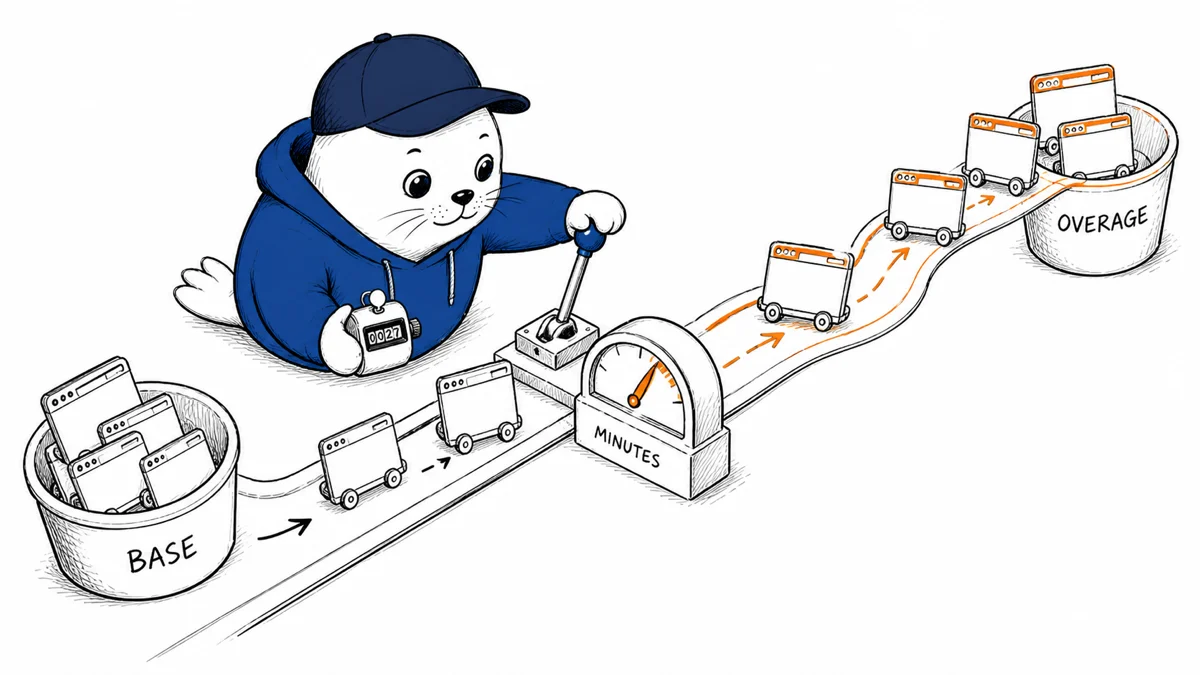
Browserbase bills more than 100 million browser minutes a month. The useful lesson is not the scale. It is that the invoice follows the unit that creates both customer value and infrastructure cost.
Browserbase usage-based billing combines a monthly subscription, included browser hours, and pay-as-you-go overage. Stripe says the system bills more than 100 million usage minutes per month, is fully automated, and helped Browserbase reach millions of dollars in revenue in its first year without dedicated billing engineers.
This is a stronger AI SaaS pricing case than a generic "charge by usage" slogan. Browser sessions have duration, concurrency, proxy, storage, and observability costs. The customer also understands what a browser hour means. A usable meter sits between those two realities.
Browserbase chose a hybrid meter
| Billing layer | Customer experience | Business purpose |
|---|---|---|
| Base subscription | A known monthly plan | Creates predictable recurring revenue |
| Included browser hours | Usable capacity before overage | Makes the plan easier to budget and compare |
| Pay-as-you-go overage | Additional usage remains available | Prevents a hard ceiling from blocking large workloads |
| Volume discounts | Lower effective price at scale | Supports larger customers without a separate billing system |
Pure subscriptions hide cost variance. Pure usage pricing makes the first invoice hard to predict. The hybrid model gives small customers a familiar plan and gives large customers room to grow. It also forces the company to define which usage event is billable and how corrections, retries, discounts, and failed sessions are handled.
The published results need careful labels
- Stripe reports more than 100 million usage minutes billed per month.
- Stripe describes the billing process as 100% automated.
- Browserbase’s founder says the company went from zero to millions of dollars in revenue with Stripe Billing.
- Stripe says a free tier helped drive a 17% increase in new customer signups within one month.
- Browserbase says no engineers manage billing after the initial integration.
These are vendor and customer claims, not an audited income statement or controlled pricing experiment. The 17% figure is signups, not retained subscribers, revenue, or profit. Stripe’s summary card uses "active subscribers," while the detailed results section says "new customer signups." I would use the narrower wording from the detailed section until the company publishes a cohort definition.
A good meter must survive retries and failures
Browser minutes sound simple until an agent opens several sessions, crashes, waits on a slow site, or retries the same job. If the meter bills every technical minute without explaining which failures count, customers will experience the system as arbitrary. If it forgives too much, the company absorbs real infrastructure cost.
- Give every metered event a stable idempotency key.
- Separate customer-initiated usage from platform retries.
- Define when a session begins, pauses, and ends.
- Show usage close to real time rather than after the invoice closes.
- Let customers set alerts and hard or soft spending limits.
- Keep a correction ledger so disputed usage can be reconstructed.
A startup does not need Browserbase’s scale to need these rules. At ten customers, an ambiguous meter creates support tickets. At 100 million minutes, it creates accounting and trust risk.
The unit should reflect value and cost
Tokens are easy for an AI vendor to count and difficult for many customers to value. Completed documents sound valuable but can vary wildly in cost and quality. Browser minutes work because they are close to the consumed infrastructure and visible in the customer’s workflow.
That does not make them perfect. A slow website can consume more minutes without producing more value. A fast, well-optimized task may save the customer far more than its duration suggests. The meter is a workable commercial approximation, not a scientific measure of outcome.
How to choose a meter for your AI product
| Question | Pass condition | Warning sign |
|---|---|---|
| Can customers predict it? | The unit appears in their normal workflow | The unit exists only in your infrastructure logs |
| Does it track cost? | Higher usage usually raises your variable expense | A cheap action and an expensive action bill the same |
| Can you audit it? | Every charge can be reconstructed from immutable events | Totals depend on mutable counters |
| Can customers control it? | Dashboards, alerts, and limits are available | Surprise invoices are the first usage report |
| Does it reward efficiency? | Better implementation can lower the bill | Retries and platform errors create revenue |
Our earlier analysis of Chipp’s subscription pricing failure shows the opposite case: one unusually expensive customer can make a flat fee nonsensical. Browserbase demonstrates a more durable response, but it still needs usage visibility and sensible overage behavior.
Billing infrastructure is product infrastructure
Stripe says Browserbase avoided months of custom billing work and did not assign engineers to ongoing billing operations. That is plausible, but "set it and forget it" should not be read literally. The payment processor can aggregate events and charge cards. Browserbase still owns meter semantics, entitlement state, incident corrections, customer communication, fraud, and the decision to change plans or discounts.
The company also announced a $40 million Series B in June 2025 and cut its Developer plan from $39 to $20 for 100 browser hours. That older pricing move shows why flexible billing architecture matters: cost improvements and market strategy can change the plan without replacing the underlying commercial system.
My verdict: meter the expensive primitive
Browserbase’s case is useful because the company did not force every customer into pure pay-as-you-go pricing. It wrapped an understandable monthly plan around the costly primitive, then allowed overage and discounts when usage moved beyond the bundle.
For an AI startup, the sequence should be similar: identify the resource that varies, confirm that customers understand it, build an auditable event stream, and expose limits before sending an invoice. Revenue is not healthy if customers cannot explain what they bought or the company cannot explain what it cost to deliver.
The payment layer belongs beside the product telemetry and the revenue operations system, not as an accounting afterthought.
Read the primary sources
- Read Stripe’s Browserbase usage-based billing case study.
- Read Browserbase’s Series B and pricing announcement.
Which event on your invoice would a customer recognize without opening your API documentation?
Checked August 15, 2026. Usage, revenue, automation, signup, engineering, pricing, and funding figures are attributed to Stripe or Browserbase. Stripe’s summary and detailed copy use different labels for the 17% result; this article uses the detailed section’s "new customer signups."