Flippa’s first-half data does not say every AI wrapper is valuable. It says buyers are searching for AI-native businesses while traditional content sales are moving the other way.
AI business valuations are hard to discuss without drifting into anecdotes. Flippa’s 2026 marketplace reports add a useful directional signal: the platform says it had 123,022 active buyers in the first half, searches for "AI-powered business" rose 20% from the previous half, and its AI Apps & Tools category recorded its first 14 sales.
At the same time, Flippa reports traditional content-business sales fell 39%. That is marketplace data from one platform, not a census of every acquisition. It is still a reason to examine what buyers may mean by "AI-native" and why adding a chatbot to a declining traffic asset is unlikely to change the underlying quality.
What Flippa reported in 2026
| Reported measure | Flippa figure | Responsible reading |
|---|---|---|
| Active buyers, H1 2026 | 123,022, up 18% year over year | Marketplace demand grew; it does not reveal how many buyers closed a deal |
| "AI-powered business" searches | Up 20% half over half | Buyer curiosity increased; search is not a transaction |
| AI Apps & Tools | First 14 sales | An emerging category, not enough data for a stable multiple |
| Traditional content sales | Down 39% | A warning for traffic-only assets on this marketplace |
| Top-quartile assets | About 1.6x–2.7x platform averages | Quality dispersion matters more than a single average |
AI-native means the product loop depends on AI
A useful AI-native business is not merely a conventional website with generated copy. The model should sit inside a customer workflow: transforming data, completing a task, improving with feedback, or reducing a meaningful cost.
- Workflow depth: The customer returns because the product completes a recurring job.
- Owned context: The business has permissions, integrations, or structured data that improve the result.
- Measurable outcome: Time saved, revenue created, errors reduced, or work completed can be verified.
- Model portability: The product can change providers without losing its entire identity.
- Margin control: Usage, fallbacks, and human review are visible at customer level.
This is different from publishing large volumes of generic pages and calling the site an AI business. Our guide to using AI for content without flattening the human layer explains why output volume alone does not create defensibility.
The 39% content decline is a business-model warning
Traditional content businesses can still be excellent assets. The weak version depends on search traffic, undifferentiated articles, and advertising or affiliate revenue that another publisher can reproduce. Generative search and cheap content make that version easier to challenge.
A content business becomes more durable when it owns a trusted audience, first-party data, a product, a community, a recognizable editorial method, or a workflow customers pay to use. Adding an AI chat box to the homepage does not fix concentration risk or disappearing search demand.
Why the top quartile matters
Flippa says top-quartile assets achieved roughly 1.6 to 2.7 times platform averages. The exact comparison varies by asset type, and the report should not be turned into a universal premium. The important point is dispersion: two businesses with similar revenue can be valued differently because one has better margins, retention, documentation, and transferability.
That makes "average multiple" a poor starting point for a founder. Improve the variables a buyer can verify instead.
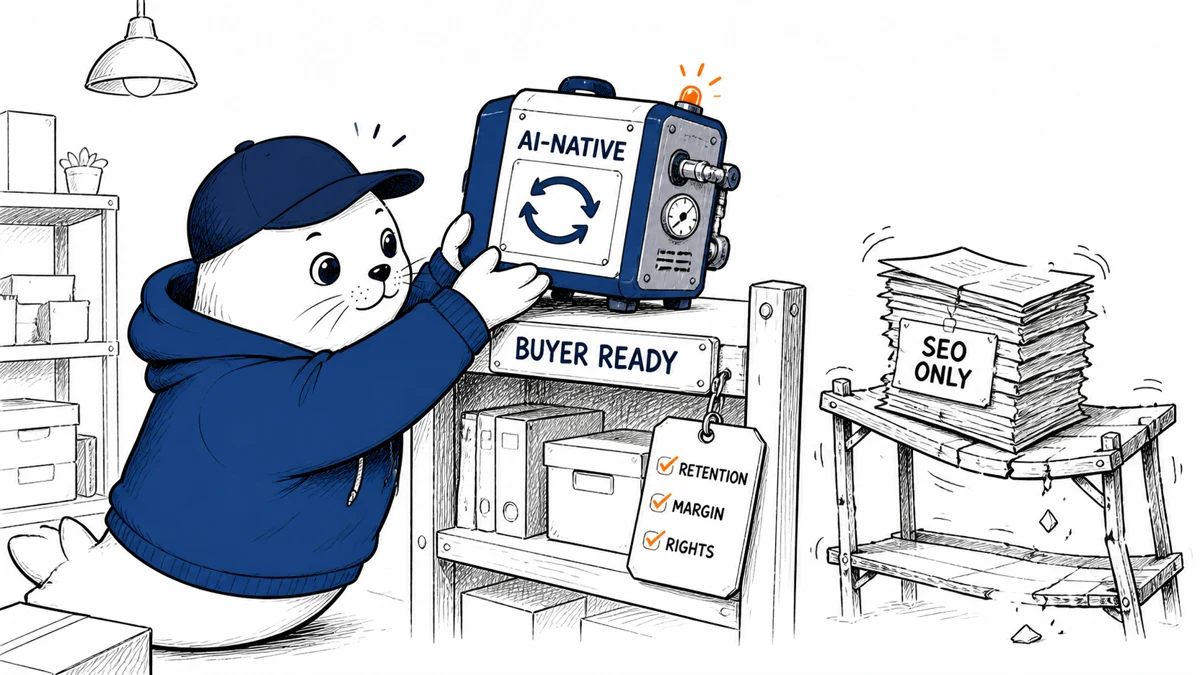
A buyer-readiness test for an AI-native asset
| Question | Strong evidence | Weak answer |
|---|---|---|
| Why do customers return? | Retention cohorts tied to a recurring workflow | "AI is growing" |
| What does one customer cost? | Model, tool, support, and retry costs by account | One blended hosting total |
| What can be transferred? | Code, contracts, data rights, accounts, SOPs | Founder knowledge and personal logins |
| What survives a model change? | Evaluation set, routing layer, customer context | One provider-specific prompt |
| How is growth repeated? | Channel cohorts and measured payback | A viral launch screenshot |
Our small-stack test for AI tools applies to acquisitions too: every subscription and dependency should justify its place through a repeatable outcome.
What the marketplace data cannot tell us
Flippa’s reports do not provide a complete table of AI sale prices, revenue, profit, and multiples. We cannot use 14 early sales to establish a stable benchmark. Search growth may reflect curiosity as well as purchase intent. The platform also sees the businesses that choose to list there, which creates selection effects.
The figures are most useful as a change in marketplace composition. They show that buyers are looking for a different kind of asset while traffic-only content sales are under pressure.
My verdict: value the workflow, not the wrapper
Early AI business valuations will remain noisy. A founder cannot control the label buyers search for, but can control retention, unit economics, rights, documentation, and the product’s ability to survive a model or ownership change.
Build an AI-native workflow because it creates customer value. If it also creates buyer demand later, treat that as optionality, not the business plan.
Read the marketplace reports
- Read Flippa’s H1 2026 digital M&A insights.
- Review Flippa’s Q2 2026 marketplace trends.
If a buyer removed the phrase "powered by AI," what durable asset would remain?
Checked August 14, 2026. Buyer counts, search growth, category sales, content-sales decline, and top-quartile comparisons are attributed to Flippa’s marketplace reports. They describe one platform and should not be treated as a complete market or a universal valuation formula.