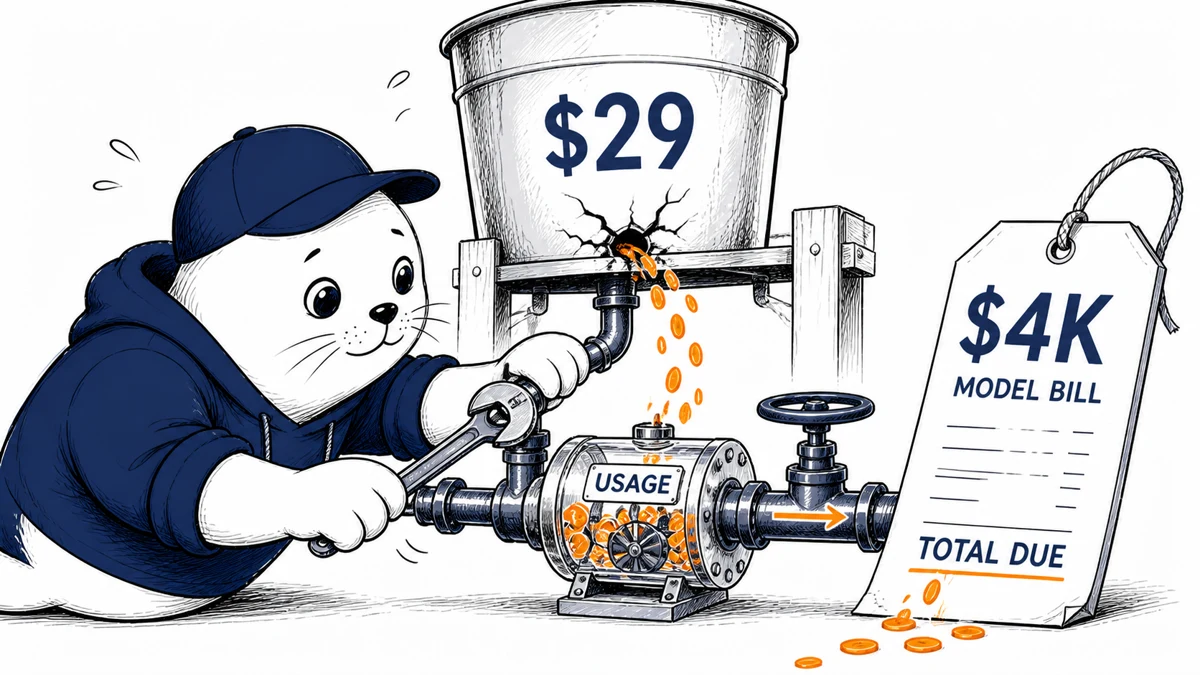
One customer paid Chipp $29 and generated a $4,000 model bill. The pricing problem was not an abstract unit-economics warning. It arrived as an invoice.
AI SaaS pricing breaks when the value sold to the customer and the cost paid to the model provider move at different speeds. Stripe’s Chipp case study says the company discovered that failure mode after one flat-rate customer consumed enough AI to create roughly $4,000 in cost.
Chipp changed to token-based billing in December 2025. Stripe reports a 20% revenue lift in the first month, 5.9 billion tokens billed in two months, and a two-day implementation. Those are company-reported results from a Stripe customer story, not a controlled test of every usage-based pricing model.
The $29 plan carried an uncapped cost
A flat subscription is easy to understand. It is also dangerous when a user can trigger an unlimited variable expense. If the product pays for every token, tool call, search, image, minute of audio, or retry, a single heavy customer can erase the contribution margin from many ordinary customers.
Chipp’s example is unusually dramatic: a customer paying $29 allegedly produced about 138 times that amount in model cost. The ratio is calculated from the figures in Stripe’s case study. It does not include hosting, support, payment fees, or other operating expenses.
Price the unit your cost model can see
| Pricing shape | Works best when | Main risk |
|---|---|---|
| Flat subscription | Usage variance and marginal cost are low | Heavy users create invisible losses |
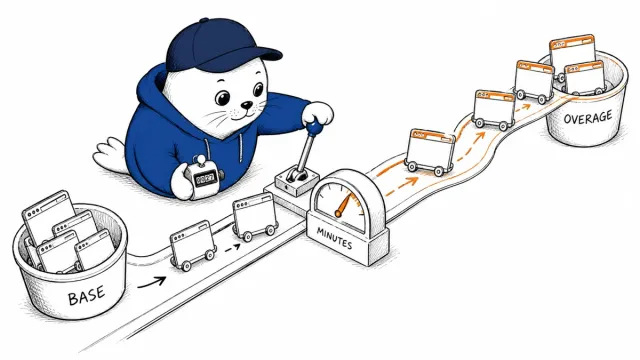
| Included allowance plus overage | Customers want predictability and costs scale with use | Poorly explained overages create bill shock |
| Prepaid credits | Several costly actions need one understandable unit | Credits can obscure the real value of a task |
| Per outcome | A completed result is measurable and valuable | Failed attempts still cost the vendor money |
| Pure usage | Buyers already understand the unit | Unpredictable invoices slow adoption |
Tokens made sense for Chipp because its costs were already tied to model use. They will not be the clearest unit for every product. A customer may understand "completed report," "resolved ticket," or "generated minute" more readily than one million tokens.
Start with contribution margin by customer
Monthly recurring revenue can look healthy while a small group of users loses money. Build a customer-level ledger that subtracts model use, retrieval, tool calls, storage, human review, refunds, and payment fees from collected revenue.
- Revenue collected: cash after discounts, credits, refunds, and taxes.
- Direct AI cost: input, output, cached, image, audio, and tool charges.
- Failure cost: retries, abandoned generations, fallbacks, and timeouts.
- Service cost: support and human review attributable to the account.
- Contribution margin: what remains before fixed company expenses.
Our analysis of Gemini pricing and retry cost shows why the advertised token rate is not the final unit cost. A cheaper model can cost more per accepted result if the workflow repeats or needs repair.
Protect the customer from the same volatility
Usage pricing should not transfer unlimited risk from the vendor to the customer. A usable plan shows the included allowance, real-time consumption, projected bill, warning thresholds, hard caps, and the effect of every expensive feature before it runs.
The product should also stop safely. If an agent enters a retry loop at 2 a.m., "we charge by usage" is not a sufficient control. The account needs maximum spend, maximum runs, and a human approval gate before expensive escalation.
A migration plan that avoids invoice shock
- Measure silently first. Calculate each customer’s usage under the proposed model without changing the bill.
- Segment the variance. Find the heavy users, ordinary users, and customers whose work produces costly failures.
- Choose a customer-readable unit. Use tokens only when the buyer can connect them to value.
- Give an allowance. Preserve a predictable entry price, then charge transparent overages.
- Add caps and alerts. Let customers pause spend before the invoice becomes a surprise.
- Grandfather deliberately. Put a time limit and a migration path around old plans rather than creating permanent pricing debt.
The broader lesson matches our no-guru-math guide to AI income: revenue is not the outcome. A durable offer produces a useful result at a margin that survives real customer behavior.
What Chipp’s case does not prove
The 20% revenue lift does not prove that token billing alone caused the increase. We do not have Chipp’s customer mix, churn, discounting, gross margin, or a comparison group. The 5.9 billion token figure measures billed usage, not customer outcomes.
It does prove something narrower: Chipp had a flat-price failure, changed the unit it billed, and reports that the new system handled substantial volume. That is enough to justify auditing any AI product whose variable cost is hidden behind an unlimited plan.
My verdict: cap the loss before optimizing the price
Do not wait for a $4,000 invoice to discover that a $29 customer is unprofitable. Measure contribution margin per account, expose the cost-driving actions, and set a hard operational ceiling before experimenting with packaging.
The best AI SaaS pricing model is not the cleverest one. It is the model that customers can predict and the company can survive.
Read the primary case study
- Read Stripe’s Chipp customer case study.
Which customer would surprise you most if you calculated their full contribution margin today?
Checked August 14, 2026. The $29 plan, approximately $4,000 model bill, 20% first-month revenue lift, 5.9 billion billed tokens, December 2025 migration, and two-day setup are reported by Stripe and Chipp. The 138-times ratio is Musthave.ai’s calculation from the reported figures.