

September 14 verification: V4 Pro remains V4-Pro-0813
Update, September 14, 2026: DeepSeek’s live API changelog and pricing page both confirm that deepseek-v4-pro continues to serve DeepSeek-V4-Pro-0813 after September 14. It has not been redirected to V4.1 Flash. The earlier September 12 clarification below remains correct.
| V4 Pro charge per 1M tokens | Off-peak | Peak |
|---|---|---|
| Cache-hit input | $0.022 | $0.044 |
| Cache-miss input | $0.66 | $1.32 |
| Output | $1.98 | $3.96 |
The compatibility aliases that now route to V4.1 Flash are deepseek-v4-flash and deepseek-v4-flash-vision-exp, not deepseek-v4-pro. Production teams should log the requested model ID, returned model version, cache class and time-of-day price window so a future alias change is visible in both regression results and cost reports.
This verification replaces no previous evidence in the article. It resolves a conflicting launch-page phaseout notice by using DeepSeek’s current operational changelog and pricing table.
Update, August 13, 2026: DeepSeek has now published the price increase that this article warned about. Peak and off-peak rates begin at 16:00 UTC on August 16. Peak hours are 01:00-04:00 and 06:00-10:00 UTC; all other hours are off-peak.
Flash gets a time-of-day price sheet on August 16
| V4 Flash token class | Current | Off-peak from Aug 16 | Peak from Aug 16 |
|---|---|---|---|
| Cache-hit input | $0.0028 | $0.007 | $0.014 |
| Cache-miss input | $0.14 | $0.22 | $0.44 |
| Output | $0.28 | $0.66 | $1.32 |
For the article’s 10,000-uncached-input and 2,000-output example, the cost moves from $0.00196 to $0.00352 off-peak or $0.00704 at peak. Ten thousand requests move from $19.60 to $35.20 or $70.40. The new cache-miss input rate is about 31.4 times the cache-hit rate, not the current 50 times.
DeepSeek also added low, high, and max thinking-effort controls to Flash. Record effort with every cost test because output volume and latency can change. For the Pro release, benchmark update, and full routing implications, read our DeepSeek V4 Pro 0813 analysis.
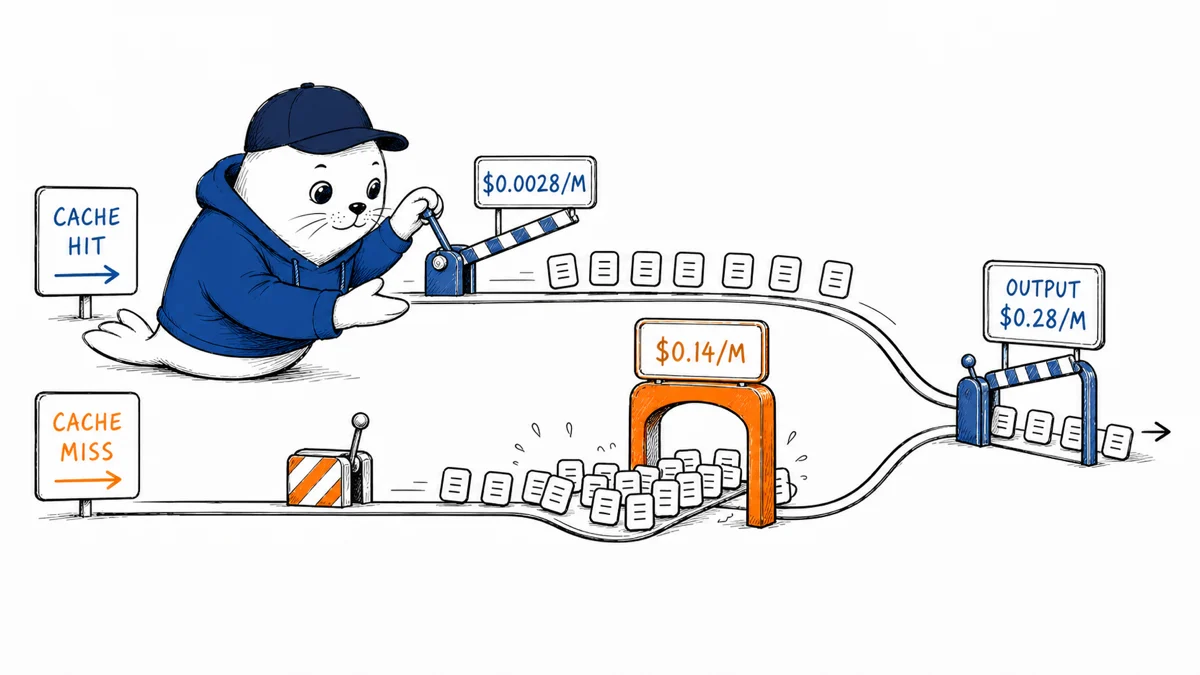
The smallest number on DeepSeek’s pricing page applies only when the input is already in cache. A miss costs fifty times more before the model writes a token.
DeepSeek V4 Flash entered public beta through the official API on July 31. DeepSeek says the 0731 build keeps the Preview architecture and size, changes only post-training, adds native Responses API support, and is adapted for Codex-style agent work.
The release pairs a one-million-token context window with unusually low published prices: $0.0028 per million cached input tokens, $0.14 per million uncached input tokens, and $0.28 per million output tokens. The cache-hit price is the eye-catching number. It is not the safe default for a budget.
The cache miss is fifty times the cached-input rate
DeepSeek’s current pricing page makes the distinction explicit. Uncached input is $0.14 per million tokens, exactly 50× the $0.0028 cached rate. Output is billed separately at $0.28 per million tokens whether the prompt hits the cache or not.
That means the cheapest published rate belongs in a cache-performance model, not in a generic "cost per request" headline. If prompts change, cache keys churn, or the provider does not reuse the prefix you expect, the uncached rate applies.
A 10,000-input, 2,000-output request shows the gap
| Scenario | Input cost | Output cost | Total per request | 10,000 requests |
|---|---|---|---|---|
| Input fully uncached | $0.001400 | $0.000560 | $0.001960 | $19.60 |
| Input fully cached | $0.000028 | $0.000560 | $0.000588 | $5.88 |
In this simplified example, perfect input-cache reuse saves $13.72 across 10,000 requests. Output dominates the fully cached request, accounting for about 95% of its cost. The calculation excludes retries, tool calls, longer reasoning traces, image or file handling, and any future price change.
The benchmark table needs its harness attached
DeepSeek reports 82.7 on Terminal Bench 2.1, 54.2 on NL2Repo, 76.7 on Cybergym, 54.4 on DeepSWE, and 70.3 on the verified Toolathlon split. It also reports 25.2 on Agent Last Exam and 25.1 on Automation Bench Public.
Those are company-reported results. The changelog says they used a minimal DeepSeek Harness with maximum effort, top-p 0.95, and temperature 1.0. DeepSeek says the harness will be released soon. Until it is public, outsiders cannot reproduce the exact agent wrapper from the official record.
The company also lists internal DSBench FullStack and Hard scores. Those results can inform a test plan, but an internal benchmark without a public task set and harness is not independently verifiable.
Only the Flash API changed
The official update says V4-Flash-0731 is the public-beta change. V4 Pro, the consumer app, and the web product were not updated with this release. Teams should avoid using a Flash API benchmark to describe every DeepSeek surface.
The API page lists one million tokens of context, up to 384,000 output tokens, and concurrency of 2,500. These are service specifications, not a recommendation to fill the window. Very long prompts increase latency, reduce cache predictability, and can amplify the cost of a miss.
Build a budget from cache behavior, not hope
- Log billed token classes: separate cached input, uncached input, and output in every cost report.
- Measure prefix reuse: record the real cache-hit rate for each workflow and prompt version.
- Model a cold path: budget the first request, changed system prompts, and cache eviction at the uncached rate.
- Cap agent loops: retries and tool calls can repeat both input and output charges.
- Recheck pricing: DeepSeek warns that a significant increase is expected and says the final plan will be announced separately.
Our review of GPT-5.6 pricing changes uses the same request-level discipline: translate token rates into a workload before comparing providers. Our guide to choosing an AI model explains why cost, latency, failure recovery, and task quality belong in one decision.
My verdict: test Flash now, price it at the miss
DeepSeek V4 Flash is worth testing for agent workflows because the official API combines a long context specification, Responses API support, and low current rates. The published benchmark table is useful for selecting tasks to reproduce, not for skipping evaluation.
For planning, use the uncached input price until your logs prove a stable hit rate. Treat savings from cache reuse as measured upside. That approach survives prompt changes, cold starts, and the price increase DeepSeek says is coming.
Read the primary documentation
- Read DeepSeek’s official API changelog.
- Check the current model specification and pricing page.
What is your measured cache-hit rate after a system-prompt change or a cold start?
Checked August 11, 2026. Release scope, API support, context and output limits, concurrency, benchmark results, harness settings, and prices come from DeepSeek’s official documentation. Benchmark figures are company-reported. Cost examples are Musthave.ai calculations and assume the published rates remain in effect.
Update: V4.1 Flash replaces both earlier Flash endpoints
Update, September 12, 2026: DeepSeek released V4.1 Flash on September 10. The current API model ID is deepseek-flash. The earlier deepseek-v4-flash and deepseek-v4-flash-vision-exp names are retired and temporarily route to V4.1 Flash for compatibility.
The architecture is a 552-billion-parameter mixture-of-experts Causal Encoder-Decoder. DeepSeek says it activates 8 billion parameters for input and 16 billion for output. The API model has native vision, a one-million-token context window and a maximum output of 384,000 tokens.
| V4.1 Flash charge | Off-peak | Peak |
|---|---|---|
| Cache-hit input per 1M tokens | $0.003 | $0.006 |
| Cache-miss input per 1M tokens | $0.15 | $0.30 |
| Output per 1M tokens | $0.60 | $1.20 |
The original cost lesson still holds: a cache miss costs 50 times the cache-hit input rate in either pricing window. For a workload with 100 million input tokens, moving from a full miss to a full hit changes peak input cost from $30 to $0.60 before output charges.
Do not migrate V4 Pro because of the launch-page phaseout sentence alone. DeepSeek’s current API changelog now says V4 Pro will continue after September 14 with unchanged billing. That newer operational notice conflicts with the V4.1 Flash launch page, which still says Pro requests would be redirected. The current changelog and pricing page should govern production planning until DeepSeek publishes another notice.
Before changing a production alias, pin deepseek-flash in staging, replay a representative cached and uncached workload, test image inputs, compare output length and tool behavior, and keep deepseek-v4-pro available as a separate rollback target.
September 13 update: Unity Gateway availability and a serverless deadline
Databricks added DeepSeek V4.1 Flash to Unity Gateway on September 11, 2026, with text and image inputs through Foundation Model APIs. Databricks notes that releases are staged, so availability can reach an account a week or more after the initial date.
Fireworks AI also set a September 25, 2026 cutoff for older serverless DeepSeek V4 Flash (0731), V4 Pro (0813) and V4 Flash Vision Exp routes, recommending V4.1 Flash as the replacement. Dedicated deployments are unaffected. Our Fireworks serverless migration guide maps all seven retiring routes and the tests to run before cutover.