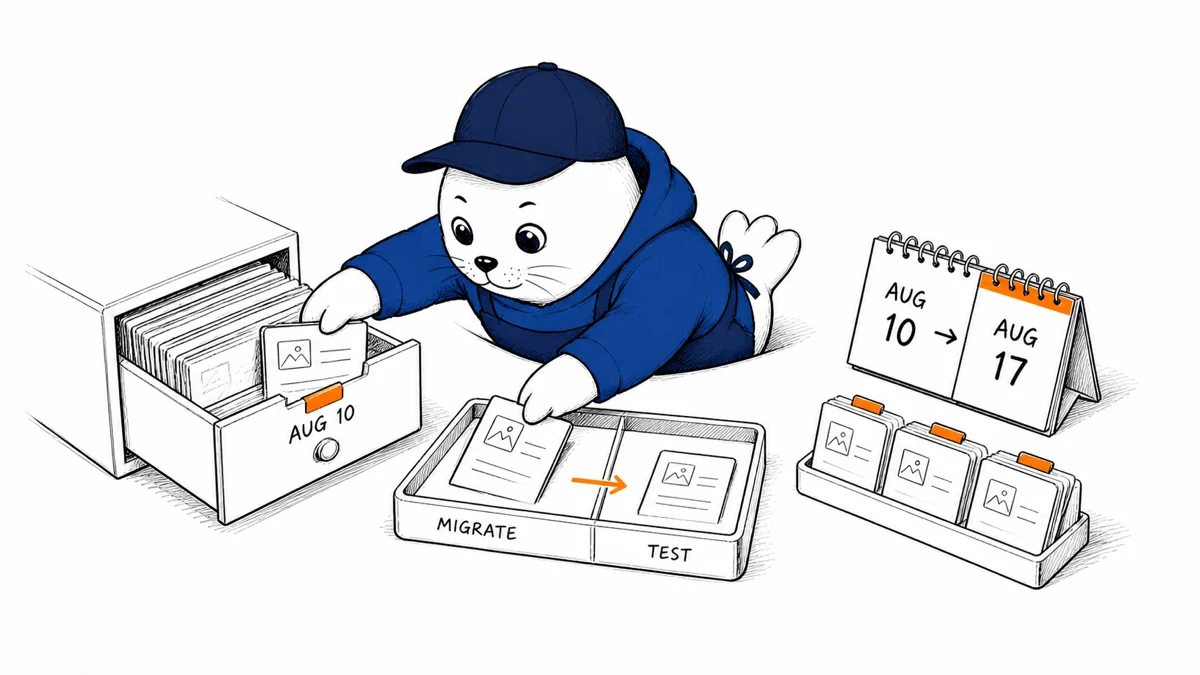
One Gemini migration reaches its listed cutoff today. The next deadline is only seven days away.
Google’s deprecation table lists August 10, 2026, as the shutdown date for Gemini embedding preview endpoint embedding-2-preview. It points developers to gemini-embedding-2. On August 17, three Imagen 4 endpoints are scheduled to follow.
This is not a reason to panic. It is a reason to search production configuration now. Model names often live in environment variables, queues, notebooks, fallback routes, evaluation jobs, and customer-specific overrides, not only in the obvious API client.
The two deadlines on Google’s current table
| Endpoint | Listed shutdown | Replacement |
|---|---|---|
embedding-2-preview | August 10, 2026 | gemini-embedding-2 |
imagen-4.0-generate-001 | August 17, 2026 | gemini-3.1-flash-image |
imagen-4.0-ultra-generate-001 | August 17, 2026 | gemini-3.1-flash-image |
imagen-4.0-fast-generate-001 | August 17, 2026 | gemini-3.1-flash-image |
Google describes these dates as the earliest possible shutdown dates and says the exact date is communicated in advance. That wording matters: a listed date is a migration boundary, not proof that every request stopped at midnight in every region. Production teams should act on the table instead of using a successful late request as permission to wait.
An embedding migration is not just a new model string
Changing the endpoint can change vector dimensions, normalization, task settings, latency, price, and retrieval behavior. Even when an API call succeeds, old stored vectors may no longer be directly comparable with new ones.
- Confirm output shape: reject a silent dimension mismatch before it reaches the vector store.
- Keep indexes homogeneous: do not mix embeddings from two models in one similarity space without evidence that it is valid.
- Re-run retrieval tests: measure recall and ranking on real queries, including empty and adversarial inputs.
- Plan re-embedding: estimate corpus size, throughput, write load, and rollback storage.
- Version every vector: retain the model ID and transformation settings with the record.
Our review of the Lattice 8 MB retriever explains why deployment size is only one part of retrieval quality. The replacement still has to prove it retrieves the right evidence.
Imagen 4 has three routes to find
The image migration is easy to underestimate because Standard, Ultra, and Fast may be routed separately. Search for all three exact IDs. A team can update its primary generator while an old fast preview, retry worker, or customer tier keeps calling Imagen 4.
Google points the three endpoints to one replacement: gemini-3.1-flash-image. That is a product change as well as a routing change. Re-test prompt following, text rendering, aspect ratios, safety refusals, output consistency, latency, and any downstream crop or compression pipeline.
Use a shadow run before switching traffic
Send a representative sample to the replacement without exposing its output to users. For embeddings, compare retrieval sets and task success. For images, use a fixed prompt pack and human review criteria. Record failures by workload instead of averaging everything into one reassuring score.
| Workload | Measure | Rollback asset |
|---|---|---|
| Embedding | Recall, ranking, dimensions, latency, cost | Old index and model-version map |
| Image | Prompt adherence, text, safety, latency, downstream compatibility | Old route config and stored prompt/output sample |
A seven-step production checklist
- Search source code, secrets, environment variables, dashboards, notebooks, and scheduled jobs for every retiring ID.
- Capture baseline quality, latency, error rate, and spend before changing anything.
- Run the replacement in shadow mode on representative inputs.
- Build or refresh the replacement index without deleting the old one.
- Move a small traffic slice and compare user-level outcomes.
- Confirm retries and fallbacks do not route back to a retiring endpoint.
- Keep a time-boxed rollback path, then remove the old configuration deliberately.
The same discipline applies to product shutdowns. Our Google Assistant migration guide focuses on auditing the workflow around the endpoint, not merely replacing its name.
My verdict: migrate by evidence, not by successful HTTP response
If embedding-2-preview still appears anywhere in production, treat it as an incident ticket today. If any Imagen 4 ID remains, use the next week to test the replacement under real workload constraints.
The goal is not simply to avoid a 404. It is to preserve retrieval quality, image behavior, cost expectations, and rollback control while the endpoint changes underneath the product.
Read Google’s current notices
- Check the Gemini API deprecations table.
- Review the Gemini API changelog for subsequent changes.
Which retiring endpoint is still hiding in a fallback or scheduled job?
Checked August 10, 2026. Endpoint IDs, replacements, release dates, and listed shutdown dates come from Google’s current deprecation documentation.