

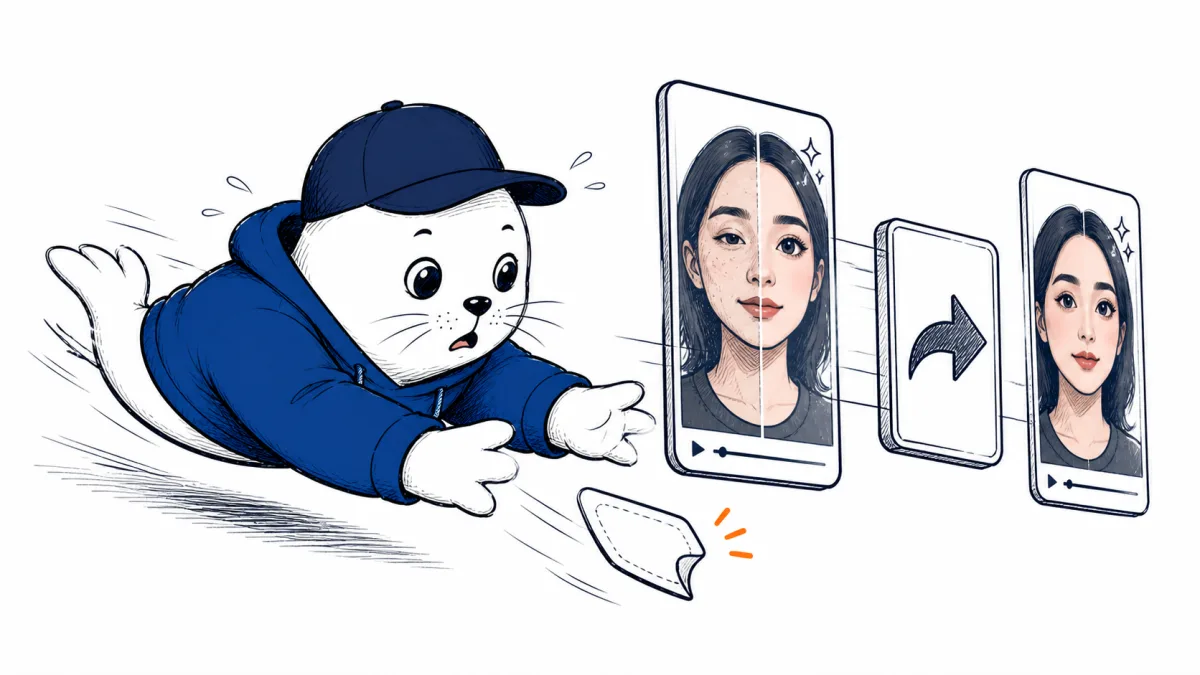
A 28-second beauty-filter clip carries its transformation everywhere. The explanation attached to it is much easier to lose.
The video below has already performed a small trick on itself. It began as a TikTok explanation of the Bold Glamour filter, then travelled to Reddit, where thousands of people argued about what it meant. In the MP4 we received, the face-changing demonstration remains. TikTok’s clickable effect label does not.
That gap is more important than whether one beauty effect deserves to be called impressive or disturbing. A realistic edit can survive downloading, cropping, and reposting. The context that tells a viewer how the image was made may not survive the first handoff.
Three Reddit comments caught three different problems
The original Reddit post was titled "social media face filters vs AI filter." The selected replies do not form a scientific sample. They are reactions from people watching one unusually convincing demonstration in March 2023. Read together, though, they map the public problem rather neatly.
What viewers were reacting to
The comments are anecdotes and opinions. Their value is in the questions they raise, not in proving an effect.
Trust
"I no longer know what is real, fake, AI, filter."
One commenter worried that visual creativity and visual evidence were starting to occupy the same uncertain space.
Self-image
"They will look in the mirror and hate themselves."
Another reply focused on children comparing an ordinary face with a frictionless, filtered one.
Memory
"Where have all the beautiful people gone?"
A dark joke imagined future archaeologists discovering that the flawless people in 2023 videos never existed.
The first comment is about provenance: can I tell how this picture came to exist? The second is about comparison: what happens when the edited version feels like the baseline? The third is about the archive: what story will a pile of detached images tell once their labels and original posts are gone?
Those are still the right questions in 2026. The technology has improved, but the basic failure can happen before anyone reaches for a deepfake detector. It happens when the disclosure and the media travel on different tracks.
What we know about Bold Glamour, and what we do not
The clip says Bold Glamour uses a generative adversarial network, or GAN, rather than placing a conventional face mesh over the camera image. That explanation fits what people saw: the effect kept working when a hand crossed the face, where older overlays often broke.
TikTok’s current Effect House documentation confirms that its "Generative Effects" component uses GANs. In 2023, independent creators and researchers also told The Washington Post that Bold Glamour was probably using machine learning to redraw or blend the face.
There is one important brake on the story: TikTok declined to explain Bold Glamour’s exact internal technology at launch. We can say the GAN account was credible and consistent with TikTok’s broader effect tools. We cannot turn an expert inference into a confirmed Bold Glamour model card.
The evidence ladder
A simple way to keep the demonstration, documentation, and inference from collapsing into one claim.
Visible in the clip
The beauty transformation is stable during movement and while a hand passes near or across the face.
Confirmed by TikTok
TikTok’s Effect House includes generative effects that use GANs, and TikTok later adopted explicit AI naming and labeling for AI effects.
Reported by experts
Independent filter creators and researchers described Bold Glamour as a machine-learning or generative effect that redraws or blends facial features.
Still unconfirmed
TikTok did not publish the exact Bold Glamour architecture, training data, or a literal accounting of whether every output pixel was regenerated.
This distinction does not make the effect less interesting. It makes the article more useful. A viral explainer can be directionally right while sounding more certain than the available evidence allows.
The real leap was not "perfect AI"
Bold Glamour was not flawless. It could make different aesthetic choices for different faces, and people could still identify it when they knew what to look for. Its breakthrough was lower friction. The user did not need Photoshop skills, a workstation, or hours of rendering. The altered face appeared live on an ordinary phone.
That changed the viewer’s job. With an obvious novelty filter, the manipulation announces itself. With a subtle beauty effect, the viewer has to infer an invisible process from a polished result. The edit can change skin texture, face shape, makeup, brows, lips, and lighting while preserving enough motion to feel like a camera rather than a composite.
The result is not merely a fake face. It is a plausible face with an unclear history. That is why the Reddit comment about future archaeologists lands: an image archive without provenance can preserve the look and erase the method.
The label problem was visible from the start
On TikTok, Bold Glamour videos carried an effect tag. But The Washington Post reported in 2023 that the tag disappeared when videos moved outside the app. The attached file is a useful illustration of that design problem. It contains captions explaining the technology, but no clickable effect record that lets a viewer inspect the original tool.
How context falls away
The transformation is encoded in the pixels. The disclosure may live only in the platform interface.
Create in the app
The effect name, creator, and platform label can sit beside the video.
Export or screen-record
The altered pixels remain, while interactive context may become ordinary decoration or vanish.
Crop and repost
Captions, watermarks, metadata, and source links can be removed intentionally or accidentally.
Watch without origin
The next viewer receives the result and has to reconstruct how it was made.
TikTok has since expanded its approach. In 2023 it introduced creator-facing AI-generated labels and said AI effects would include "AI" in their names and effect labels. In a later update, TikTok said it reads C2PA Content Credentials, uses detection models, and is adding invisible watermarks to some AI-generated content.
The company also acknowledged the hard part: labels can be removed when content is edited or reuploaded elsewhere. Invisible signals and interoperable credentials are an improvement, but they do not absolve publishers. A person embedding a clip can preserve the origin link, name the effect, explain the uncertainty, and keep the disclosure in the caption where readers can see it.
That is the same trust issue behind our guide to AI-content labels under the EU AI Act and our analysis of Meta AI video features. Detection helps. Durable context is better.
What the body-image research can support
The Reddit concern about children looking in the mirror is emotionally direct. Research supports caution, but it should not be exaggerated into "one filter causes a disorder." Most studies in this area measure associations, often through surveys. They do not prove that a single effect caused a particular person’s body-image problem.
A 2024 study of 912 adolescents and young adults in Canada found that photo-filter use was associated with greater muscle-dysmorphia symptoms. The authors explicitly called for more research into the mechanisms behind the association. A separate study of 209 people aged 16 to 18 found that more frequent use of image-based social platforms (and using social media for appearance-related reasons) was associated with more body-dysmorphic symptoms.
Those findings widen the issue beyond girls and makeup. Face and body filters can reinforce thinness, muscularity, skin, age, and facial-feature ideals across different groups. The practical response is not panic. It is media literacy that arrives at the moment of comparison: this look was generated, the original source is here, and the effect is not a neutral camera.
A 30-second check before you share a filtered face
Publishers, parents, teachers, and creators do not need to reverse-engineer a neural network before sharing a clip. They do need to preserve the facts that another viewer cannot recover from the pixels alone.
The repost context check
Tick every item you can preserve. If the source is missing, say so instead of guessing.
Name the effect
Write "TikTok Bold Glamour filter" in the caption, not merely "AI face."
Link the origin
Keep the original post, creator, or effect page beside the repost whenever it is available.
Separate proof from explanation
Say what the clip demonstrates, what the platform documents, and what experts inferred.
Keep the disclosure visible
Do not rely only on hover text, app chrome, metadata, or a label that disappears after download.
Describe the material change
Tell viewers whether the media alters appearance, voice, action, or identity in a realistic way.
Useful rule: if the edit survives outside the platform, the disclosure should survive outside the platform too.
My verdict: keep the method attached to the image
The Reddit discussion was not really predicting that AI would create flawless faces. Beauty retouching and face filters already existed. What people noticed was that the edit was becoming harder to distinguish from an ordinary camera image and easier to repost without its label.
Bold Glamour made the edit cheap, live, and difficult to catch through the old "wave a hand in front of it" test. The next problem was predictable: the video could travel farther than the label.
Use the effect if you want. Critique it, parody it, or teach with it. Just keep the method attached to the result. A disclosure hidden in one app’s interface is not durable enough for media designed to be copied.
Go deeper
- Watch the original Reddit post and read the three linked comments as reactions, not research evidence.
- Review TikTok’s Generative Effects documentation.
- Read TikTok’s 2023 AI-label announcement and its later labeling and watermark update.
- See the 2024 photo-filter and muscle-dysmorphia study and the 2023 study of social-media use and body-dysmorphic symptoms.
When you save a filtered video, what context should be impossible to leave behind?
Checked August 6, 2026. The Reddit comments are personal reactions, not a representative survey. The body-image studies cited above report associations and do not establish that one filter causes a clinical disorder. The uploaded clip identifies its creator as Zhangsta.