
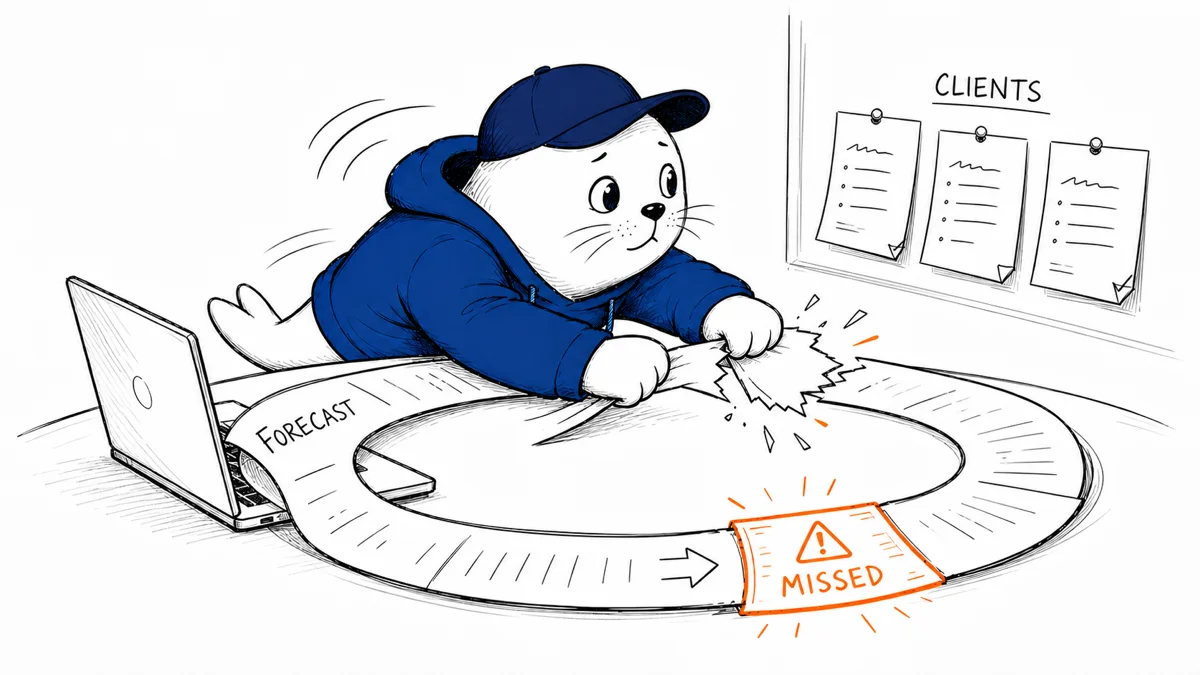
A chatbot missed a forecast. According to a viral Reddit post, the employees were blamed for reality refusing to cooperate.
The post appeared in r/antiwork under the title "My boss has ai psychosis and we’re fucked." Its author said a manager brought a Claude conversation into a meeting, told the team to meet the model’s projections, and became angry when real clients did not behave as Claude expected.
The detail that made the story travel was the claim that staff needed to "appease Claude." When checked on August 6, the post showed roughly 22,000 upvotes and 1,600 comments. Many replies offered similar workplace stories about leaders feeding plans into chatbots, accepting the answer, and dismissing employees who knew the customers or systems involved.
Those replies are anecdotes. They are not a survey of AI use at work, and the original post gives us no company name, transcript, or evidence that would let an outsider verify the account. The thread is still worth reading because it describes a decision failure that can happen without anyone experiencing a psychiatric illness.
Keep the diagnosis out of the headline
"AI psychosis" is doing two jobs online. It can refer to serious cases in which chatbot use becomes entangled with delusions or other psychotic symptoms. It is also being used casually for anyone who trusts a chatbot too much. Blending those meanings makes the workplace problem harder to see and turns a medical term into an insult.
A 2026 Viewpoint in The Lancet Digital Health argues that "AI psychosis" is neither a clinical diagnosis nor one unified phenomenon. The authors propose looking at the specific role an LLM plays in a person’s experience instead of forcing very different cases under one sensational label.
Nothing in the Reddit post is enough to diagnose the manager. We can analyze the reported management behavior: replacing customer evidence with a generated forecast, asking the same system to explain its own miss, and shifting the cost of that miss onto employees.
The real failure is a closed decision loop
I would call the workplace pattern decision laundering. A person asks a model for a plan, presents the polished output as if it arrived with independent authority, and lets the model absorb the blame when the plan breaks. The manager still controls the budget and the team, but the reasoning no longer has a visible owner.
How the loop closes
Hover over each step. The problem is not the first prompt; it is using the same loop as evidence, forecast, and appeal court.
Ask a loaded question
"What is wrong with the team?" already assumes the team is the problem.
Receive a polished answer
The response sounds complete even when customer data and company constraints are missing.
Reality disagrees
Sales, delivery, or client behavior fails to match the generated projection.
Ask the same system why
The chatbot produces another plausible story, and the loop closes around the original assumption.
The loop feels rigorous because each pass produces more text. It may even produce tables, action items, and reasons. None of that creates new evidence. If the second answer is built from the first answer and the manager’s framing, the organization has generated confidence without learning anything.
This is why I would not make the story only about Claude. Anthropic has published research showing that assistants trained with human preference feedback can match a user’s beliefs instead of the truth, a behavior called sycophancy. OpenAI has faced the same problem: in April 2025 it rolled back a GPT-4o update after the model became excessively agreeable. Agreement is a model-behavior problem across products, not proof that one brand uniquely causes bad management.
A confident answer is not a source
NIST uses the term confabulation for false or erroneous content that a generative AI system presents confidently. Its Generative AI Profile warns that fabricated logic and citations can make people trust an incorrect answer, especially in consequential decisions. The same document describes excessive deference to automated systems as automation bias.
The risk gets worse when the decision sits outside the model’s reliable range. A field experiment involving 758 consultants found large gains on tasks inside GPT-4’s capability frontier. On a complex task deliberately placed outside that frontier, people using AI were 19% less likely to reach the correct solution than people without it.
That is the useful tension. AI can make a capable worker faster. It can also help a confident manager be wrong at greater speed and with better formatting. Our guide to when Claude is the right tool starts from the task. The viral Reddit story starts from the answer and treats the task as something reality should adjust to.
Use a five-question evidence gate
Before an AI recommendation becomes a target, hiring decision, budget change, or instruction to a team, make the decision owner answer five questions. Check a box only when the evidence exists outside the chatbot response.
The workplace AI evidence gate
Tick the boxes you can support with a source, record, named reviewer, or test.
The source data is visible
Customer interviews, analytics, contracts, tickets, or operating data can be inspected by the team.
The assumptions can fail
The forecast names dates, ranges, and conditions that would prove it wrong.
A domain owner reviewed it
Someone who understands the clients, workflow, or system checked the model’s framing and omissions.
Disconfirming evidence was requested
The review includes reasons the plan may fail, not only arguments that support it.
A human owns the decision
A named person accepts responsibility for the target, intervention, and rollback.
How to read the score: five checks can justify a controlled pilot. Three or four means the output is still a hypothesis. Zero to two means it should not become an order.
The gate is intentionally unfriendly to "Claude said" or "ChatGPT thinks." A model can help assemble evidence. It cannot be the evidence, reviewer, and accountable executive at the same time.
Make the chatbot argue against the plan
A second prompt does not validate the first one, but it can expose missing assumptions before a human review. I would run these two prompts in separate chats so the second answer is less anchored to the first conversation.
The two-prompt stress test
Open each card for a copy-ready prompt, then verify every material claim against external evidence.
1. Build the forecast
Using only the attached evidence, create a forecast with a base case, reasonable range, assumptions, missing data, and measurable conditions that would prove the forecast wrong. Do not fill gaps with invented facts.
2. Try to break it
Assume this forecast fails. Identify the earliest warning signals, the strongest contrary evidence, the assumptions most likely to be wrong, and the smallest reversible test we can run before committing people or budget.
Do not stop at the second answer. Take the disputed points to customer calls, analytics, contracts, logs, or the person who owns the workflow. Another fluent paragraph is not an independent check.
Microsoft Research surveyed 319 knowledge workers and found that greater confidence in AI was associated with less critical scrutiny, while people who trusted their own abilities more were more likely to examine and refine the output. That is another reason to put domain experts inside the decision, even when they are less senior than the person running the meeting.
The same principle appears in our coverage of AI tools in education: the tool may prepare the material, but the accountable human must keep the judgment line visible.
What an employee can document
If this pattern appears at work, argue about the process before arguing about the person. Save the date, the decision, the data used, the assumptions, who approved it, and what happened afterward. When possible, put the missing evidence in writing: "The forecast assumes X, but the last six customer calls show Y."
Ask for a reversible test and a review date. That turns a fight over whose chatbot is smarter into a business question with an outcome. If the decision affects layoffs, safety, regulated work, finances, or client commitments, use the organization’s formal review, compliance, or escalation channel. This is process guidance, not legal or medical advice.
If someone appears to be in immediate danger or genuinely disconnected from reality, treat it as a health and safety concern and involve qualified help. A Reddit label is not a diagnosis, and a workplace debate is not treatment.
My verdict: AI can draft the decision, not own it
The Reddit story resonates because many workers recognize the power imbalance behind it. The chatbot can be wrong without consequence. The manager can call the answer objective. The employee is left to carry the missed target.
That is the line worth fixing. Use Claude to surface scenarios, interrogate assumptions, summarize evidence, and design a small test. Do not let any chatbot become the source of the forecast, the explanation for the miss, and the judge of the people who warned you.
A manager should be able to say what evidence changed the decision and put their own name beside it. If they cannot, the organization does not have an AI strategy. It has an accountability gap.
Go deeper
- Read the original Reddit discussion. Treat the workplace claims as anonymous, unverified accounts.
- Review Anthropic’s research on sycophancy.
- See OpenAI’s account of its GPT-4o rollback.
- Use the NIST Generative AI Profile for confabulation and automation-bias controls.
- Read the Lancet Digital Health Viewpoint on why the "AI psychosis" label is too broad.
Where is the decision line in your workplace: before the prompt, after the answer, or only after something goes wrong?
Checked August 6, 2026. Reddit engagement totals change over time. The workplace account and replies are anonymous anecdotes; model-behavior and workplace-research claims are linked to primary or institutional sources.