

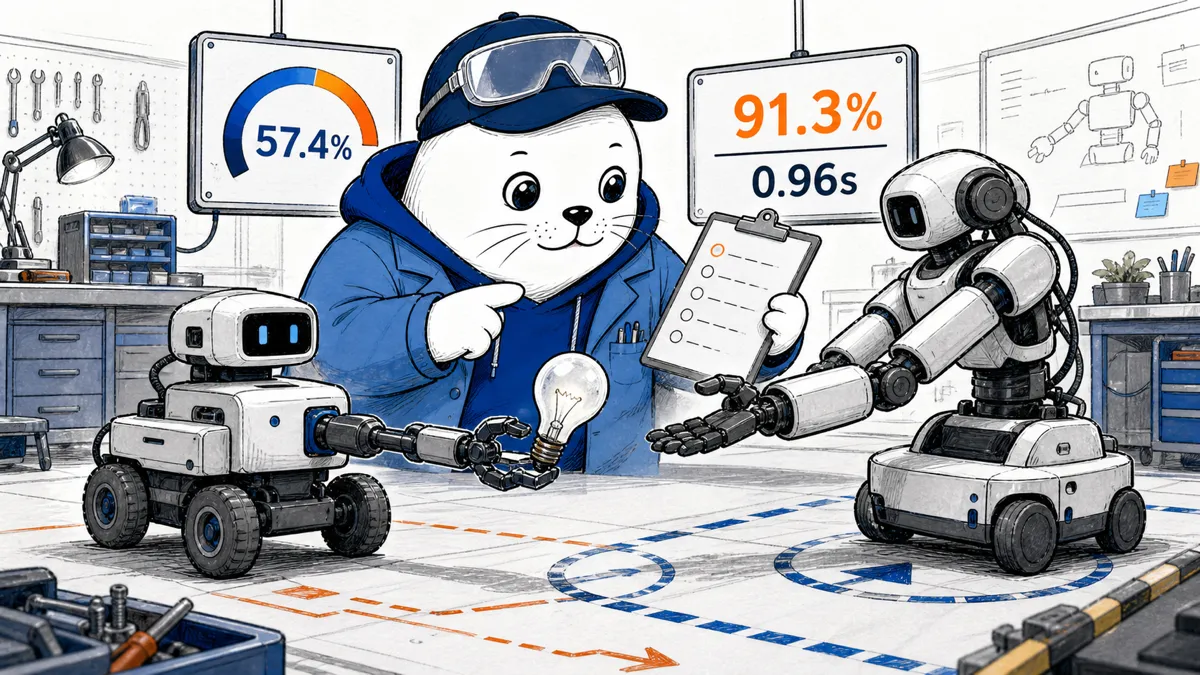
Gemini Robotics 2 can identify the right moment to stop a physical action with impressive accuracy. Ask it how far the whole job has progressed, and the answer gets much less certain. That gap is more informative than the polished robot demo.
Google introduced Gemini Robotics ER 2 on July 30 as a high-level brain for robots. It watches streaming video, listens to audio, reads instructions, plans multiple steps, calls tools, and hands motor execution to lower-level robot systems.
Google made the model available through the Gemini API and Google AI Studio, with a private preview on its enterprise agent platform. The release includes useful benchmark numbers. They show both progress and an important boundary.
The 33.9-point benchmark gap
Google-reported accuracy for two different video-understanding tasks.
Moment finding
91.3%
Progress band
57.4%
Calculated difference: 91.3 − 57.4 = 33.9 percentage points. These tasks are related but not interchangeable.
What Gemini Robotics 2 is supposed to do
ER 2 is not the motor controller that directly decides every joint movement. It is the orchestrator above that layer. Google describes it as the system that understands the scene, breaks a goal into steps, uses tools such as Search or developer functions, and delegates the physical action to a vision-language-action model or an existing robot API.
The robot-agent handoff
A simplified view of the architecture described by Google.
1. Understand
ER 2 reads live video, audio, text, and task context.
2. Orchestrate
It plans steps, calls Search or functions, and checks progress.
3. Execute
A lower-level VLA model or robot API controls physical movement.
This separation is sensible. A warehouse robot may need one system to interpret a work order and another to move safely. It also creates handoff risk. A good plan can fail in execution, a safe controller can receive the wrong goal, and a correct action can be mistaken for an incomplete one.
Finding a moment is not understanding a job
Google reports 91.3% accuracy for locating a target moment in video, with a mean absolute distance of 0.96 seconds. That is useful when a robot must stop pouring, recognize that an object arrived, or hand control to the next step.
Progress classification is broader. The model had to place a task into one of five stages and reached 57.4% accuracy. In plain language, it was better at answering “when did this event happen?” than “where are we in the entire process?”
That difference matters in long jobs. A robot can correctly spot that a drawer closed while still misunderstanding whether the workspace is ready, the item is complete, or the next robot should begin.
The four-times-faster claim needs context
Google says the model executes four times faster than the prior system. Speed is valuable, especially when video arrives continuously. But a buyer needs to know what was measured: model inference, end-to-end task time, hardware, network delay, robot control, or all of them.
A faster wrong handoff is not a productivity gain. The useful number is successful task completion per hour, including resets and human intervention.
What a real pilot should report
Ask for the failure boundary, not only the best clip.
Completion
How many full tasks finish without human help?
Intervention
How often does a person pause, correct, or reset the robot?
Recovery
Can the system recognize and repair a failed handoff?
Latency
What is the end-to-end delay on production hardware?
Safety
What happens near people, tools, spills, and unexpected objects?
Transfer
Does performance survive a new room, robot, and task variant?
What developers can test now
The public API makes ER 2 more than a research video. Developers can test video understanding, tool use, step planning, and progress detection before connecting the model to a costly robot.
I would begin with recorded video and a simulated action layer. Ask the model to identify state changes, choose tools, and explain what evidence triggered each handoff. Then introduce a narrow physical task with a safe stop, a human confirmation point, and a complete log.
If the project is new to agent design, start with our explanation of agentic AI in plain English. For the wider Google stack, see where Gemini already lives in Google’s products.
My read: the limitation makes the release credible
Gemini Robotics 2 is interesting because Google published a strong number and a much weaker one. The 57.4% progress result does not make the model a failure. It tells teams where human oversight and better evaluation still belong.
The next robotics race will not be won by the best single demo. It will be won by systems that understand the job, execute safely, expose uncertainty, and recover when the physical world refuses to follow the script.
Go deeper
- Read Google’s official Gemini Robotics ER 2 announcement.
- Review the earlier Gemini Robotics ER 1.6 architecture.
- See how Google positions speed and specialization in Gemini models.
- Use our model-selection checklist before treating one benchmark as a buying decision.
Benchmarks and availability checked August 5, 2026. Values are Google-reported; the 33.9-point difference is Musthave.ai’s calculation.