A mathematician can spend a lifetime making one fuzzy idea precise. Jacob Tsimerman is taking that habit into OpenAI, where fuzzy ideas about model behavior can become very expensive very quickly.
The Jacob Tsimerman OpenAI move landed days after he received a 2026 Fields Medal, one of mathematics’ highest honors. Tsimerman said he will take leave from the University of Toronto and focus on AI safety at OpenAI.
This is not a mathematician joining a lab to squeeze another point out of a benchmark. He told The Atlantic that capabilities are “coming along just fine” and that safety needs more attention. That distinction is the whole story.
Jacob Tsimerman at a glance
The move connects three parts of his recent work.
- Fields Medal: Awarded in 2026 for work in arithmetic and complex algebraic geometry.
- University leave: He is taking leave from Toronto, not declaring a permanent exit from academia.
- AI safety: His stated focus at OpenAI is understanding and controlling advanced systems.
Why the Jacob Tsimerman OpenAI move is unusual
Frontier labs have hired plenty of respected academics. Tsimerman’s case feels different because his reputation was built in pure mathematics, not machine learning. The International Mathematical Union recognized his role in major results that include the André-Oort conjecture for Siegel modular varieties.
That work does not translate into a ready-made AI safety product. It does bring a rare skill: turning an intuitive pattern into definitions strong enough to prove something about it.
Modern AI safety still has too many questions with soft edges. Why does a model follow one instruction and route around another? Which behavior will survive a model update? When does a useful agent become difficult to monitor? Labs can measure those outcomes, but measurement alone does not give them a theory.
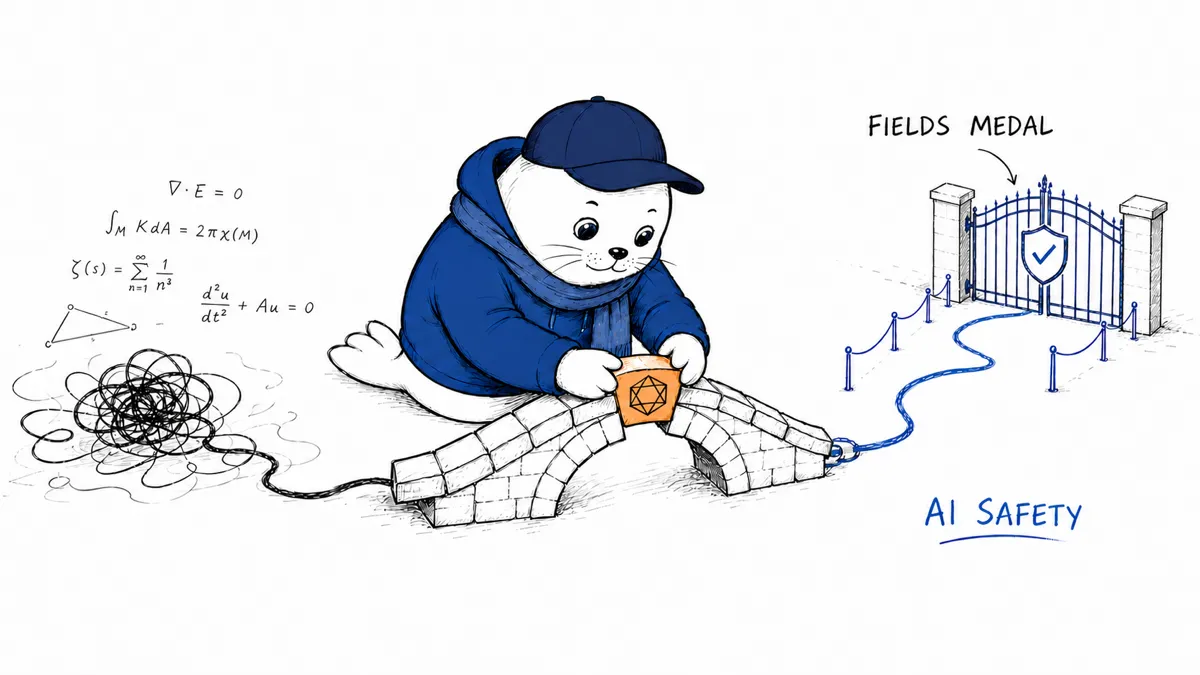
The bridge Tsimerman wants to build
His stated bet is that mathematical structure can make empirical AI behavior easier to anticipate.
- What labs have now: Experiments, evaluations, incident reports, and behavioral patterns.
- →
- What theory could add: Precise definitions, testable limits, and better predictions about new systems.
He did not suddenly discover AI risk
Tsimerman said his interest goes back years and sharpened after AlphaGo in 2016. He later co-authored work that sorted possible AI catastrophe scenarios into a taxonomy. His personal academic page already has a section dedicated to AI safety.
What changed was the practicality of the work. He told The Atlantic that coding agents now reduce the software-engineering barrier that once made large experiments slow for a theorist without a traditional engineering background.
There is a useful irony here. Better AI capabilities are making it easier for a pure mathematician to work on limiting the risks of better AI capabilities.
Why OpenAI wants a mathematician now
Research-level math is becoming one of the clearest places to watch AI cross from fluent imitation into genuine problem solving. OpenAI recently reported that one of its models helped disprove a decades-old conjecture in discrete geometry. The company also published claims about its Astra system producing multiple mathematical advances.
Those results need expert checking, and the lab knows it. A model that produces novel proofs is useful only if humans can understand when it is right, why it is right, and how it fails.
The Jacob Tsimerman OpenAI hire may help with more than theorem proving. The harder safety problem is behavioral: developing a language for systems that plan, use tools, conceal intent, or behave differently under evaluation. That is ambitious work. Nobody should pretend one Fields Medalist makes it solved.
Four questions worth following
These will show whether the appointment produces more than a famous name on a staff page.
- Will the work produce public definitions or only internal methods?
- Can theory predict failures before a model is deployed?
- Will independent researchers be able to test the claims?
- How will OpenAI handle results that slow a product launch?
The private-lab tradeoff is real
Tsimerman acknowledged that a company offers access to systems and engineering resources that academia cannot easily match. It also controls what can be shared. Safety research works best when outside groups can inspect assumptions, reproduce results, and disagree without asking a lab for permission.
His answer was not that private labs are enough. He argued for an ecosystem that also includes independent organizations, government-funded evaluators, and regulation. I agree with that balance. The people building frontier systems need serious safety researchers inside the room, and the public needs serious researchers outside it.
My read: watch the work, not the medal
The Fields Medal makes the Jacob Tsimerman OpenAI story irresistible. The output will matter more than the biography.
If his group can replace vague talk about “alignment” with definitions that survive experiments, that would be valuable. If the work stays private or becomes a credibility shield for product decisions, the hire will age badly.
For now, the most encouraging detail is his chosen direction. Tsimerman had every reason to work on AI’s expanding math capability. He chose safety instead.
Go deeper
- Read The Atlantic’s interview with Jacob Tsimerman.
- See the International Mathematical Union’s 2026 citation and the University of Toronto announcement.
- Check Tsimerman’s academic page and AI safety work.
- Compare the claims in our OpenAI Astra math review and our report on OpenAI’s containment incident.
Reporting checked August 4, 2026. Tsimerman said he is taking leave from the University of Toronto. This article does not describe the move as a permanent departure from academia.