An AI-assisted image is sitting in your publishing queue. The useful question is no longer simply, “Did AI touch this?” It is: what kind of content is it, who is putting it in front of the public, and which disclosure belongs with it?
August 2 changed the workflow, not every image overnight
The transparency rules in Article 50 of the EU AI Act began applying on August 2, 2026. That date matters to AI companies, publishers, creators, agencies, newsrooms, and anyone using synthetic media in public-facing work.
It does not create one universal “AI made this” sticker for every output. Article 50 splits responsibility between the company providing the AI system and the person or organization deploying its output. It also treats a chatbot, a deepfake video, an edited product photo, and an AI-written public-interest article differently.
That is why the rule is easy to flatten into a misleading headline. The practical job is to identify your role and the content in front of you.
How Article 50 reached the publishing desk
The transparency duties arrived in stages rather than in one big launch.
- August 1, 2024 The AI Act enters into force The regulation becomes EU law, with different provisions scheduled to apply later.
- August 2, 2025 General-purpose AI obligations start Rules for providers of general-purpose AI models begin applying.
- July 20, 2026 The Commission publishes Article 50 guidance The guidance explains the transparency duties and the voluntary Code of Practice.
- August 2, 2026 Article 50 transparency rules apply Provider and deployer duties for certain AI interactions and content take effect.
- December 2, 2026 Limited legacy-system grace period ends Generative systems placed on the market before August 2 get four additional months for the machine-marking duty.
The rule splits the job between providers and deployers
If you run the model or product that produces synthetic media, the provider duties are the important side. If your company uses AI output in a campaign, article, video, or customer experience, you are usually looking at deployer duties. A business can be both, but most independent creators will mainly encounter the second column.
Who has to do what?
A plain-English responsibility map based on Article 50 and the Commission guidance.
- AI provider Build transparency into the system Tell people when they are interacting with AI, unless it is obvious. Mark synthetic audio, image, video, and text output in a machine-readable, detectable way. Make the marking effective, interoperable, robust, and reliable as far as technically feasible.
- Deployer or publisher Disclose specific uses to the audience Clearly disclose deepfake image, audio, or video. Disclose AI text published to inform the public on matters of public interest when it lacks human review or editorial control. Tell affected people about emotion-recognition or biometric-categorization systems.
The provider’s machine-readable mark can travel inside or alongside the file. The deployer’s disclosure is meant for the human audience. Those are related controls, but they are not interchangeable.
No, every AI picture does not need a giant visible watermark
This is the point I would tape above the editor’s desk. The Act requires providers of generative AI systems to make their synthetic outputs identifiable in a machine-readable format. The visible-disclosure duty for deployers is narrower. It targets deepfakes and certain AI-generated or manipulated text used to inform the public on matters of public interest, plus a few other specified systems.
The provider marking rule also has an exception for systems performing a standard assistive editing function, or making no substantial change to the input or its meaning. A crop, background cleanup, or light correction is not automatically treated like a fully synthetic scene. The boundary depends on what the system actually changed.
For creators, “AI was involved” is therefore the beginning of the check, not the answer.
A five-question pre-publish check
Use this before an AI-assisted asset reaches your site, social feed, newsletter, or client.
- 1 Does it imitate a real person, place, object, entity, or event and falsely appear authentic? Treat it as a likely deepfake and add a clear audience-facing disclosure.
- 2 Is it text about a matter of public interest? Record the human review and editorial owner. Without that review or control, disclose the AI origin.
- 3 Is the AI change merely assistive? Document what changed. A routine technical edit is not the same as generating a new claim or scene.
- 4 Did the file lose its provenance information? Check your export, CMS, and social workflow. A useful machine mark can disappear during compression or conversion.
- 5 Can a person notice the disclosure before being misled? Put visible disclosure where the content is first encountered, not behind an obscure policy link.
What counts as a deepfake under Article 50
The Act defines a deepfake as AI-generated or manipulated image, audio, or video that resembles existing people, objects, places, entities, or events and would falsely appear authentic or truthful. That is more specific than “an image made with AI.”
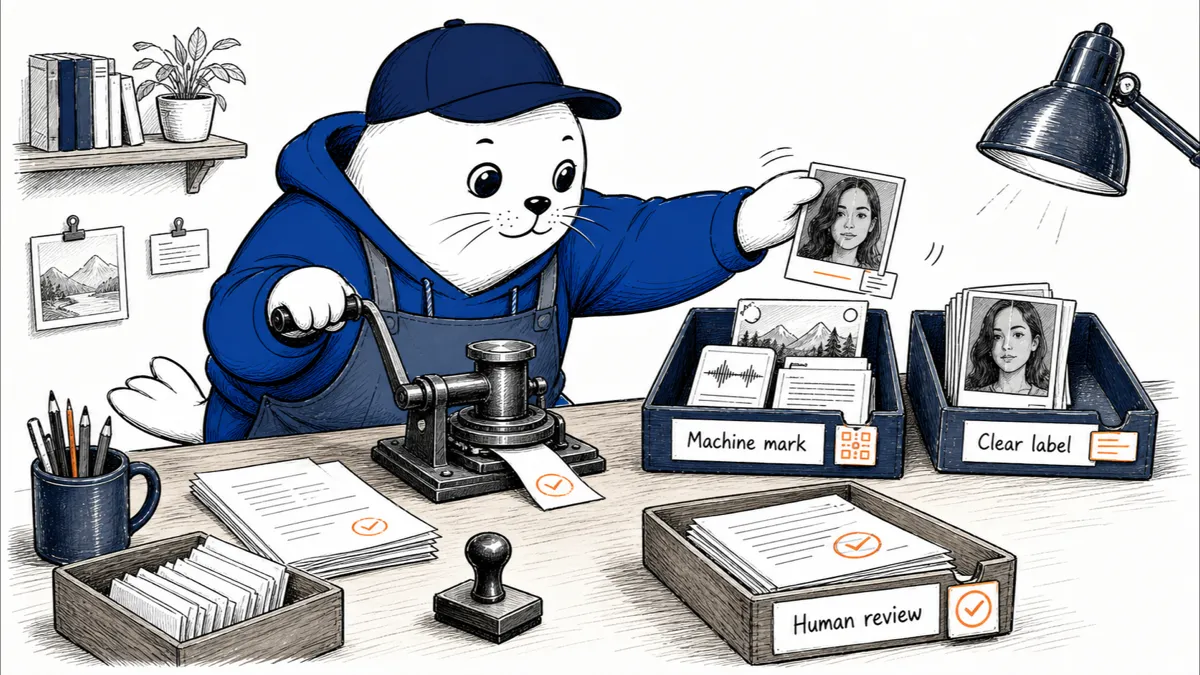
A fictional seal running a labeling press is obviously illustrative. A realistic video making a CEO appear to announce a product they never discussed is a different case. The second piece borrows a real identity and presents a false event as authentic.
Artistic, creative, satirical, fictional, and similar works still fall within the disclosure rule when they are deepfakes, but the Act allows the disclosure to be made in an appropriate way that does not spoil the display or enjoyment of the work. The label can fit the medium. It does not need to shout over it.
If your workflow includes synthetic spokespeople or realistic video, our guide to choosing AI image and video tools is worth revisiting with this distinction in mind.
The editorial-review exception matters for newsrooms
Article 50 gives publishers an important exception for AI-generated or manipulated text published to inform the public on matters of public interest. The visible AI disclosure is not required when that text has gone through human review or editorial control and a person or organization holds editorial responsibility for it.
That does not mean changing two words and clicking publish. A defensible review leaves evidence: who checked the claims, which sources were opened, what was corrected, and who accepted responsibility for the final version.
On Musthave.ai, that translates into a simple rule. AI can help collect, compare, or structure material, but a named editor must verify the factual claims against primary sources. That is already the standard we use when covering changes in AI image tools and when a fast-moving incident requires us to separate confirmed facts from reported timelines.
A five-minute workflow creators can use today
- Keep the original. Save the prompt, source asset, export, model or tool name, and publication date together.
- Classify the change. Record whether the AI work was assistive editing, full generation, identity imitation, or factual text generation.
- Inspect the export. Check whether resizing, screenshotting, your CMS, or a social network strips the provenance data supplied by the tool.
- Add the human-facing disclosure where needed. Use direct language such as “AI-generated reenactment” or “Voice recreated with AI.” Name the important change instead of hiding behind “enhanced.”
- Log the review. For public-interest text, keep the editor’s name, sources checked, corrections made, and final decision in the publishing record.
This small record is more useful than a vague internal rule saying “label AI.” It tells the next editor why a disclosure exists and gives you something concrete to show if the decision is questioned.
The penalty number is real, but context matters
Breaching the transparency obligations can lead to an administrative fine of up to €15 million or, for a company, up to 3% of its total worldwide annual turnover from the previous financial year, whichever calculation applies under the Act. The Regulation also calls for proportional treatment of smaller companies.
That headline number should get attention, but it should not push creators into putting the same warning on everything. The better response is a repeatable classification and review process. National market-surveillance authorities will handle much of the enforcement, with the AI Office involved in the cases assigned to it.
The four-month grace period also needs to be read narrowly. It applies to the provider-side marking obligation for generative systems placed on the market before August 2, 2026. It is not a general delay for every Article 50 duty, and it does not turn new synthetic media into a label-free zone until December.
Put the label where the risk actually is
The EU rule is less dramatic than the “watermark everything” version circulating online. It is also more demanding. Providers need technical marking. Publishers need to recognize deepfakes and public-interest text. Editors need a review trail that means something.
Before your next upload, do not ask only whether AI touched the file. Ask what the audience could reasonably mistake for real, whether a human accepted editorial responsibility, and whether the disclosure will still be attached after the asset leaves your editing tool.
That is a better publishing habit even outside the EU.
Read the rule before your next upload
- Start with the European Commission’s plain-language Article 50 quick facts.
- Read the Commission’s detailed transparency guidelines.
- Check the binding wording in the EU AI Act itself.
- Review the voluntary Code of Practice for AI-generated content.
What part of your current publishing workflow would lose an AI label first: the export, your CMS, or the social platform? Tell me in the comments.
Research note: I checked the dates, duties, exceptions, and penalty framework against the European Commission’s Article 50 guidance, quick facts, Code of Practice material, and the official text of Regulation (EU) 2024/1689 on August 3, 2026. This is practical editorial guidance, not legal advice.