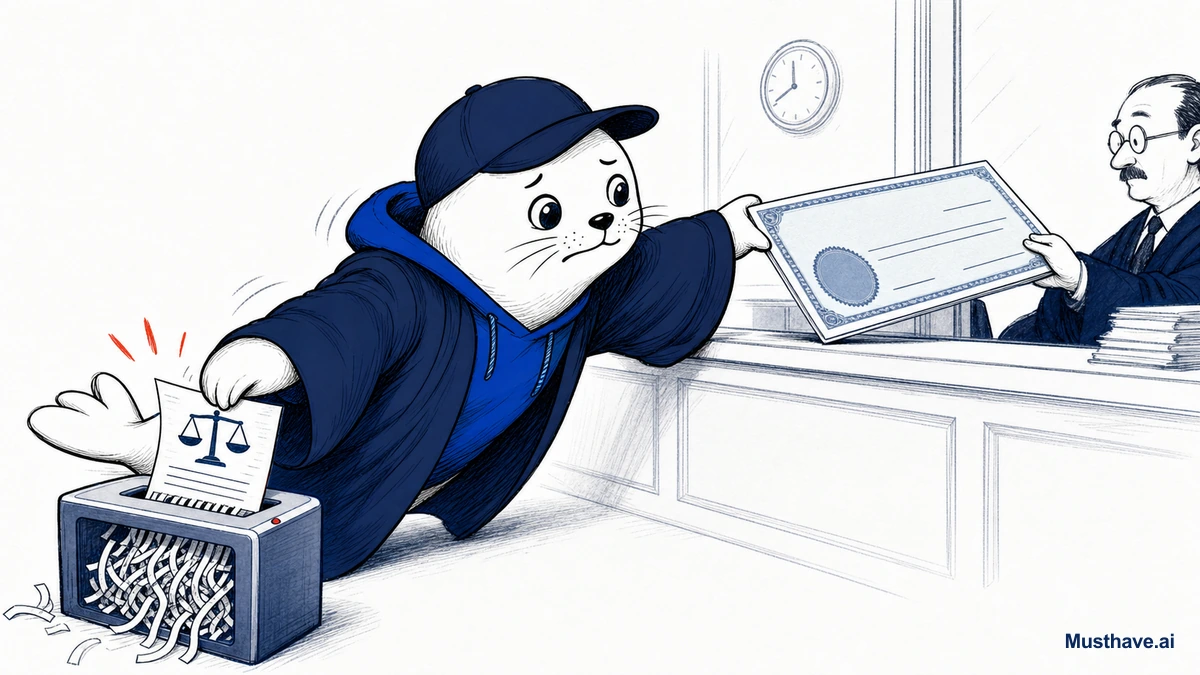
Imagine winning the biggest legal argument of your company’s life (a federal judge rules your core AI training practice is fair use) and then paying $1.5 billion anyway, specifically to make sure nobody else can use your win. That’s roughly what just happened to Anthropic, and the reasoning behind it is more interesting than the headline number.
What actually got approved
On July 20, 2026, Judge Araceli Martínez-Olguín of the US District Court for the Northern District of California gave final approval to Anthropic’s $1.5 billion settlement with a class of authors and publishers. The case was a class action over books Anthropic had downloaded from pirate libraries to help train Claude, not a case about whether training AI on books is legal in general, but specifically about how those particular books were obtained.
That distinction is the whole story, so keep it in mind as we go.
The money, broken down
The $1.5 billion, broken down
Four installments spread across nearly two years.
- Oct 2025 (1st payment) $300M
- 2026 installment $400M*
- 2027 installment $400M*
- Sep 2027 (final) $400M*
*Remaining $1.2B split across three later instalments per the settlement FAQ; exact interim dates aren’t fully public.
Here’s what makes this genuinely the largest settlement of its kind: 482,460 books sit on the official settlement list, and 440,490 claims were filed, a striking 91.3% participation rate. Do the simple math and each claimed book nets its author or publisher roughly $3,000 before costs and fees. Payment isn’t a single wire transfer, either, it’s structured across four installments, starting with $300 million paid back in October 2025 and wrapping with a final payment due September 2027.
The part everyone’s missing: settling erased its own win
This is the detail that makes the story worth your attention beyond the dollar figure. Back in June 2025, in that same underlying case, Judge William Alsup sided with Anthropic on the core question and found that turning books into Claude’s training data counted as fair use. That’s a huge, favorable finding for every AI company watching.
But Anthropic settled rather than let that ruling survive an appeal. And because it settled, the favorable fair-use finding will never become binding precedent. It applies to this case and these parties only. Other courts, hearing near-identical arguments from other plaintiffs against other AI companies, are free to reach a completely different conclusion.
What the settlement does (and doesn’t) establish
The numbers are real. The precedent isn’t.
- ✓ 482,460 books Total works on the official settlement list.
- ✓ 440,490 claims filed 91.3% of eligible authors/publishers submitted a claim.
- ✓ ~$3,000 per book Average payout before legal costs and fees.
- ✗ No binding precedent The favorable fair-use ruling applies only to this case, it can’t be cited as controlling law elsewhere.
Why would a company walk away from a win like that? Because the piracy claim (not the fair-use question) carried the real financial risk. Statutory damages for willful copyright infringement in the US can run into the hundreds of thousands of dollars per work. With 482,460 books on the list, that exposure was the kind of number that ends companies, not just quarters. $1.5 billion, paid on Anthropic’s own terms and schedule, was almost certainly the cheaper outcome, even after giving up a favorable precedent.
Why this connects to the bigger AI-copyright fight
This settlement doesn’t happen in isolation. It’s playing out alongside The New York Times’ ongoing copyright case against OpenAI, which is still grinding through discovery with no binding resolution yet. Anthropic’s outcome doesn’t decide that case, but it does show the shape of the pressure every AI lab is under: massive statutory exposure over how training data was sourced, regardless of how strong the fair-use argument for the training itself might be.
Expect more settlements that look exactly like this one: a company pays big, avoids setting precedent either way, and the underlying legal question, is training AI on copyrighted work fair use?, stays genuinely unresolved nationally, one case at a time.
What this means if you make content
If you’re a writer, blogger, or any kind of creator, here’s the practical takeaway, not the legal theory. The legality of AI training on copyrighted work is still an open question, this settlement didn’t close it, no matter what a headline implies. What did get established is that how data was sourced matters enormously, and pirated or improperly obtained content carries real, quantifiable financial risk for whoever used it.
So: keep dated proof of your own authorship for anything valuable. Watch for licensing programs emerging from cases like this one, a real market for “AI training rights” is forming, and getting paid for access beats hoping a lawsuit eventually favors you.
The bottom line
Anthropic just paid $1.5 billion, and one of the biggest things that money bought was making sure its own favorable court ruling can’t help anyone else. That’s not a loophole, it’s a rational, if slightly uncomfortable, use of a settlement. The fair-use question that actually matters to the entire AI industry is still open, still being litigated case by case, and still worth watching closely if any part of your income touches original content.
Go deeper
Related reading:
- Our breakdown of the still-active Publishers vs OpenAI copyright fight, the case that hasn’t settled yet
Does knowing this ruling won’t bind other courts change how you think about AI and copyright, or does the size of the check speak for itself? Tell me in the comments.
Sources: Court filings and reporting via Silicon Canals, TechTimes, and US News, July 20-21, 2026. Anthropic quote via deputy general counsel Aparna Sridhar.
Verification sources and related guides
Primary reference: Anthropic Copyright Settlement website. This is the controlling platform or government guidance. Recheck it before publishing, deploying, or selling because rules and eligibility can change.