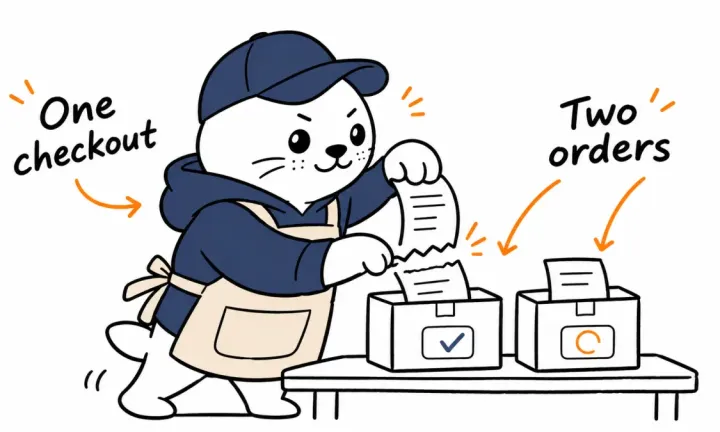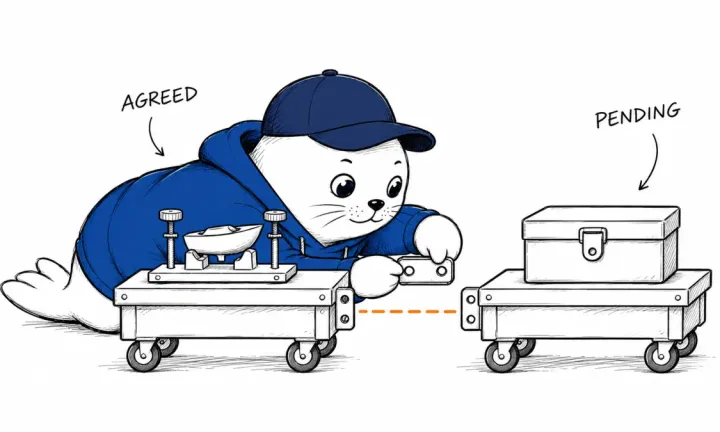


The first useful business automation may be a draft that arrives on time and waits for the right person to approve it.
Start an AI business workflow with one defined job, a clear acceptance rule, and a limit on what it can change. A founder can learn more from a reliable launch-summary draft than from a diagram containing dozens of agents with overlapping responsibilities.
Large agent systems attract attention because they suggest a complete operating model. The diagram rarely shows the rejected outputs, broken connections, or time spent reviewing the result. Those details determine whether automation saves work.
This guide develops a proposed founder workflow and calculates its economics. It does not describe a live deployment or claim that an AI system operates a company. The example is a launch-promotion draft that a person must approve before publication.
Define the business result before choosing the agent
A useful job description could read: turn approved product facts into a draft launch announcement with the correct public URL and publication date. The result must preserve the eligibility terms of any offer and avoid inventing customer claims.
That description supplies a reason to use a language model: adapting facts into readable copy. Date validation, duplicate detection, and destination permissions can be ordinary application rules. Each component has a job that can be checked.
Anthropic’s discussion of agent architecture distinguishes predefined workflows from systems where the model directs its own process. It recommends adding complexity only when the task benefits. The essay dates to December 2024 and notes that its tooling context has since changed.
Use that distinction to ask a practical question. Does the model need to choose new actions, or write one bounded output? A fixed sequence can be easier to inspect when the same business rule should apply on every run.
Give the launch draft a small source record
The input should identify the product and the approved version of its facts. Include the public listing URL, publication date, audience, what is new, and what the visitor can try. Offer terms need their own expiry and eligibility fields.
Missing facts should remain missing. If the founder has not supplied a discount, the draft should not create one. If a product has a private beta, the announcement should direct visitors to the stated access process.
Keep a source version with the draft. That makes a later change visible: an editor approving a 14-day trial should not accidentally approve a replacement draft promising a free lifetime plan. A revision to a material fact should trigger another review.
For an early pilot, manually supplying the approved record can be sensible. It limits moving parts while you evaluate writing quality. Automated collection can come later, with its own source and permission checks.
Separate draft creation from permission to send
The model can have access to a draft destination without access to public publishing. This lets a founder check factual accuracy before granting permission for an external action. The review should show the actual destination and final content.
In n8n’s human-review workflow, selected tool calls pause for approval. A reviewer can approve the requested operation or deny it. The approval request can expose the tool name and its parameters, with the review happening in a configured channel.
The exact payload matters. Approving a description such as “share the launch” leaves several questions unanswered: which account, which audience, which link, and which offer? A concrete review should include those values before any public action occurs.
A changed payload should need a new decision. Saving the identity of the approved version with its destination makes the operation easier to audit. This is an application design recommendation, not a claim that every automation platform provides that behavior automatically.
Use a short acceptance record
| Stage | Required result | Reason to stop |
|---|---|---|
| Read approved facts | Listing URL and source version are present | The record is missing or superseded |
| Write the draft | New feature and visitor action match the source | The draft invents a claim or offer |
| Review | Reviewer sees final content and destination | The intended recipient or terms changed |
| Publish or send | One confirmed external result | Prior success is uncertain |
| Record outcome | Result URL, time, and status are saved | The receipt cannot be connected to the approved version |
A result URL or delivery receipt gives the workflow something concrete to inspect. A conversational statement that the job succeeded should not be the only evidence. The final check belongs at the destination.
Keep the draft available when a reviewer declines it. The rejection reason can identify a missing source field or an unclear instruction. Deleting the evidence would make the next attempt harder to improve.
Calculate cost per accepted draft
Suppose a pilot processes 100 launch records. Each attempt costs an assumed $0.08 in model and workflow charges. Every record gets one attempt, and 20 need one additional attempt. Total execution spending is 120 × $0.08, or $9.60.
If all 100 drafts eventually pass review, execution cost is $0.096 per accepted draft. If only 80 pass with the same spending, it becomes $0.12. These are reproducible hypothetical calculations, not measured prices or results for n8n or a particular model.
Now include review time. Assume a reviewer spends three minutes on each of the 100 final drafts, or five hours. At an explicitly chosen labor value of $20 per hour, review adds $100. Total cost is $109.60, or $1.096 per accepted draft if all pass.
This changes what deserves optimization. Cutting execution spending in half saves $4.80. Cutting final review time from three minutes to two saves about $33.33 at the same labor assumption. The pilot should measure both before a team spends days tuning token usage.
A manual comparison completes the budget. If preparing each draft manually takes six minutes, 100 drafts take ten hours. At the assumed hourly value, that is $200. The hypothetical automated workflow saves $90.40 before setup and maintenance. Those extra costs can erase the savings for a small batch.
Plan for an uncertain result before allowing retries
A timeout can leave an awkward question: did the destination accept the request before the response disappeared? Repeating a draft-generation request wastes money. Repeating a public-send request can create a second message.
Use a stable business identifier for the intended action and keep its recorded status. Before retrying an uncertain public operation, inspect the destination or its supported receipt mechanism. A generated identifier alone does not guarantee that an external service prevents duplicates.
n8n’s error-handling documentation describes error workflows and execution records. Those can help alert the operator and investigate failed runs. An alert does not settle whether a remote operation already succeeded; the application still needs that reconciliation step.
Stop the workflow when the answer is uncertain, and the next action could duplicate a public result. Record the uncertainty for a person to resolve. A useful automation should make exceptions visible instead of hiding them under repeated retries.
Add another agent only for a separate measured need
A second reviewer model may catch errors, but it creates another bill and another acceptance question. Measure what it adds on the cases that previously failed. Agreement between models does not establish that a product claim is true.
Keep this first pilot narrow enough to compare with manual work. Record accepted drafts, review minutes, and exceptions for a week of actual activity. Expand only when a new component addresses an observed bottleneck.
Our model-cost guide explains why accepted work is a better denominator than token price. For scheduled execution, read the Claude Code scheduling update. Which single recurring draft would be worth measuring in your business?

Abdessalam Alaoui
I'm Abdessalam Alaoui, founder of Musthave.AI. I write practical guides to AI models, tools, generative media.