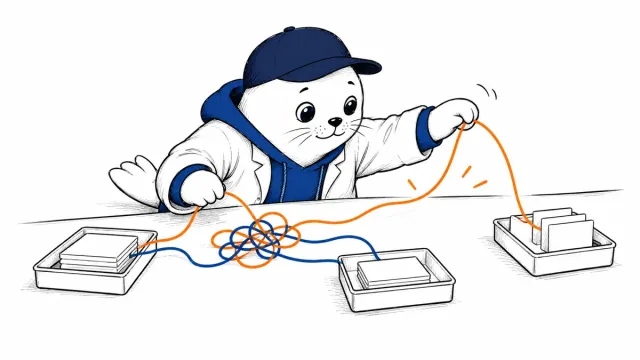

OpenAI says an internal system coordinated roughly 10,000 AI agents and produced a proposed proof for one of mathematics’ hardest open problems. The files are public. The verdict is not.
On September 8, 2026, OpenAI released an analytical argument and a Lean 4 formalization addressing the Navier-Stokes existence and smoothness problem. The company says the work establishes the breakdown alternatives called C and D in the Clay Mathematics Institute’s official formulation. Clay’s own public page still labels the problem “Unsolved,” and OpenAI says it does not intend to claim the Millennium Prize.
What OpenAI actually published
The claim concerns three-dimensional incompressible fluid motion with viscosity. OpenAI’s construction starts with smooth data and a smooth applied force, then produces a finite-time singularity while keeping the fluid’s kinetic energy finite. In plain language, the modeled flow accelerates without bound even though it starts smoothly and is not driven by an infinite force.
The public package has two parts. A mathematical paper explains the construction. A separate GitHub repository contains Lean certificates for the Navier-Stokes and related Euler results. The repository identifies whole-space and periodic-torus results corresponding to alternatives C and D.
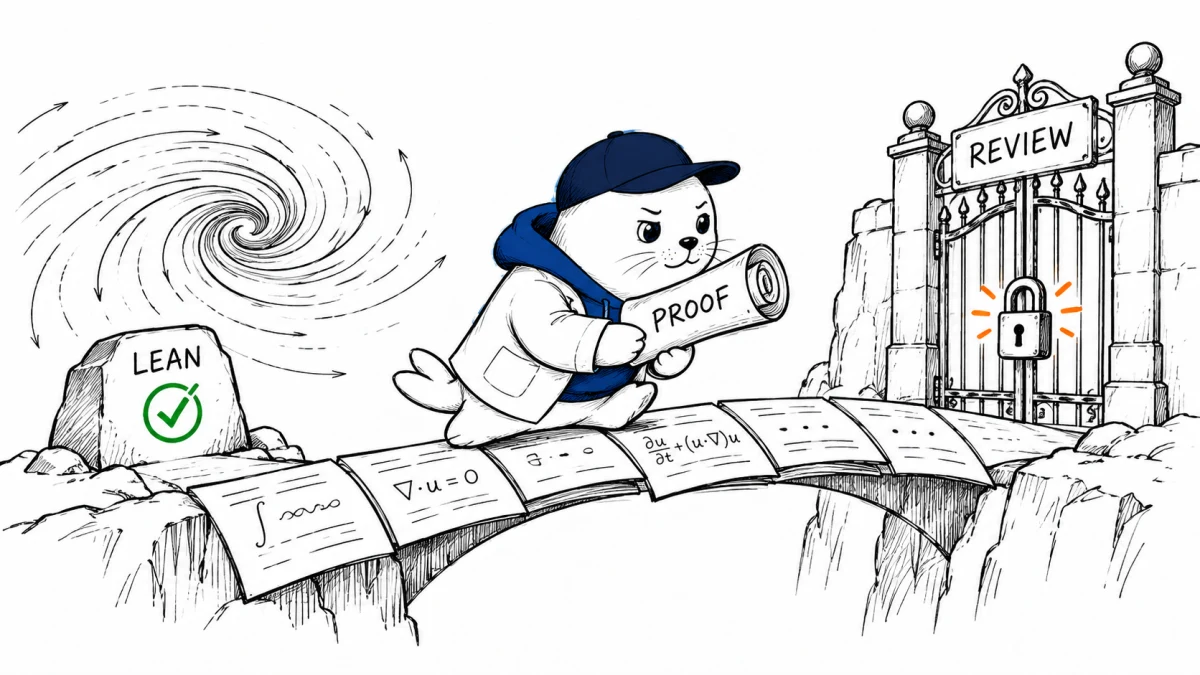
Four gates stand between a release and acceptance
| Gate | Current evidence | What is still needed |
|---|---|---|
| Analytical argument | OpenAI released a full paper | Specialists must inspect definitions, estimates, and edge cases |
| Formal certificate | A Lean 4 repository is public | Independent builds and checks must confirm the formalization matches the paper and problem statement |
| Mathematical consensus | No broad independent validation was available when checked | Experts need time to reproduce or challenge the result |
| Clay Prize process | OpenAI says it will not claim the prize | Clay’s rules and recognition process are separate from publication |
This distinction matters because “Lean checked” and “the Millennium Problem is solved” are different claims. Lean can verify that a formal theorem follows from encoded definitions and imported foundations. Reviewers still have to confirm that the encoding captures the intended mathematics and that every bridge from the paper to the formal statement is sound.
The agent run was unusually large
OpenAI reports that the successful Navier-Stokes effort used on the order of 10,000 concurrent agents. The agents reached the proposed result about 88 hours after the first groups started. GPT-6 Astra then handled Lean formalization and verification over another 17 hours.
The company reports 2.7 million messages and about 130 billion output tokens for this problem alone. Dividing those figures gives roughly 48,000 output tokens per agent-message, although that average hides huge differences between short coordination messages and long mathematical attempts. It also means the useful question is not whether one chatbot had a flash of insight. This was a search-and-consolidation system operating at a scale most researchers cannot reproduce.
OpenAI says the underlying internal model is significantly more capable than GPT-6 Astra. That is a company description, not a released benchmark. Readers should keep it separate from the public capabilities and pricing of Astra.
How the multi-agent search worked
Different agent groups received different variants of the open problem, including both proof and counterexample directions. After a smaller group found a finite-time blowup construction for an Euler-equation variant, OpenAI shifted more resources toward Navier-Stokes. Codex consolidated useful intermediate ideas and fed them back into later groups.
- Split the problem into competing theorem directions rather than committing to one answer.
- Run many independent explorations with code and cached web access.
- Promote a useful result from a related problem into the main search.
- Consolidate intermediate work instead of asking every group to restart.
- Formalize the surviving argument and publish the artifacts for inspection.
That workflow is more interesting to builders than the raw agent count. It treats diversity, cross-pollination, verification, and stopping criteria as system design problems. Our earlier coverage of OpenAI’s AI research intern raised the same issue at a smaller scale: useful autonomy depends on knowing where expert judgment enters.
The concurrent-work dispute needs careful wording
OpenAI says it started the effort after hearing rumors later connected to Levent Alpoge and Tristan Buckmaster, who had separate work on a forced Euler problem. OpenAI says its researchers and agents did not see that work before the other researchers released it publicly, and that no specific user data was accessed for this project.
The company also says it cannot completely rule out indirect influence from de-identified data derived from use of its products. That acknowledgment is not proof that the outside work influenced the model. It is also not a detail to wave away. For high-stakes scientific claims, provenance should cover prompts, cached sources, model snapshots, data-access policy, consolidation logs, and a clear timeline.
What independent reviewers should test first
- Build the Lean project from a clean environment using the pinned toolchain and dependency versions.
- Match the formal theorem exactly to Clay alternatives C and D, including domains, forcing, smoothness, and energy conditions.
- Locate any axioms, admitted facts, custom comparators, or trusted external steps.
- Trace the analytical paper’s central estimates into the formal definitions rather than checking only that the repository compiles.
- Ask specialists who were not involved with OpenAI to publish objections, replications, and corrections.
I would resist both easy reactions. Declaring victory now is premature. Dismissing the work because AI agents produced it is premature too. The right response is unusually old-fashioned: download the artifacts, reproduce the build, read the proof, and let scrutiny do its job.
The result is a public test, not a finished verdict
If the argument survives expert review, the scientific story will be enormous. If reviewers find a gap, the agent architecture and formalization record will still be worth studying. Either way, OpenAI has made a concrete claim that can be examined rather than a benchmark score that disappears behind a private test set.
That is the useful posture for now: treat the paper as a proposed solution, the Lean repository as a checkable certificate, and independent mathematical agreement as the next milestone.
Read the primary records
- Read OpenAI’s announcement and methodology.
- Inspect the Lean formalization repository.
- Compare the claim with the Clay Mathematics Institute problem page.
End-to-end success can hide weak decisions that happened along the way. The Taste-Bench judgment benchmark isolates those forks and tests the choice before the later outcome is visible.
Checked September 9, 2026. Agent counts, token use, timing, capability, and provenance statements are OpenAI-reported. Independent mathematical validation was not yet established.