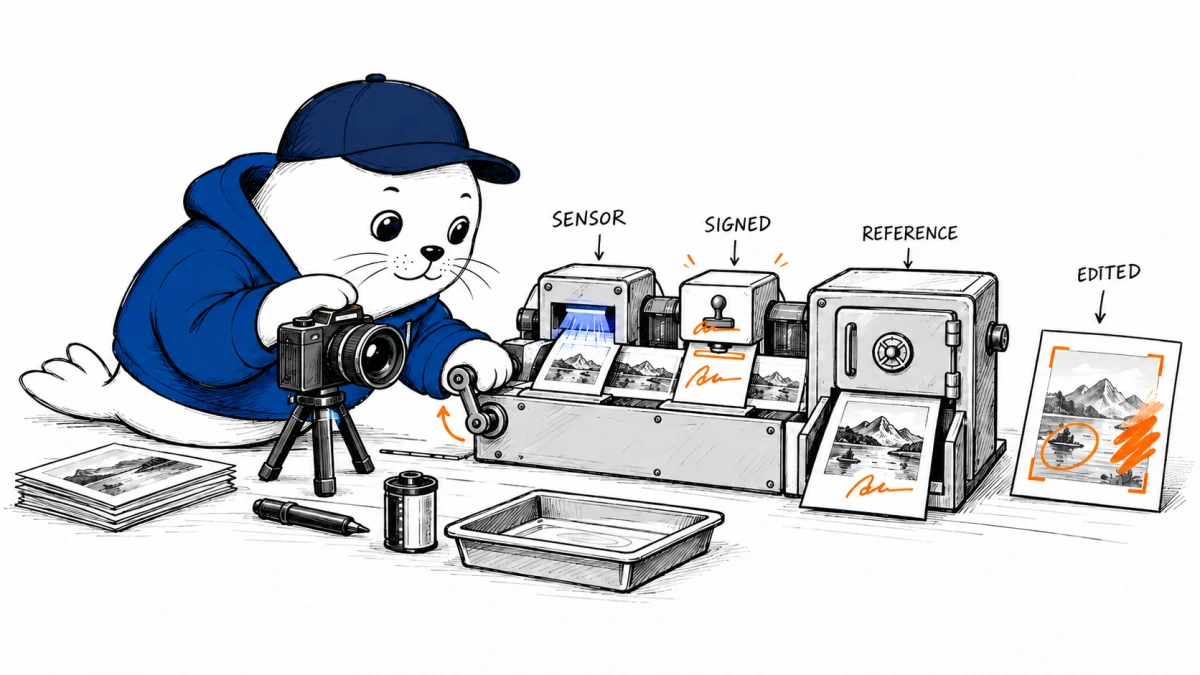
The iPhone 18 Pro’s most useful AI-era camera feature may be the one that does not generate anything. Apple Reference Image creates a signed record of what the main camera sensor captured, giving editors and readers a comparison point after a photo has been cropped, cleaned up, extended, or otherwise changed.
Apple introduced the feature with iPhone 18 Pro and iPhone 18 Pro Max on September 9, 2026. The phones start at $1,199 and $1,299 in the U.S., with preorders on September 12 and availability beginning September 18.
Reference Image is easy to misread as an AI detector. It is not. A detector examines published pixels and estimates how they were made. Apple’s system starts at capture time, records signed sensor data in an opt-in camera mode, and develops a separate reference through Private Cloud Compute.
How iPhone 18 Pro Reference Image works
- The photographer chooses Reference mode. Apple describes the feature as opt-in, so ordinary camera captures should not be assumed to include it.
- The main camera records signed sensor data. Apple says the new sensor can sign what it sees at the pixel level.
- Private Cloud Compute develops the reference. Apple says this produces an unalterable reference image.
- The working photo can be edited. Cropping, cleanup, reframing, extension, color work, or other changes can occur on the main image.
- A viewer compares both assets. Photos can display the reference beside the main image, and Apple provides viewing APIs for third-party apps on iOS, iPadOS, and macOS 27.
The system is closer to a digital negative with a cryptographic chain than to a watermark printed across the final image. Its value comes from preserving a trusted comparison object outside the editable copy.
What the signed reference can prove and what it cannot
| Question | What Reference Image can support | What still needs other evidence |
|---|---|---|
| Did the published image change after capture? | A viewer can compare the working image with the signed reference. | The system still needs a policy for deciding which changes are acceptable. |
| Did this scene reach the named iPhone sensor? | The signed sensor record is designed to anchor the reference to the capture process. | An independent security review would be needed to assess the full implementation. |
| Who took the photo? | Not established by the pixels alone. | Identity, account, assignment, and custody records. |
| Where and when was it taken? | The visual reference shows sensor content. | Trusted time, location, and custody evidence. |
| Was the scene truthful or unstaged? | No. A camera can faithfully capture a staged event. | Reporting, witnesses, context, and editorial verification. |
| Was an image created without Reference mode? | No conclusion. The feature is opt-in. | Other provenance records or forensic analysis. |
A signed capture can answer a narrower question more reliably than a detector: how does the edited image differ from the sensor reference? It cannot turn a photograph into proof of the caption, the photographer’s identity, or the truthfulness of the event.
Why provenance is different from guessing from pixels
AI detectors work after the fact. They search for statistical traces, metadata, fingerprints, or generator-specific signals. Compression, screenshots, cropping, re-encoding, and unfamiliar models can weaken those signals. Our analysis of NVIDIA’s AI video detector explains why a detection threshold and a source record are different tools.
Reference Image begins before publication. It establishes a known capture path that can survive alongside later edits. That changes the verification question from “Do these pixels look synthetic?” to “Can the recipient validate this reference, and does the published image match it closely enough for the stated use?”
The second question is operational and editorial. A crop that removes an empty wall may be harmless. Removing a person, extending a crowd, changing a sign, or adding an object may change the meaning. Reference Image can expose the difference, but a newsroom still has to define the policy.
The trust chain has five parts
Apple’s announcement compresses a complex system into a short feature description. A practical review should separate the chain into five parts:
- Sensor: the camera hardware produces the original data.
- Signature: the device binds the capture to a cryptographic record.
- Private Cloud Compute: Apple’s remote system develops the protected reference.
- Viewer: Photos or a third-party app validates and displays the relationship.
- Recipient: the editor, publisher, platform, or reader decides what the comparison means.
A weakness, ambiguous status message, or lost identifier at any stage can reduce practical trust. Apple has not yet published all the details a forensic team would want, including long-term key management, revocation behavior, offline validation limits, and how references survive export through common publishing systems. Those are questions for documentation and independent testing, not reasons to dismiss the design.
A newsroom policy is more important than the camera toggle
Organizations should decide when Reference mode is required before photographers reach the scene. An editor cannot recreate a missing reference after an ordinary capture.
- Define high-risk assignments. Elections, conflict, public safety, investigations, and evidence-heavy reporting may justify a Reference mode requirement.
- Preserve both assets. Keep the working photo and its reference together in the asset system.
- Record validation state. Store whether the reference was available, validated, unavailable, or broken during transfer.
- Document permitted edits. Separate exposure and crop corrections from content-changing removal, extension, or generation.
- Test the publishing path. Confirm that the reference relationship survives import, export, resizing, content management, syndication, and archive workflows.
- Explain it to readers. A visible status should state what was checked without implying more than the evidence proves.
A useful label would be specific: “A signed iPhone reference was validated and the published image was compared with it.” A vague “verified photo” badge invites readers to assume identity, location, time, and scene truth that the mechanism may not establish.
Reference Image has major launch limits
The feature is limited to iPhone 18 Pro models and Reference mode is optional. Apple says capture will not be available in the European Union at launch. Users with iOS 27, iPadOS 27, and macOS 27 in the EU will still be able to develop and view reference images. In China, Apple Reference Image will not be available at launch because of regulatory requirements.
Those limits create an uneven evidence system. A global newsroom cannot assume every photographer, region, or assignment can produce the same reference. Any policy needs an alternative path for unsupported devices and countries, plus a clear way to distinguish “not captured” from “failed validation.”
SynthID is a separate layer and is not available at launch
Apple also plans support for Google’s SynthID standard later in 2026. Apple says it will be included for most edited images, depending on the edits applied. That roadmap should not be written as a shipped iPhone 18 Pro feature.
The two mechanisms solve different problems. Reference Image anchors a camera capture. SynthID can mark generated or edited media. Metadata can carry additional history. Using several signals is stronger than asking one badge or detector to represent the entire chain.
This matters as image tools become more capable. Our ChatGPT Images 2.5 guide shows how quickly generation and editing workflows are expanding. Better provenance needs to develop at the same pace.
A20 Pro supplies the AI context, but provenance is the bigger story
iPhone 18 Pro uses the A20 Pro with a 6-core CPU, 7-core GPU, and Dual 16-core Neural Engine. Apple says its 32 neural cores provide twice the AI processing power of A19 Pro. The phone also introduces AI-assisted photo editing, photorealistic Image Playground output, Siri AI, and AI-related cellular improvements.
Reference Image stands apart because it addresses the consequences of those editing tools. The more convincingly a device can reframe, extend, clean, or generate imagery, the more valuable a trustworthy pre-edit record becomes.
The same A20 Pro also appears in Apple’s foldable, but the value proposition is different. Our iPhone Duo AI comparison calculates the $800 premium and separates the two-screen workflow from the shared chip.
Siri AI begins rolling out in English beta on September 14. Our Siri AI guide tracks devices, language expansion, regional limits, and daily server-side usage rules.
Questions independent reviewers still need to test
- Can validation work offline, and what information is exposed when it cannot?
- What happens when a device signing key is compromised or revoked?
- Which exports preserve the reference relationship across non-Apple tools?
- How do screenshots, messaging apps, social platforms, and content delivery networks affect the viewer state?
- Can a recipient identify exactly which edits separate the reference from the working photo?
- What audit information is available to newsroom asset systems and forensic tools?
- How clearly does the interface distinguish missing provenance from failed provenance?
Apple’s announcement is the primary source for the launch design, but it is not an independent security audit. The answers will determine whether Reference Image becomes a durable professional standard or a useful feature that works mainly inside Apple’s own software.
My verdict: this is evidence of capture, not proof of truth
Apple Reference Image is a smarter response to synthetic media than another universal detector score. It starts with a known capture process and gives the recipient something concrete to compare with the edited image.
Its value will depend on opt-in use, preservation, viewer support, key security, regional availability, and honest labeling. Used carefully, it can strengthen a photo’s chain of evidence. Marketed carelessly, it could become a badge that promises much more than the signed sensor record can prove.
Primary sources
- Apple’s iPhone 18 Pro and Reference Image announcement
- Apple iPhone 18 Pro product page
- Apple iPhone 18 Pro technical specifications
Checked September 10, 2026. Feature behavior, regional limits, and future SynthID timing are based on Apple’s written launch materials. Security and workflow questions are identified as tests, not established failures.