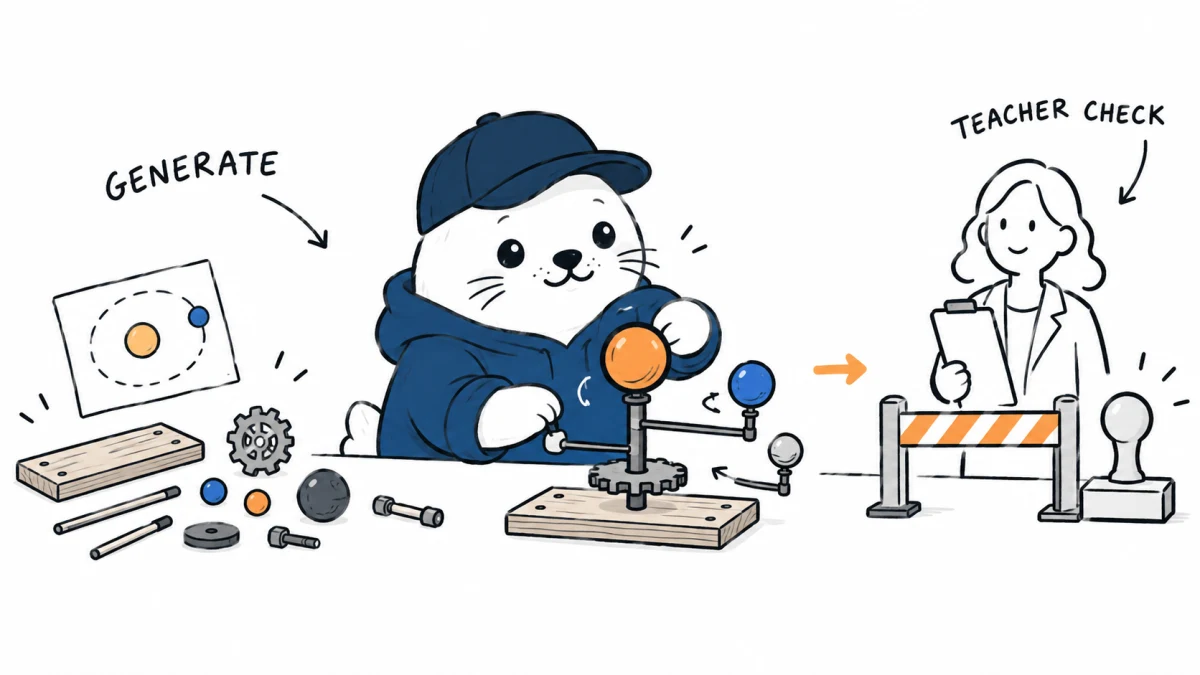
Google Research is testing a form of generative UI for classrooms: a teacher requests a simulation, the system builds an interactive experience and a human checks whether it belongs in the lesson.
Google STEM simulations now appear in a public library of more than 30 teacher-reviewed interactives, while a Google for Education pilot lets educators request curriculum-specific versions. The strongest number in Google’s report is also the clearest warning: the initial US study involved only 12 teachers.
How the generation-and-review loop works
- A teacher describes the concept, grade level and instructional goal.
- The system produces a browser-based interactive rather than only explanatory text.
- Automated checks test whether the experience runs and can be solved.
- Teacher reviewers inspect pedagogy, clarity and classroom fit.
- An accepted interactive enters the library or a pilot lesson plan.
The browser check is useful because generated code can look plausible without functioning. It is not a pedagogy test. A simulation can run correctly while teaching the wrong abstraction, hiding a scientific assumption or rewarding guessing.
What Google actually studied
| Evidence item | Reported result | Limit |
|---|---|---|
| Expert review | 40 STEM interactives reviewed by expert teachers | Review does not equal classroom learning evidence |
| Teacher study | 12 US teachers | Small sample and limited geography |
| Custom requests | Three interactives requested per teacher | 36 requests do not establish broad curriculum coverage |
| Quality rating | Average 8 out of 10 | Company-reported rating with no learning-gain result |
| Future evidence | Learning and engagement studies planned | Those results are not available yet |
The 8 out of 10 score is a usability signal
An average quality rating of 8/10 suggests that participating teachers found the outputs promising. It does not answer whether students learned more, retained the concept longer or developed misconceptions. The score also needs its rubric: visual quality, scientific accuracy, lesson fit and accessibility are different dimensions.
A teacher validation gate should inspect six things
- Scientific correctness: variables, units, constraints and causal relationships.
- Learning objective: the interaction practices the intended concept instead of a nearby skill.
- Feedback quality: wrong answers produce useful guidance rather than only a red mark.
- Accessibility: keyboard use, labels, contrast, motion and alternatives for visual or motor tasks.
- Data handling: no unnecessary student identifiers or behavioral data.
- Failure behavior: the lesson still works when a device, browser or network fails.
The public library and the pilot are different products
The library provides already reviewed examples. The Google for Education pilot tests teacher-requested generation. A school should not assume that a public example guarantees access to the authoring workflow, or that a pilot feature has the support, privacy terms and administrative controls of a generally available education product.
A classroom pilot that produces useful evidence
- Choose one concept with a known misconception and an existing non-AI lesson.
- Have two teachers independently review the generated simulation.
- Record every scientific, instructional and accessibility correction.
- Use a short pre-task and post-task tied to the same learning objective.
- Compare time on task, error patterns and teacher workload with the existing lesson.
- Collect student feedback without turning engagement into the only success metric.
- Preserve the exact interactive version used in the lesson.
Questions for a school administrator before joining the pilot
- Which accounts, student data and telemetry enter the experiment?
- Can teachers export or archive the exact interactive used in class?
- Who receives a correction when a scientific or accessibility issue is found?
- Does the school keep ownership of teacher-authored prompts and lesson context?
- What support exists when a generated interactive fails during a lesson?
Those answers determine whether the pilot can produce reusable evidence instead of a collection of attractive demos. They also help teachers distinguish a classroom resource from a research artifact that may change during the study.
Version preservation matters because a regenerated or silently updated simulation may not match the experience students used. A screenshot is not enough; schools should retain the content version, configuration and review record where policy permits.
Why this matters beyond education
Generative UI changes the output from an answer into an environment a person can manipulate. That makes runtime testing and domain review part of content quality. The same principle appears in our report on the Google and MIT AI science study: time saved is useful only when the result is verified. Our Google agent anomaly-detection analysis likewise separates automated checks from human judgment.
The practical verdict
Google’s research shows a credible workflow for generating and checking curriculum-specific interactives. The public library offers tangible examples, and the 12-teacher study gives an early quality signal. It is still a pilot. Schools should wait for larger, independent learning and engagement evidence while using teacher review as a required gate, not a ceremonial final click.
Primary source
Checked September 18, 2026. Study design and results are company-reported by Google. Evidence interpretation and classroom testing guidance is MustHave.ai analysis.