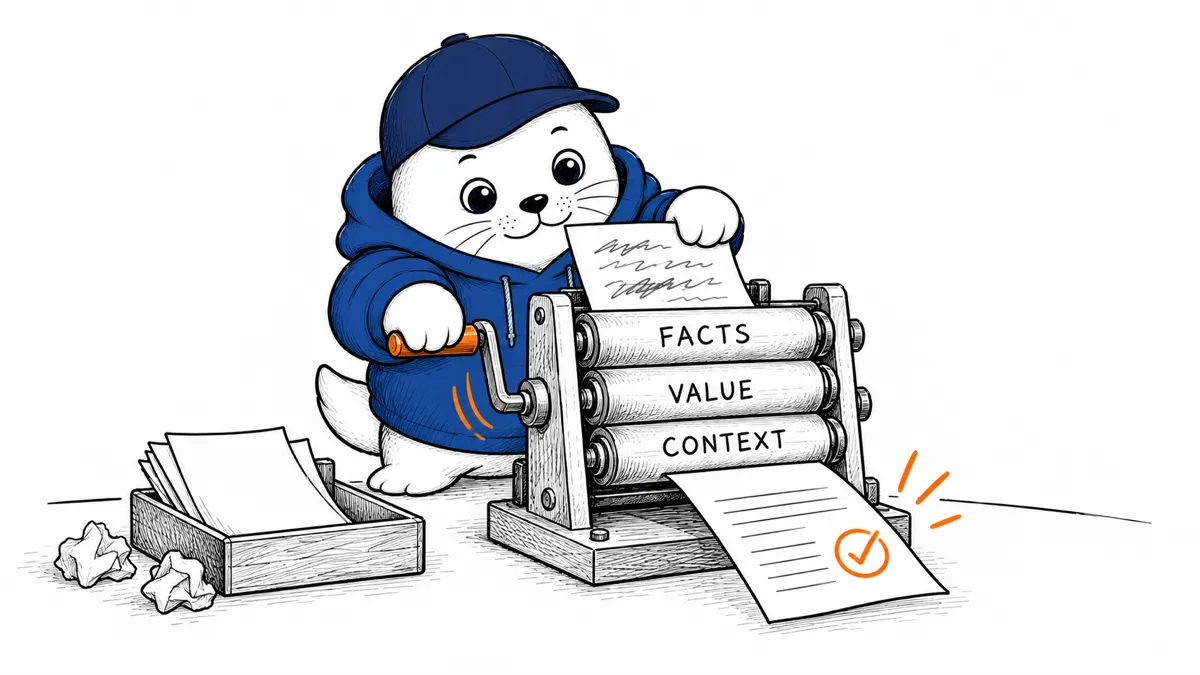
Google does not ban AI-assisted content. It does require the publisher to take responsibility for every claim, every metadata field, and the reason the page exists.
Google updated its guidance on generative AI content on October 1, 2026. The short version is easy to repeat and easy to misuse: generative AI can help with research and structure, but publishing large amounts of low-value material may violate the scaled content abuse policy.
The practical lesson is not “use AI” or “never use AI.” It is to build an editorial process in which a named person can prove why the page is useful, where its facts came from, what was checked, and why the metadata accurately describes the visible content.
Google regulates the outcome and purpose, not the keyboard
Google defines scaled content abuse as producing many pages primarily to manipulate rankings rather than help people. The policy covers AI-generated pages, scraped or lightly transformed pages, stitched summaries, and keyword-filled pages that make little sense. It does not depend on whether a human, a model, or a mixed workflow produced the text.
That distinction matters. One carefully researched AI-assisted guide can satisfy a real reader need. One thousand templated pages can fail even if an editor presses the publish button on each one. Human involvement is not proof of value; the page still needs original effort, accurate evidence, and a clear audience.
Google’s people-first content guidance gives the strongest diagnostic: ask who created the content, how it was produced, and why it exists. The “why” should be to help the intended reader, not to capture another keyword variation.
What Google now makes explicit
1. Manual fact-checking is a publication requirement
Google says generative models predict likely word sequences and may produce inaccuracies. It calls manual fact-checking and review critical before publication. A smooth paragraph is not evidence, and a citation-looking URL is not proof that the linked page supports the sentence.
For each material claim, open the source, confirm the exact scope, record the date, and preserve any limitation. Product availability, price, geographic rollout, benchmark results, legal requirements, and deadlines deserve claim-level checks, not a general read-through.
2. Metadata needs the same review as the article
The review does not stop at the body. Google specifically names title elements, meta descriptions, structured data, and image alt text. An accurate article can still create a misleading search result if its title exaggerates, its description promises a result the page doesn’t deliver, or its schema includes facts the reader cannot see.
Google’s structured data guidelines require markup to represent the visible page. Passing a syntax test makes the markup technically readable; it does not guarantee a rich result or prove the underlying claim is true.
3. Readers may need context about automation
Google recommends explaining how content was created when that context would help the audience understand the work. This is not a ranking trick and not a requirement to add the same banner to every spell-checked sentence. The useful disclosure explains the model’s role, the human review, the source standard, and any limitation that could change how a reader interprets the page.
For ecommerce, the rule can be more specific. Google points merchants to Merchant Center policies that require labeling for certain AI-generated product data and embedded IPTC metadata for AI-generated product images. Treat those as channel-specific compliance tasks, not as a generic blog disclaimer.
Assign the work before you generate the draft.
The safest workflow separates assistance from accountability. A model can accelerate a task, but a named editor must own every decision that affects what the reader sees or believes.
| Workflow stage | AI can assist with | A person must approve |
|---|---|---|
| Research | Topic maps, question lists, source discovery | Source authority, freshness, and claim scope |
| Drafting | Outline, structural alternatives, plain-language rewrites | Angle, evidence, examples, and final wording |
| Quality review | Consistency checks, missing-question prompts | Accuracy, originality, usefulness, and tone |
| Search presentation | Title and description options | No exaggeration; exact match to the visible page |
| Publication | Formatting and repetitive CMS tasks | Final sign-off, disclosure decision, and rollback owner |
A full AI-assisted publishing workflow
Step 1: define the reader and the decision
Write one sentence that identifies the intended reader and the decision or task the page will help with. If the only answer is “people searching this keyword,” stop. Search demand can validate a topic, but it cannot substitute for a useful purpose.
Step 2: build a claim-source map
List the claims the article must establish and assign a primary source to each one. Mark company performance statements and survey findings as source-reported unless you can reproduce them—separate confirmed facts from interpretation and recommendations.
Step 3: constrain the model’s role
Give the model the verified source set, the intended audience, the article angle, and a list of claims it must not invent. Ask it to flag missing evidence rather than fill gaps. Do not ask for a finished “SEO article” from a topic phrase and treat the result as research.
Step 4: add information the model could not supply generically
Add first-hand testing, a calculation, a comparison against an older version, an implementation decision, a failure example, or a useful boundary. Google’s newer guidance for generative AI search calls this non-commodity content: work that does more than restate what any model could produce.
Step 5: verify prose and presentation separately
Run one pass for factual claims and a separate pass for titles, descriptions, alt text, captions, links, dates, tables, and structured data. This catches the common failure where the article is corrected, but an old claim survives in the search snippet or schema.
Step 6: decide whether disclosure adds useful context
Disclose substantial automated generation when a reasonable reader would want to know how the work was produced. Make the statement concrete: what the model did, what sources controlled the draft, and what a person verified. Avoid vague labels that transfer responsibility to “AI.”
Step 7: publish, inspect, and maintain
Preview the rendered page, test every link, validate relevant structured data, and check the mobile layout. After publication, use Search Console and reader feedback to find mismatches between the page’s promise and its result. Update facts when the source changes; do not change the date merely to simulate freshness.
The pre-publication checklist
Purpose and audience
- The page solves a defined problem for an existing or intended audience.
- The topic fits the site’s purpose; it was not selected only because it is trending.
- The article would still be worth publishing if search traffic were unavailable.
- The title describes the actual value without hype or an unsupported promise.
Evidence and accuracy
- Every material fact has been checked against an open source that supports the exact claim.
- Prices, dates, availability, regions, benchmarks, and policy statements include their limits.
- Company or study claims are labeled as reported rather than presented as independently proven.
- Quotes, calculations, names, product versions, and outbound links are manually verified.
- Uncertainty is visible; a confident model has not replaced missing evidence with a guess.
Original value
- The page adds analysis, experience, testing, a calculation, a decision framework, or a new comparison.
- It does not merely stitch together source summaries or paraphrase the current search results.
- Overlapping pages on the site have been consolidated or given clearly different intent.
- A reader can complete the promised task without searching again for the missing steps.
Authorship and process context
- The byline and author information are accurate; no invented expert identity or credential is used.
- A named editor owns the final claims and publication decision.
- The page explains substantial AI or automation use when readers would reasonably expect that context.
- Any disclosure describes the real workflow instead of making a vague “AI-generated” statement.
Search presentation and technical checks
- The SEO title and meta description match the visible article and contain no outdated claims.
- Alt text describes the image rather than stuffing keywords or inventing visual details.
- Structured data matches visible content and passes the appropriate validation test.
- The canonical URL, indexability, internal links, mobile rendering, and page experience have been checked.
- Ecommerce teams have applied the current Merchant Center rules for AI-generated product data and images where relevant.
Use a green, amber, or red publication decision
| Decision | Meaning | Action |
|---|---|---|
| Green | Claims are sourced, the page adds original value, and metadata matches. | Publish with a named owner and review date. |
| Amber | The draft is useful but contains unresolved scope, disclosure, or evidence questions. | Hold the page and revise the weak claims or presentation. |
| Red | The page exists mainly for search coverage, repeats other pages, or cannot be verified. | Reject, consolidate, or keep it out of Search. |
My rule is simple: if nobody can name the reader, defend the evidence, and explain what the page adds, the page does not ship. A batch should not pass because most pages look acceptable; each URL needs a defensible purpose and evidence trail.
What this checklist cannot promise
Following Google’s guidance does not guarantee crawling, indexing, a rich result, an AI Overview citation, or higher rankings. Google says eligibility and compliance are prerequisites, not promises. The quality rater guidelines are also evaluation material for Google’s systems; individual rater scores do not directly rank a page.
Google’s generative AI search guide also rejects several shortcuts. You do not need special AI schema, a llms.txt file for Google Search, tiny “AI-friendly” content chunks, or a separate page for every query variation. Foundational SEO still matters, but it builds on useful content rather than replacing it.
For a page-by-page review, use Search Engine Answer’s 30-check generative AI content audit checklist. For the broader production process, use our AI-assisted research-to-publication workflow. For voice and originality, pair it with our human-voice checklist. The principle connecting these guides is simple: automate the repeatable work, preserve the evidence, and keep publication judgment accountable to a person.
Primary sources
- Google Search guidance on using generative AI content
- Google Search spam policy on scaled content abuse
- Creating helpful, reliable, people-first content
- Optimizing for generative AI features on Google Search
- General structured data guidelines
Source check: October 2, 2026. Google marked its generative AI content guidance and people-first content guidance as updated on October 1, 2026.