Google has put a short clock on the Antigravity Agent preview. The model name changes, but the operational risk sits in the tool protocol around it.
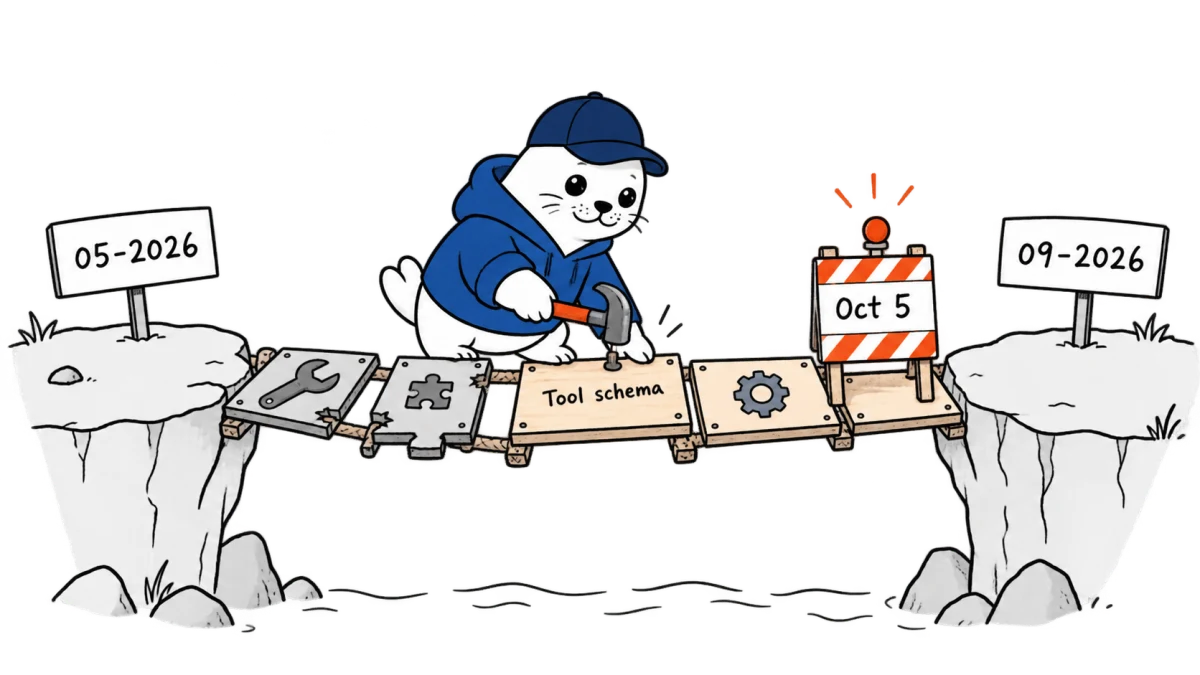
Antigravity Agent 09-2026, published September 17, replaces antigravity-preview-05-2026. Google says the May preview shuts down October 5, 2026. Teams have less than three weeks to update pinned model names, tool schemas and parsers.
The October 5 deadline comes first
Start by finding every reference to the May preview in application code, evaluation harnesses, deployment variables, saved agent configurations and documentation. A model alias hidden in an environment-specific configuration can survive a code search and fail only when traffic reaches that environment.
Do not replace the identifier directly in production. Create a parallel configuration, replay representative jobs against both previews and compare tool-call traces. The output text may look similar while a renamed tool or changed argument shape breaks execution.
File-tool changes to map
| May preview pattern | September preview pattern | Migration test |
|---|---|---|
write_file | write_to_file | Create a new file and verify the exact path and contents. |
| Full-file edit path | replace_file_content | Replace known text and reject a stale match. |
read_file | view_file | Read full and ranged content without truncation surprises. |
list_files | list_dir | Confirm directory ordering, hidden-file behavior and pagination. |
| No direct equivalent | find_by_name and grep_search | Test exact, fuzzy and no-result searches. |
Parser changes can be more dangerous than model changes
Google calls out PascalCase and line-range replacements for local and function-call parsers. If your middleware normalizes field names, validates calls against a JSON schema or converts edits into patches, it must recognize the new representation before the model is switched.
A permissive fallback is not a safe migration strategy. Silently dropping an unknown field can turn a bounded edit into an empty or misplaced operation. Reject unknown shapes, record the raw call and make the failure visible to the orchestrator.
Remote output-only integrations have a smaller change
For remote output-only use, Google describes an agent-string change. That is narrower than the local tool-schema work, but it still deserves a contract test. Capture a known request and assert the string or identifier your downstream system expects instead of depending on visual inspection.
A migration sequence that preserves rollback
- Inventory. Search code, configs, stored prompts and monitoring labels for the old preview.
- Dual-run. Send a fixed evaluation set to both versions without changing production traffic.
- Validate each tool. Cover create, view, list, find, grep and line-range replacement separately.
- Canary. Route a small reversible workload to 09-2026 and monitor rejected or malformed calls.
- Cut over with a fallback. Keep the prior configuration available only until the October 5 shutdown, then remove it deliberately.
What does not change
Google says shell and web tool interfaces are unchanged. That reduces the migration surface, but it does not prove end-to-end behavior is unchanged. The agent may choose tools differently, and a file step can affect a later shell command. Replay complete trajectories, not only isolated calls.
Our earlier guide to Antigravity administration and MCP controls covers permissions. The same release discipline appears in the Perplexity Sonar migration deadline: pin versions, test contracts and preserve a reversible cutover.
Observability must survive the rename
Update dashboards and alerts so old and new tool names remain comparable during the canary. Track attempted calls, schema rejections, execution failures, retries and final task completion. If the dashboard treats write_file and write_to_file as unrelated events, a cutover can look healthier simply because the historical failure series disappeared.
Preserve raw redacted tool envelopes for failed migrations and attach the model version to every trace. That lets an operator distinguish a model choice from a parser failure or tool implementation bug. After the old preview shuts down, remove its credentials, fixtures and alert labels so no stale fallback can hide in the system.
The practical verdict
This is a schema migration with a model label attached. Teams that only change the preview name risk failures at the file-action boundary. Treat October 5 as the end of rollback, complete the tool map now and make malformed calls fail closed.
Read the primary record
Checked September 18, 2026. Product details and reported results come from the linked first-party sources. Interpretation, limitations and implementation advice are MustHave.ai analysis.