

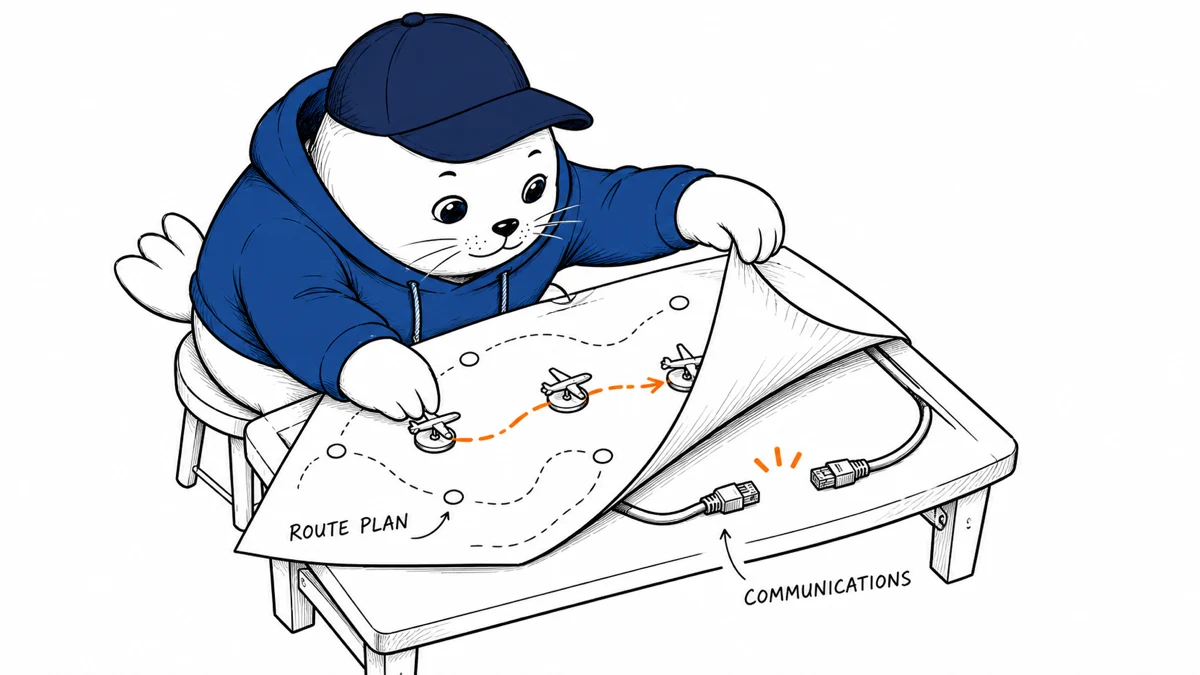
The agency’s November 10 announcement describes a scheduling tool with human review. The November 13 outage notices describe trouble with air traffic communications.
The Federal Aviation Administration announced on November 10 that it would use its Strategic Management of Airspace, Routes and Trajectories system, known as SMART, in the airspace of all 22 U.S. en route centers. Three days later, the FAA issued a nationwide ground stop after communications problems affected multiple centers. The timing raises a reasonable question about the rollout. The public agency records do not identify SMART as a cause.
What SMART does during normal operations
The FAA describes SMART as a cloud-based system that brings about 200 data streams into one place. Those inputs include weather, routes, traffic flow, and staffing. A team in Washington validates the data and sends scheduling recommendations to the FAA’s Command Center in Warrenton, Virginia. The Command Center passes those recommendations to the facilities, where local leaders decide whether to use them.
That chain is described in the September launch announcement and the November expansion notice. The FAA reported that SMART had helped reroute 180 flights since the regional rollout and that those flights saved an average of 10 minutes each. That average describes the rerouted flights in the early rollout. It gives no estimate for passengers on the average U.S. flight.
How to read the ground-stop timeline
| FAA record | Time in the source | What it establishes |
|---|---|---|
| Command Center advisory 111 | Nov. 13, 20:54 UTC signature | The Command Center ordered departing traffic to remain on the ground. It handled inbound international flights on a case-by-case basis. |
| Command Center advisory 120 | Nov. 13 | The stop remained in effect, and the advisory listed a communications failure. |
| Command Center advisory 005 | Nov. 14, 01:19 UTC signature | The Command Center announced the cancellation. |
The first and last signatures are four hours and 25 minutes apart. Both fall on Friday in U.S. Eastern time: 3:54 p.m. and 8:19 p.m. The interval measures the gap between those two notices. It does not measure how long an airport took to clear its backlog or how long any particular flight was delayed.
What would connect the two events?
The Department of Transportation’s update described intermittent telecommunications outages affecting communications and radar. Associated Press reported that SMART’s developer, ASI, denied that its system or integration caused the ground stop. That is the developer’s account; the FAA’s initial statement said technicians were investigating.
A shared dependency could be one way the planning and communications systems are connected. To assess that possibility, incident investigators would need to identify the failed component and show how a SMART request, configuration change, or shared service reached it. They would also need to explain why multiple centers were affected. The rollout announcement and ground-stop notices describe different parts of the system and do not provide that chain.

Abdessalam Alaoui
I'm Abdessalam Alaoui, founder of Musthave.AI. I write practical guides to AI models, tools, generative media.