
An AI search answer says revenue grew because of renewals. The useful follow-up is no longer only “which documents were retrieved?” It is “which chunks did the model use for this answer?”
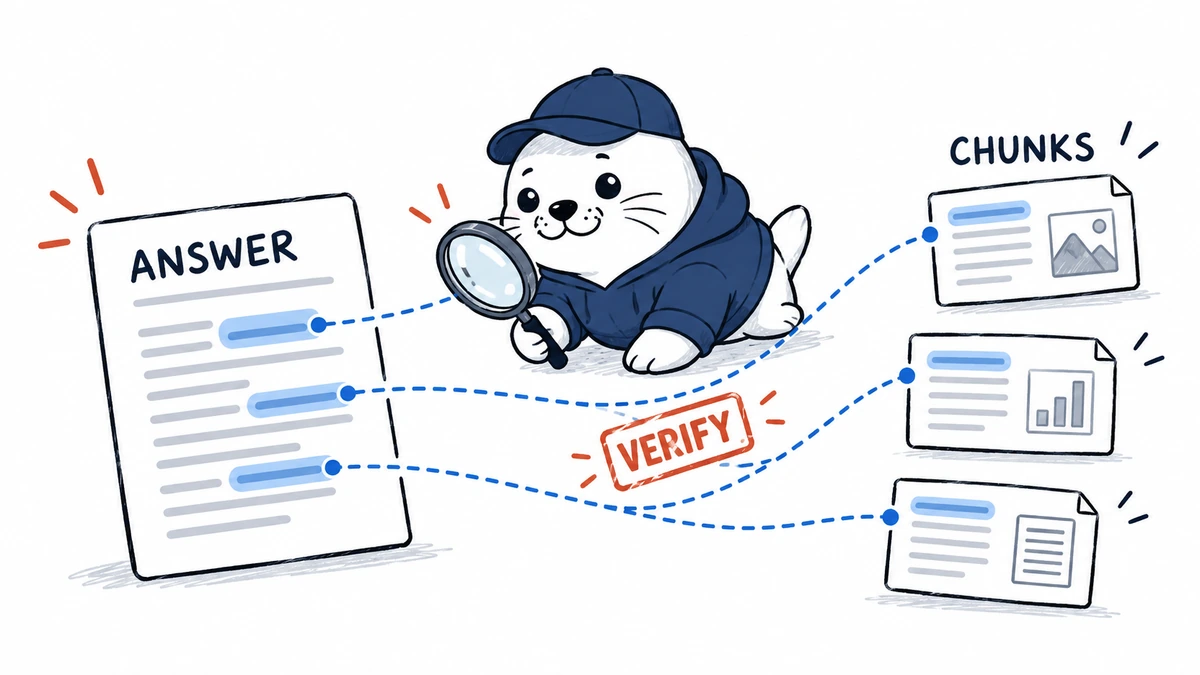
Databricks added a beta chunk-citation option to its ai_search function on September 8, 2026. When generate_citations is enabled, the result can identify the retrieved chunks used to support each generated answer.
The new evidence path
The feature adds a useful middle layer between retrieval logs and a polished response:
- The search system retrieves candidate chunks.
- The model generates an answer from some of that context.
- Citation data indicates which retrieved chunks supported the answer.
- A reviewer can inspect those chunks against the answer’s individual claims.
Without that link, a team may know which documents entered the retrieval stage but not which passages shaped the generated statement. Chunk-level support narrows the investigation.
What a citation proves
| A citation can help show | A citation does not prove |
|---|---|
| The answer was linked to a retrieved passage | The passage is factually correct or current |
| Which chunk a reviewer should inspect first | Every answer claim is supported |
| Whether retrieval reached an expected source | The model interpreted the passage correctly |
| Whether two answers rely on different evidence | The best available source was retrieved |
This distinction matters. Citation presence is an observability signal. Citation correctness is a separate evaluation.
Use claim-level checks, not a citation-count score
A response with five citations can still contain an unsupported sentence. Break each answer into verifiable claims, then ask whether at least one cited chunk entails each claim. Also flag citations that are topically related but do not actually support the wording.
- Entailment: does the chunk justify the specific claim?
- Coverage: does every material claim have support?
- Freshness: is the cited source current enough for the question?
- Authority: is the passage from the right owner or record?
- Conflict: did retrieval omit a source that contradicts the answer?
A small evaluation set reveals more than a large demo
Create 25 to 50 questions with known source passages. Include easy lookups, multi-document comparisons, dates, negation, conflicting records and questions that should return “not enough evidence.” Save the expected chunks and material claims.
For each answer, score retrieval recall, citation precision, claim coverage and unsupported-claim rate. This separates four failure modes that otherwise look alike: the right chunk was never retrieved, the right chunk was retrieved but unused, the citation points to the wrong chunk, or the answer adds a claim beyond the evidence.
Where chunk citations improve operations
Support teams can send a questionable answer directly to the relevant passage. Data owners can see which stale document is influencing responses. Developers can compare retrieval changes without reading every candidate chunk. Auditors can sample answer-to-source paths instead of treating the generated output as an opaque endpoint.
That same evidence-first approach is central to our data-agent permissions guide. Knowing what an agent may read is the first control; knowing what it actually used is the next. The OpenAI Agents API evaluation guide offers a related pattern for keeping tool traces and task results together.
A practical rollout rule
Expose citations to the reviewer, but keep correctness gates tied to verified claims and trusted sources.
Start with internal users and questions where the evidence can be checked. Log citation payloads beside the answer and retrieval configuration. When a bad answer appears, preserve the exact chunks and model settings so the team can reproduce the path rather than debug from a screenshot.
Why the beta matters
Chunk citations do not solve retrieval-augmented generation. They make one hidden relationship inspectable: the connection between the answer and the context used to support it. That is enough to improve debugging, evaluation and review, provided teams resist turning a visible citation into an automatic truth badge.
Primary source
Checked September 13, 2026. Feature availability and option naming are attributed to Databricks. The feature is labeled Beta.