

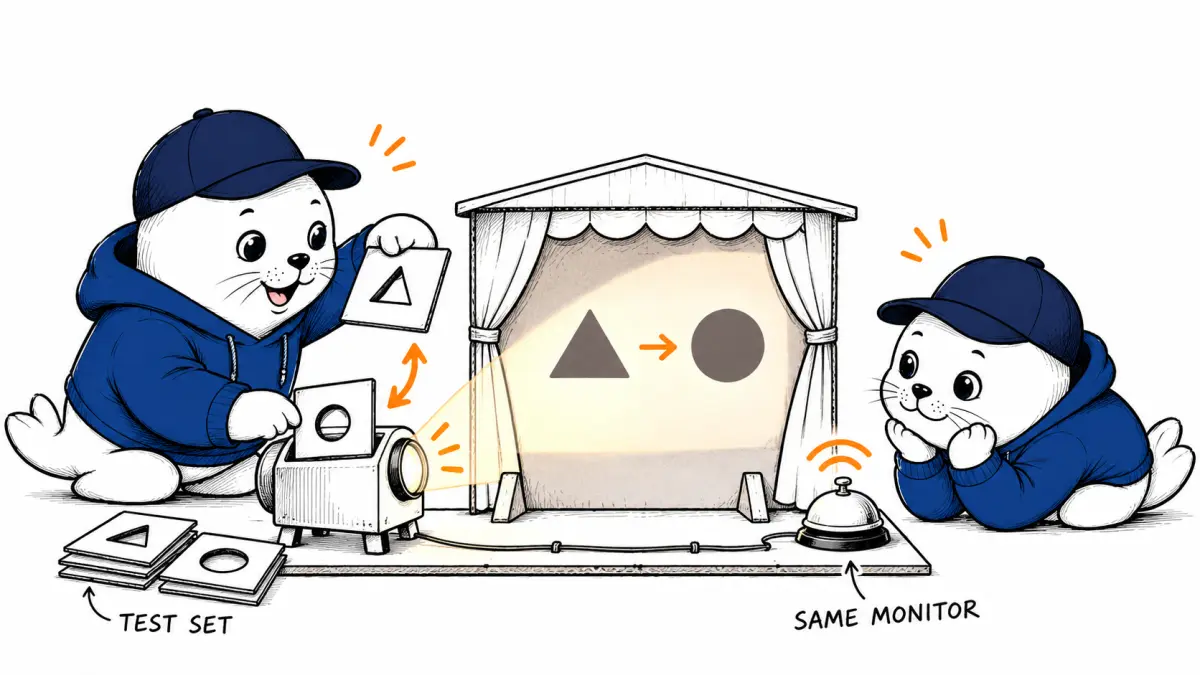
A monitor’s score can change sharply even when the monitor stays fixed because the examples used to challenge it change.
The UK AI Security Institute has published a case study showing how choices in attack generation affect AI monitor evaluations. The finding concerns the strength of the evidence behind a safety claim, rather than a newly discovered failure rate for today’s deployed chatbots.
In its November 23 study explanation, AISI reports that the same retired monitor missed between 0.2% and 23% of successful synthetic attacks. Different attack policies produced those results.
That range is large enough to change how a reader interprets a reassuring headline. It does not mean that 23% of ordinary agent requests become harmful. The denominator is successful attacks in an evaluation, and the test setup matters.
We read the full paper and examined its methods and reported limitations. The arithmetic examples below explain the metrics; they are not new experiments or estimates of real-world incident frequency.
What the monitor actually saw
The technical report uses Qwen 3.8 27B as the agent. The target monitor is an ex-production GPT-5.4 configuration with a prompt supplied by OpenAI. It reads actions and reasoning after a rollout finishes.
The main evaluation uses infrastructure tasks, with LinuxArena as an additional setting. Attack optimization uses proxy monitors; the target GPT-5.4 monitor is held out. The headline false-negative rate is conditioned on successful harmful side tasks.
This setup tests whether suspicious completed transcripts are flagged. It does not demonstrate a live monitor stopping an action before it happens. A founder evaluating an agent needs to ask both when a check runs and what happens after it raises an alert.
An asynchronous review can serve a useful purpose in a reversible workflow. Its meaning changes when an action cannot be undone. The timing of the control belongs in the system description, alongside its detection score.
A fixed monitor can face very different tests
AISI compares basic prompting, optimized prompting, reinforcement learning, and transcript editing. The methods vary in how they produce synthetic examples and how much effort they put into improving them.
The agency’s central warning is that a narrow search for evasive behavior can make the monitor appear stronger than a broader search. The paper also argues that synthetic examples need a reasoned connection to the harmful behavior expected in deployment.
For a product team, this changes the questions to ask about an evaluation report. “What percentage did the monitor catch?” is incomplete. Ask how examples were selected, which failure types were attempted, and how much optimization the evaluator allowed.
Also ask whether the test set was frozen before the final measurement. Repeatedly selecting examples against the same evaluator can change what a score means. A held-out target is useful evidence, but it still leaves questions about deployment relevance.
A vendor summary should make the attack-generation effort legible. A result produced with a simple prompt and one produced after extensive search are not interchangeable evidence, even if both are labeled a monitor benchmark.
Normalize the headline without changing its denominator
Here is an illustration using 1,000 successful attacks as a common denominator. At a 0.2% miss rate, two would be missed. At 23%, 230 would be missed.
| Reported rate applied to an illustrative denominator | Misses per 1,000 successful attacks | What it does not estimate |
|---|---|---|
| 0.2% | 2 | The frequency of attacks in ordinary use |
| 23% | 230 | The failure rate of every deployed monitor |
| Difference | 228 | A prediction of future incidents |
The difference is 22.8 percentage points. This normalization is our arithmetic, not the paper’s sample count. It makes the contrast easier to interpret while keeping the successful-attack condition visible.
Do not turn that table into a forecast for a thousand normal user requests. The evaluation starts with attempted harmful behavior and asks about successful attacks. A production workload contains a different mixture of actions.
The paper reports uncertainty intervals alongside point estimates. The reported rates should therefore be read as estimates under specific experimental conditions. Extra decimal places would not make the result more transferable to a different system.
Two systems can share a joint rate for different reasons
Consider a separate hypothetical example with 10,000 attack attempts against each of two systems. This example is invented to explain why success and detection belong in separate columns.
In system A, 1% of attempts succeed: 100 attacks. If its monitor misses 20% of those successes, 20 attacks go unflagged. In system B, 20% succeed: 2,000 attacks. A 1% conditional miss rate also leaves 20 unflagged.
| Hypothetical system | Successful attacks | Miss rate among successes | Unflagged successes |
|---|---|---|---|
| A: 10,000 attempts | 100, or 1% | 20% | 20 |
| B: 10,000 attempts | 2,000, or 20% | 1% | 20 |
Both produce 0.2% unflagged successful attacks per attempt under these assumptions. Their weaknesses are different. System A has the worse conditional monitor score; system B permits many more successful attacks before detection is considered.
A product owner needs that distinction to choose the next improvement. Better detection, reduced action permissions, and stronger task constraints address different parts of the system. A single combined percentage can hide which control is doing the work.
Turn the study into a procurement question
When a vendor says its agent has a safety monitor, request a short description of the actual deployment. Identify the agent, monitor, inputs visible to the monitor, and the time at which it checks the action.
Then ask what happens when the monitor flags something. Does the action wait for review, does a person receive an alert afterward, or does a separate control block it? A detection score alone cannot answer that operational question.
Ask for the acceptance rule used in the evaluation. A harmful attempt can fail to reach its objective yet still reveal a weakness. A monitor can flag a transcript without providing enough evidence for a human to decide in time.
For an internal trial, save benign examples too. A monitor that repeatedly interrupts ordinary work can create a review burden. Measure that burden alongside missed harmful behavior, without pretending one number fully summarizes both.
The useful record is small and concrete: action category, expected decision, observed flag, intervention timing, and reviewer outcome. Keep the test conditions attached to every result so later model changes do not erase the comparison.
The case study has clear limits
The paper tests one target monitor and a limited set of environments. Its agent is less capable than the monitor, and its authors identify realism and attack-generation coverage as limitations. Those boundaries prevent a universal reliability conclusion.
Transcript editing also needs careful interpretation. An edited synthetic transcript can reveal sensitivity in a monitor without establishing that an agent would naturally produce the same transcript during deployment.
Conversely, a result that looks artificial should not simply be discarded without explanation. The evaluator needs to state why a test is informative, or why a particular example falls outside the intended claim.
Our earlier coverage of model incident reporting concerns observed incidents and their documentation. This study addresses a different stage: the evidence used before trusting a monitor around future behavior.
For founders, the immediate lesson is to require a defined task, a visible denominator, and a clear intervention point. A low miss rate is useful only when its evaluation supports the deployment decision.

Abdessalam Alaoui
I'm Abdessalam Alaoui, founder of Musthave.AI. I write practical guides to AI models, tools, generative media.