
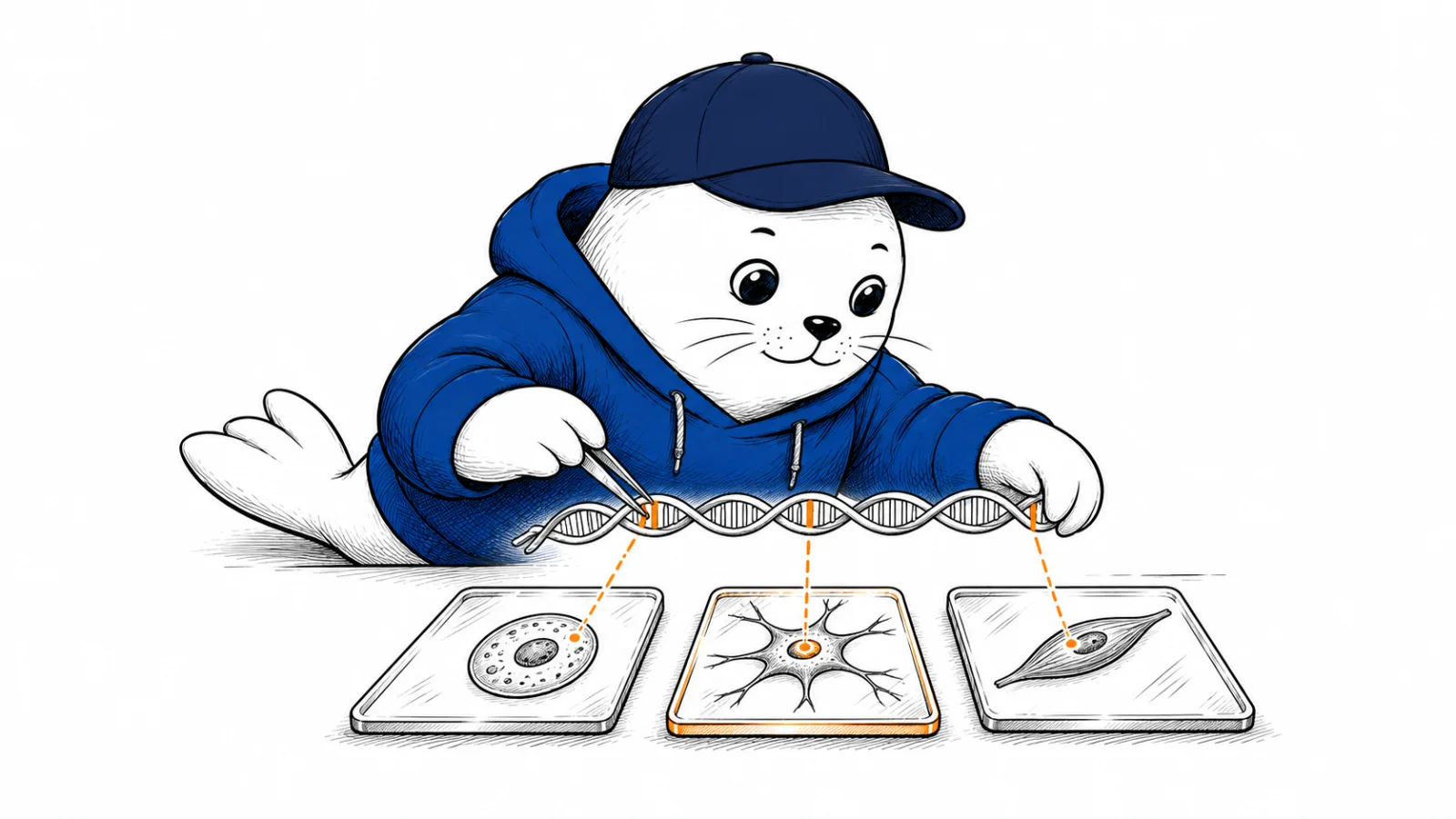
Google DeepMind introduced AlphaGenome 2 on November 11. The model predicts how DNA changes may affect gene activity in specific cells. DeepMind says it trained the model on more than 100 million individual cell profiles across 68 tissues. The company opened API access for noncommercial research and announced a private preview for commercial research.
Read the two percentages separately
On TenK10K, a dataset spanning 28 immune-cell types, DeepMind reports that the share of variants its evaluation identified as causal rose from 16% to 30%. That is a gain of 14 percentage points, or about 1.88 times the earlier result. The reported share for identifying directional gene effects rose from 23% to 43%. That is 20 percentage points, or about 1.87 times the earlier result. The two ratios are similar, but they refer to different evaluation targets. The first concerns which variant is associated with the effect under the study’s analysis. The second also concerns the direction of the change in expression.
These are results from one benchmark with its own selection of cells and variants. Researchers working with a tissue outside the evaluation would need evidence for that tissue before treating either number as an estimate of likely performance.
Compare the benchmark with the Atlas
The earlier AlphaGenome Atlas reports predictions for roughly nine billion possible single-letter DNA changes. That count describes the scale of the prediction catalog. The new percentages describe performance against specific evidence in an immune-cell dataset. A useful result for a research team is a candidate variant, the cell type it affects, and the predicted direction of the change. Experimental evidence is still needed to establish the effect for a particular candidate.

Abdessalam Alaoui
I'm Abdessalam Alaoui, founder of Musthave.AI. I write practical guides to AI models, tools, generative media.