

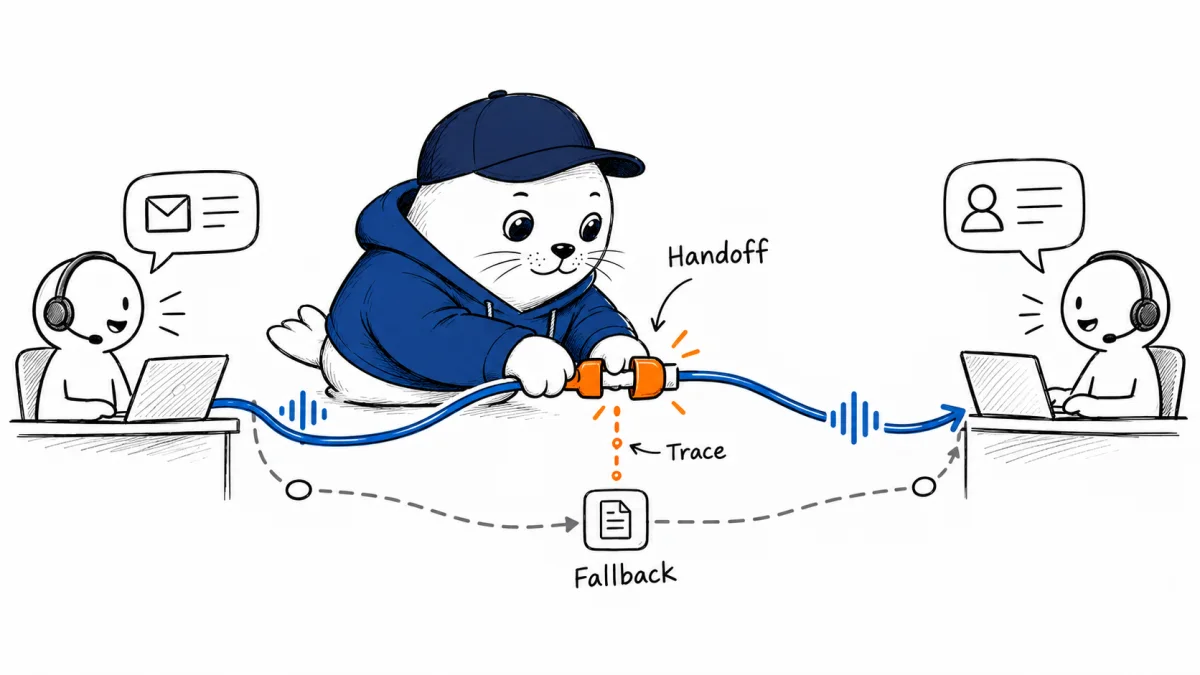
A customer calls about a delayed order. The first AI agent can handle the conversation, but a specialist makes the delivery decision. Amazon Connect Customer’s new agent-to-agent collaboration lets the first agent ask another AI agent to do the work or hand over the customer conversation, without building an unrelated voice stack for every specialist.
What Amazon Connect Customer A2A changes
AWS’s administrator guide says a Connect Customer AI agent can collaborate during a live contact with another agent in the same Connect instance, an agent hosted on Amazon Bedrock AgentCore, or a third-party external agent. It uses the Agent-to-Agent protocol with AWS extensions for voice streaming, continuity, and observability. The important distinction is that a contact-center conversation can keep a primary agent while invoking specialized agents as needed.
Two handoff patterns, two customer experiences
In the first pattern, the primary agent stays with the caller. It sends a text request to a collaborator, receives a result, and uses it in its response. The Customer never talks directly to the specialist. In the second pattern, the collaborator takes over the customer conversation for a defined task and then returns control. That is a real conversation handoff, not just a tool result. AWS documents both patterns for voice and chat contacts.
For voice, teams have another choice. Connect Customer can convert speech to text, stream the text to the collaborator, and speak the text response, allowing a text-only specialist to participate. Or it can pass bidirectional audio to a collaborator with its own voice system. The first path simplifies voice plumbing; the second offers more direct control but raises integration and latency questions that teams must test themselves.
Context, traces, and fallback are part of the design.
Connect Customer establishes the session, passes conversation context, and collects collaboration traces. External agents must return required trace data; AWS says it can disable an endpoint that fails to do so for new contacts. Teams also configure a fallback path for a collaborator that times out or errors. These are not decorative features. In a customer-support setting, a missing trace can make an incorrect answer difficult to reconstruct, and a missing fallback can leave a caller stranded.
A useful pilot should record three measurements for each specialist: time to first response, successful return to the primary agent, and what the Customer hears on failure. Add permission and data-minimization checks before passing full conversation context to an outside endpoint. Our earlier report on Bedrock knowledge connectors covers another part of the support stack: keeping reference material synchronized. Collaboration does not replace source-data quality.
Who can use it, and how it is configured
There are two immediate gates. The instance must be on the Connect Customer tier, not Customer Basic, and the collaborator must implement A2A with the Connect extensions. AWS describes this as an API-only feature, with no console setup screen. Administrators configure collaborators through the QConnect CreateAIAgent and UpdateAIAgent operations, then publish a deployable version with CreateAIAgentVersion. Check account-specific feature access and regional documentation before promising a deployment date.
A sensible first production test
- Start with a narrow, reversible task such as looking up order status rather than authorizing a refund.
- Keep the primary agent in the conversation for the first test, so the collaborator only returns an action result.
- Confirm consent, authorization, and data access before sending context to a third party.
- Force timeouts and malformed responses to verify the fallback path, including what the caller hears.
- Inspect traces across both agents and review the cost per completed contact, not just cost per invocation.
These are editorial testing recommendations, not AWS guarantees. The contact-center team remains the final control point: specify which agent can speak, which one can act, and who owns recovery when a task fails. A cost guardrail such as the one outlined in our AI agent spend-cap guide is useful when one customer request can trigger several specialist calls.
What this announcement does not prove
A2A support is an integration capability, not proof that a multi-agent call will be faster, cheaper, or more accurate than a well-designed single agent. AWS’s documentation establishes the supported paths and operational requirements; it does not supply a universal latency or resolution-rate benchmark for every external collaborator. Those outcomes depend on the connected agent, workflow, and contact volume. Teams should pilot one measurable handoff before redesigning the whole voice journey.