Google and the International Telecommunication Union have committed 100,000 online certificate scholarships, but access begins with participating governments rather than individual applications.
Who can actually apply
The Google ITU 100000 scholarships program runs through the Giga Learning Hub and the AI for Good Skills Coalition. Countries engaged with Giga, or countries that have expressed interest in it, can submit an Expression of Interest through their designated focal point.
Individual students cannot use the government application form as a direct scholarship application. Selected governments will identify priority groups, organize outreach and choose participants according to their national digital-skills plans.
What the scholarships cover
The opportunity includes Google online learning in artificial intelligence, data analytics, cybersecurity, information technology, project management, digital marketing and user-experience design. Countries may prioritize public employees, educators, students, job seekers, entrepreneurs or other groups.
The courses lead to industry-recognized certificates. The announcement calls the credentials free for learners, while country delivery and participant support remain important implementation responsibilities.
The allocation model rewards completion
| Stage | Published rule | What to watch |
|---|---|---|
| Initial country allocation | Up to 10,000 scholarships for an initial six-month utilization period | Final amounts depend on equity, readiness, demand and anticipated impact |
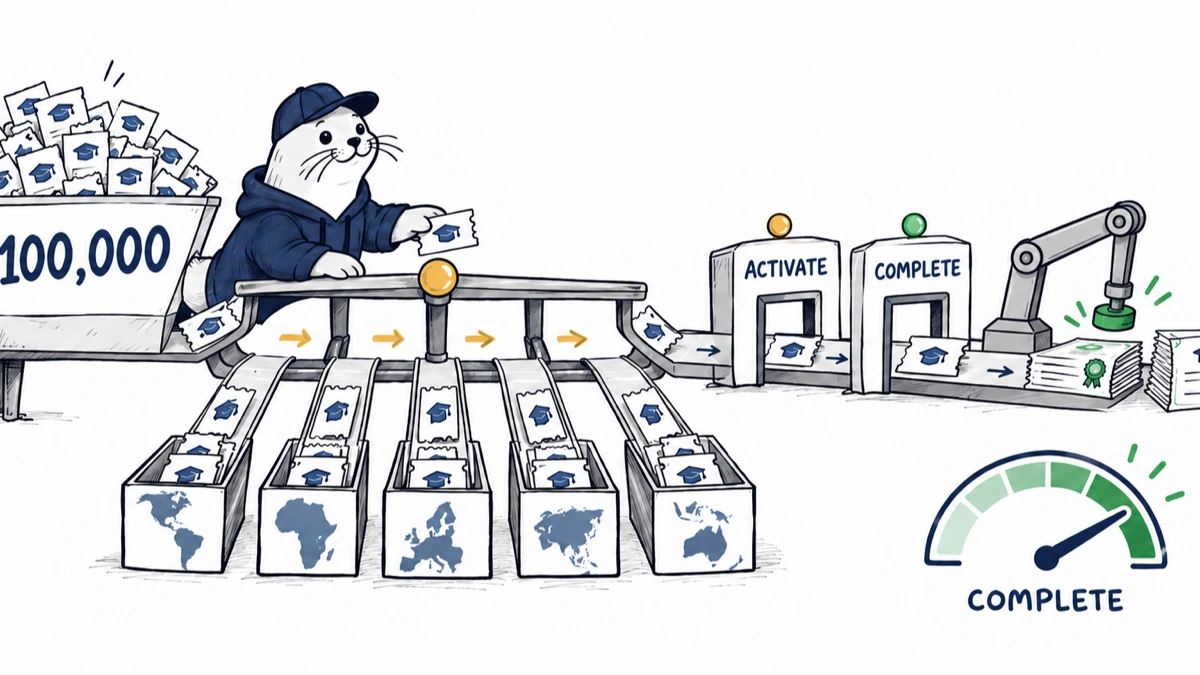
| Additional allocation | Available when enrollment, utilization and completion exceed 70 percent | High registration alone is insufficient |
| Country selection | Applications evaluated after the October 21 deadline | A request does not guarantee the amount requested |
| Program measurement | Activation, participation, completion, certificates and reported skill use | Outcome quality depends on transparent country reporting |
The published application timeline
- Government Expressions of Interest: September 21 to October 21, 2026.
- Evaluation: October 22 to October 27, 2026.
- Selected governments announced: October 28, 2026.
- Government induction: November 5, 2026.
- Training start listed for November 18, with implementation continuing into 2027.
- Preliminary results planned for the June 2027 AI for Good Summit.
The ITU page contains an apparent year inconsistency in one training-date line. MustHave.ai is not reproducing the incorrect year as a confirmed program end date; applicants should rely on direct ITU communication for scheduling.
Country responsibilities will decide the outcome
Governments are expected to select beneficiaries transparently, support participation, monitor progress and report outcomes. Those responsibilities matter because online scholarship programs often lose learners between activation and completion. Internet access, language, study time and mentoring can be more limiting than the course fee.
A strong national plan should publish selection criteria, accessibility support, certificate choices, completion targets and a way for applicants to challenge exclusion.
How success should be reported
- Report scholarships allocated, activated and completed as separate counts.
- Break participation down by country, region and priority group.
- Publish course-level completion rather than one blended percentage.
- Track whether graduates use the skills in work, education or public service.
- Measure employment or role changes without claiming every outcome was caused by the certificate.
- Record unused allocations and the reasons learners disengaged.
How this differs from a general AI-literacy campaign
The program connects certificates to national workforce goals and uses utilization thresholds to expand allocation. That makes it more operational than a pledge to make training available. It also places significant power with country focal points, so transparency and equitable selection are central.
MustHave.ai’s AI education coverage shows why access programs need clear eligibility and outcome measures. The Maroc IA 2030 scorecard offers a model for separating trained, certified and employed participants.
The practical verdict
The 100,000-scholarship commitment is real, but it is a country-mediated capacity program rather than a public global coupon. Its most promising design choice is linking further allocations to actual utilization and completion. The next evidence should show which countries are selected, how learners are chosen and how many finish and apply the skills.
Applicants should watch national digital agencies and the ITU Academy rather than assuming Google will publish one worldwide application form. Country administrators, meanwhile, should publish selection dates, eligibility rules, language availability and waiting-list procedures. A simple dashboard should separate allocated, activated, enrolled and completed places, because each stage answers a different policy question and prevents unused scholarships from being presented as trained people.
The outcome measure that matters most comes after the certificate. Participating countries can track whether learners enter further training, obtain interviews, change roles or use the skill in public-service projects. Those measures are harder than counting registrations, but they reveal whether the program expands opportunity or merely distributes access codes.
Primary sources
- ITU: Digit’all announcement
- ITU Academy: Giga Learning Hub scholarship details
- Google: ITU AI Skills Coalition partnership
Checked September 23, 2026. Scholarship availability depends on country selection and national implementation. One timeline line on the ITU page contains an apparent year inconsistency.