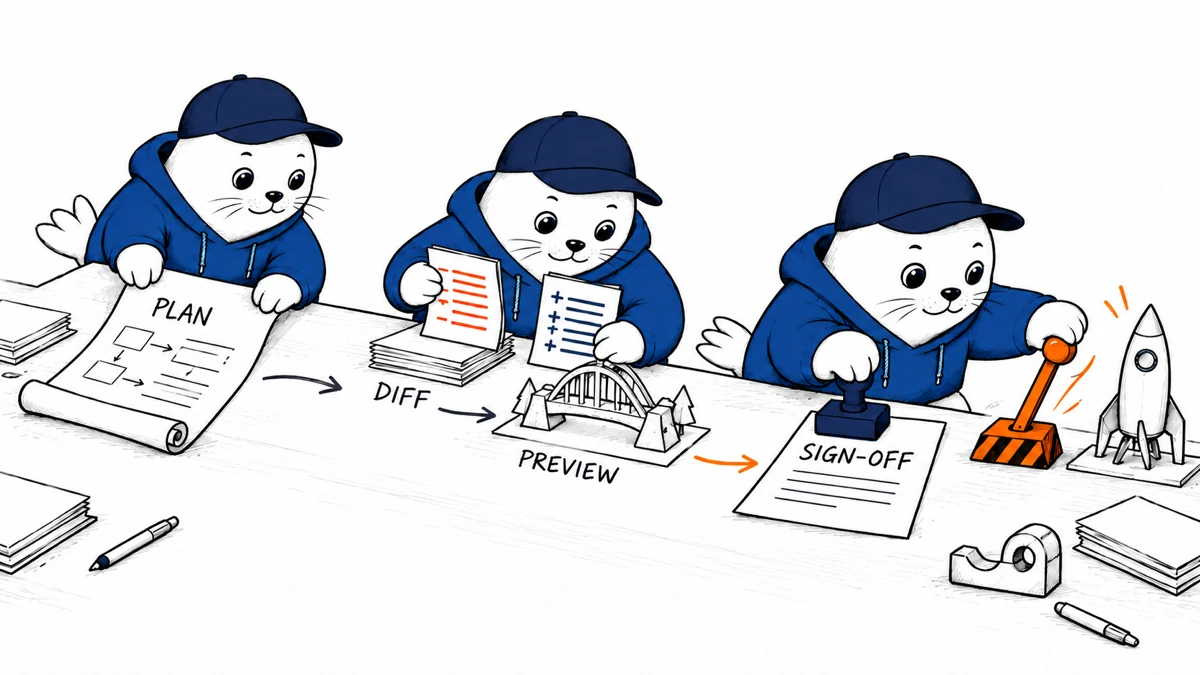
Slack Code moves the coding agent from a private tab into a shared channel where the team can inspect the plan, diff and preview before approving production work.
Slack Code is now available as part of Slack’s September 2026 agentic-work updates. A dedicated code channel brings people and AI agents into the same conversation, with the plan, code diff and working preview visible to the team. Slack says high-stakes steps such as pushing to production are packaged for a teammate’s sign-off.
What changes when the agent works in public
A private coding-agent session hides decisions until a pull request appears. Slack Code exposes the work earlier. A product manager can report a bug, an agent can propose a repair, and an engineer can review the resulting change inside the same channel. The value is not chat alone. It is the shared sequence of intent, plan, artifact and approval.
- A person states the problem and the acceptance condition.
- The agent posts a plan before changing code.
- The team sees the proposed diff and working preview.
- A reviewer challenges assumptions or asks for another test.
- The agent packages high-stakes work for sign-off.
- An authorized teammate approves or rejects the release step.
The sign-off boundary is the feature to test first
Slack’s announcement describes teammate sign-off for high-stakes actions. Teams should test what that boundary means in their own workspace. Does the agent stop before merging, deploying, changing a database or sending a customer message? Can a channel guest approve? Is the approval tied to a specific diff, or can the artifact change afterward?
| Control | Test question | Evidence to retain |
|---|---|---|
| Identity | Who requested and approved the work? | User IDs and timestamps |
| Artifact binding | Did approval cover this exact diff? | Commit or artifact hash |
| Environment | Where can the agent act? | Repository, branch and deployment target |
| Revocation | Can access be removed immediately? | Permission change and failed retry |
| Audit | Can investigators reconstruct the sequence? | Plan, tool calls, preview and decision |
Which agents can appear in a code channel
Slack names agents from Anthropic, Cognition, GitHub, Vercel and OpenAI among the systems that can work in these channels. It also lists new agents from Cedar, CodeRabbit, Datadog, Factory, Lovable, Mistral, NanoClaw, Replit, Rhythms and Snowflake. That breadth creates a second governance problem: a channel is shared, but each agent can have different scopes, retention rules and billing.
Start with one repository and one reversible task. Give the agent read access first, then add a narrow write path. Our Claude Code permissions guide shows why cross-session communication still needs explicit authority. The same principle applies when the shared surface is Slack.
Availability is split across four product states
| Feature | Slack’s stated status | Deployment note |
|---|---|---|
| Slack Code | Available now | Plan and license can still affect access |
| Slackbot in Channels | Early pilot | Not a general rollout |
| Big Mode | Available now | Full-screen research and file workspace |
| Slackforce Surfaces | Available now | Built under existing data permissions |
| Two-way voice and video generation | Coming later in 2026 | Future capability, not current availability |
| Slack Frontline | Preview | General availability is planned later |
Slack also says some features may not appear immediately because of rollout timing, Slack plan requirements or additional licenses. Slackbot is included in Business+ and Enterprise+ plans, while some Salesforce access can use Flex Credits. Administrators should verify the exact entitlement instead of treating “available now” as universal availability.
Slackbot in Channels changes the context boundary
Slack says Slackbot is powered by Claude and grounded in public channels the user can access. When it joins a channel, its answer becomes shared material that others can extend. That can spread good prompting patterns, but it can also spread a mistaken answer faster. Channel membership, connected data and the difference between public and private content should be part of the pilot checklist.
The broader risk resembles browser and MCP agents: a convenient conversational surface can hide a powerful action boundary. Our WebMCP permission-boundary guide provides a useful model for separating observation, preparation and consequential action.
A safe 30-day pilot
- Week 1: one read-only repository, one small team, no production credentials.
- Week 2: allow branch creation and tests, but keep merge and deploy manual.
- Week 3: test preview generation, permission revocation and failed approvals.
- Week 4: compare cycle time, review findings and escaped defects with the previous workflow.
Do not measure only how much faster an agent creates a patch. Measure whether the shared channel helps the right people catch a bad assumption before it reaches production. If the sign-off record is vague or the approved artifact can change, the collaboration surface is not yet a control.
Primary source
Checked September 21, 2026. User counts and availability descriptions are Slack-reported.