
Claude Code has made two small-looking changes with large operational consequences: it can now inherit a portable project-instruction file, and the safety classifier behind auto mode may run in a different place with a different billing result.
Claude Code AGENTS.md support arrived in version 2.1.277 on September 18, 2026. Version 2.1.278 followed on September 19 with a server-side auto-mode classifier for eligible sessions. The first change can reduce duplicated repository guidance. The second can remove classifier overhead from the bill, but only when the session actually uses the server path.
Two releases changed two different boundaries
| Version | Published change | Boundary to remember |
|---|---|---|
| 2.1.277 | Reads AGENTS.md when a project has no CLAUDE.md. | This is fallback precedence, not an automatic merge of both files. |
| 2.1.278 | Defaults eligible sessions to the server-side auto-mode classifier. | Unsupported routes can fall back to separately billed classifier requests. |
Anthropic also added an Auto mode server row to /status. That row is the fastest way to distinguish the intended server path from a local fallback during a real session.
The AGENTS.md rule is simpler than a merge
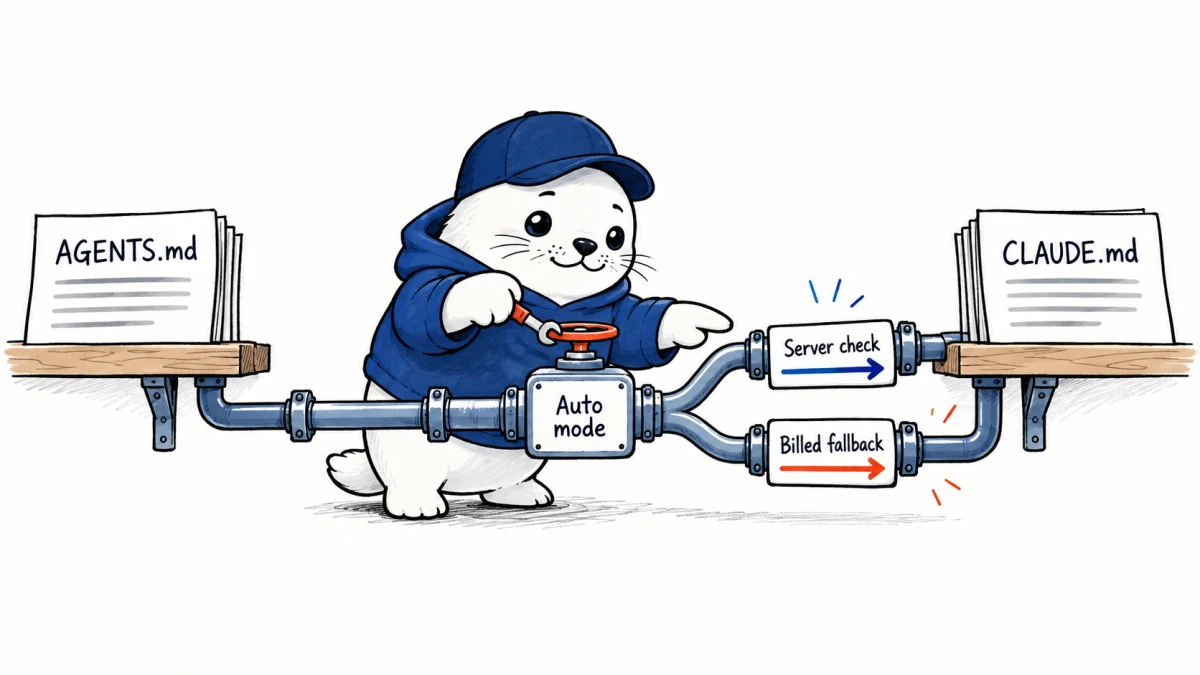
The precedence is explicit: if CLAUDE.md exists, Claude Code uses it as the project instruction file. If it does not exist, Claude Code can read AGENTS.md instead. A team should not assume that both files are combined or that conflicting instructions are resolved automatically.
| Repository state | Claude Code behavior in 2.1.277 | Migration implication |
|---|---|---|
| Only CLAUDE.md | Uses CLAUDE.md. | No change is required. |
| Only AGENTS.md | Uses AGENTS.md on supported routes. | One portable instruction file can serve more than one agent. |
| Both files | CLAUDE.md takes precedence. | Keep shared rules synchronized or intentionally separate them. |
| Neither file | No repository instruction file is inherited through this feature. | The agent relies on other configured context. |
At release time, Anthropic said this fallback was not yet available on Amazon Bedrock, Google Vertex AI or Microsoft Foundry. That provider limitation matters if a company tests against the direct API and deploys through a cloud marketplace route.
A safe one-file migration test
- Copy only stable repository rules into
AGENTS.md: build commands, test commands, generated-file boundaries and review requirements. - Move agent-specific shortcuts or unsupported syntax out of the shared file.
- Temporarily rename
CLAUDE.mdin a disposable branch. - Start Claude Code 2.1.277 or later and inspect the project-instruction setting in
/config. - Ask the agent to state the build and test commands before it edits anything.
- Run the same bounded task in Codex and compare instructions followed, files changed and tests executed.
- Restore
CLAUDE.mdif the shared file cannot express a necessary Claude-specific rule.
Our Codex versus Claude Code guide explains why a portable instruction file does not make the two agent harnesses identical. Tool permissions, skills, plugins, models and execution environments still differ.
Auto mode safety and auto mode billing are separate questions
Auto mode evaluates whether a tool call can proceed automatically. In version 2.1.278, supported Claude API and Enterprise sessions, plus eligible Bedrock, Vertex, Foundry and gateway routes, default to a classifier that runs on Anthropic’s server path. Anthropic says those server checks do not create a separate classifier charge.
If that route is unsupported, the safety workflow does not simply disappear. Claude Code can fall back to the earlier classifier-request path, and those fallback requests are billed as before. The application warns when this happens.
| Observed status | Who runs the classifier | Billing interpretation |
|---|---|---|
| Server enabled | Server-side classifier | No separate classifier overhead according to Anthropic. |
| Billed fallback warning | Claude Code classifier requests | Classifier calls are billed as before. |
| Opted out on a supported cloud or gateway route | Fallback path | Expect the earlier billing behavior. |
Gateways can change the answer without changing the policy
A company gateway can accept ordinary model traffic while failing the server-classifier negotiation. Common causes include removed request fields, rewritten beta headers, unsupported streaming keys or a provider path that has not implemented the capability. That is why a successful completion is not proof that the unbilled classifier path was used.
- Upgrade Claude Code on the client that starts the session.
- Run
/statusand record the auto-mode server row. - Check for a billed fallback warning before comparing costs.
- Test direct API and gateway routes separately.
- Verify proxy allowlists preserve the fields required by the current release.
- Keep a small approval-sensitive task as a regression test after gateway changes.
The same boundary principle appears in our WebMCP permission-boundary guide: an agent’s safety claim must be tied to the component that actually evaluates and authorizes the action.
What teams should record in cost experiments
- Claude Code version and installation channel
- Direct API, Enterprise, Bedrock, Vertex, Foundry or named gateway route
- The
/statusauto-mode server result - Whether a billed fallback warning appeared
- Model input, output and cache usage
- The exact repository instruction file that was active
Without those fields, a before-and-after cost comparison can attribute savings to the model when the real change was classifier location. It can also blame auto mode for costs that came from longer prompts or a different cache state.
The practical verdict
Claude Code 2.1.277 makes AGENTS.md a useful portability layer, but only as a fallback when CLAUDE.md is absent and only on supported routes. Version 2.1.278 can remove separate classifier overhead from eligible auto-mode sessions. Teams should verify both changes in the session itself instead of inferring them from the presence of a file or a successful request.
Primary sources
Checked September 20, 2026. Provider coverage and billing behavior can change, so verify the current session with /status before relying on a cost assumption.