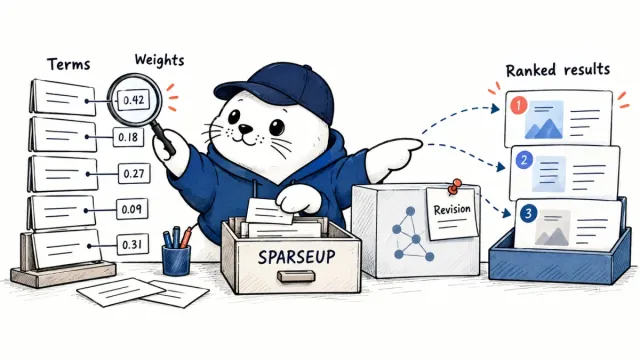
A visual document retriever does not need to read every page into Markdown before search. It needs to preserve the visual details that make the right page retrievable, without turning the index into an unaffordable pile of vectors.
Tencent EVIE is an open family for visual document retrieval. Tencent released a high-capacity 8B teacher and a 4.5B student with adjustable embedding width and training-free token compression. The code, weights, training pipeline and evaluation scripts are available under Apache 2.0.
EVIE searches page images rather than flattened text
Dense text embeddings usually reduce a document into one vector after text extraction. EVIE keeps multiple token-level representations of a page image and uses late interaction to compare query tokens with page tokens. That helps preserve tables, charts, typography and spatial layout.
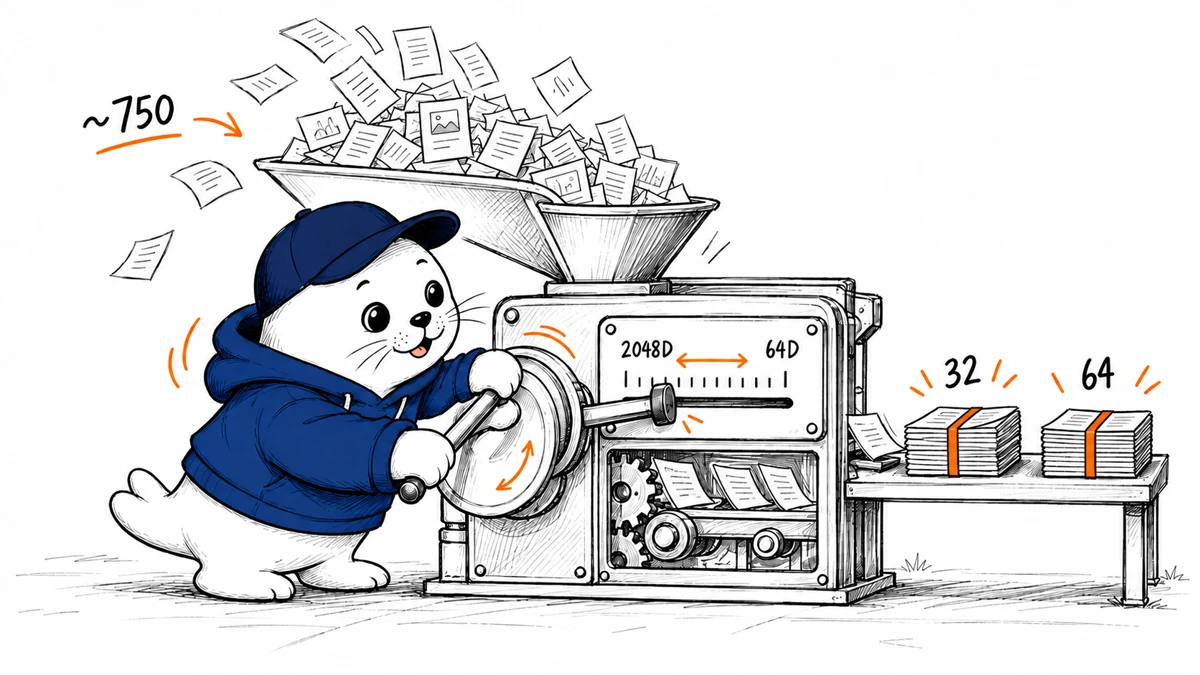
The tradeoff is index size. Hundreds of vectors per page can become expensive at millions of pages. EVIE’s 4.5B model addresses that with two separate controls: embedding-width truncation and token-count compression.
Two compression controls solve different problems
| Control | What changes | Published range | Risk to test |
|---|---|---|---|
| Prefix-MRL | Dimensions inside every token vector | 2048D down to 64D | Fine semantic distinctions can disappear at narrow widths. |
| HAC | Number of vectors stored for each page | Roughly 750 down to 32 or 64 | Small layout or typography evidence can be merged away. |
Because the controls attack different dimensions of storage, they can be combined. The smallest index is not automatically the best deployment. Teams should find the narrowest width and token count that preserve retrieval on their documents.
The 4.5B student is the practical centerpiece
- EVIE-8B: a 4096D teacher designed for maximum published accuracy and distillation.
- EVIE-4.5B: a smaller student with one 2048D projection that supports runtime truncation.
- HAC compression: a training-free clustering step that can reduce stored page tokens after encoding.
- Sentence Transformers support: a familiar interface for multi-vector document and query encoding.
The repository includes training and distillation scripts as well as a 138-task evaluation harness. That makes the release inspectable, but Tencent says the formal paper and full architectural ablations are still forthcoming.
What Tencent reports on ViDoRe
| Model | Published ViDoRe V3 nDCG@10 | Representation |
|---|---|---|
| EVIE-8B | 66.75 | 4096D token vectors |
| EVIE-4.5B | 66.02 | 64D to 2048D Prefix-MRL |
| EVIE-4.5B at 64D | 64.51 | Narrow runtime prefix |
These results are author-run and company-reported. Tencent also estimates that the most compressed published setting can reduce a one-million-page index to approximately 3.81 GiB. Reproduction should include the exact page budget, dtype, compression settings and benchmark version.
Build a storage-quality curve, not one benchmark point
- Create a representative set of queries and relevant pages.
- Encode once at full width and preserve the source embeddings.
- Evaluate 64D, 128D, 512D and 2048D prefixes.
- At each width, compare uncompressed, 64-vector and 32-vector page representations.
- Record nDCG, recall, index bytes, query latency and peak memory.
- Inspect misses by document type instead of relying only on the average.
A financial archive may need small table text that a slide-deck search system can safely compress. Multilingual collections should also be broken out by script and language because an average can hide a serious regional regression.
Retrieval and parsing belong in different stages
EVIE is designed to rank relevant pages. The new Tencent WeVisDoc parser reconstructs selected pages into Markdown, tables and equations. Combining the two can reduce total parsing cost: retrieve visually first, then parse only the pages needed for an answer.
The MustHave.ai AI GitHub repositories guide contains vector databases, evaluation libraries and serving tools that can support a reproducible retrieval pipeline.
The practical verdict
Tencent EVIE is interesting because it exposes the two resource controls visual retrieval teams actually need: how wide every token vector is and how many vectors each page keeps. The open code and weights make direct testing possible. Until independent reproductions and the formal paper arrive, the published leaderboard should be treated as a starting hypothesis, not a deployment guarantee.
Primary sources
Checked September 19, 2026. Retrieval scores and index-size estimates are reported by Tencent. The formal research paper was still forthcoming.