The cheapest API call is not always the cheapest usable image. Resolution, latency, retries and quality settings can move the real cost by far more than the public list price suggests.
OpenRouter image models produced a roughly 22-fold billed-cost spread in the platform’s new comparison. OpenRouter sent the same prompt through 20 models on September 11, 2026 and read the cost reported in each response’s usage data. Default-setting calls ranged from approximately $0.006 to $0.134.
The headline number is useful but incomplete
| Published observation | What it shows | What it does not show |
|---|---|---|
| 20 models tested | A cross-section of the platform’s image catalog. | Every available model or provider route. |
| One shared prompt | Better control than unrelated prompts. | Performance across portraits, products, text, edits or diagrams. |
| $0.006 to $0.134 | A large default-call billing spread. | Equal resolution, format, latency or usable quality. |
| 52 catalog models | The wider catalog was already larger than the test set. | That all 52 were available under identical conditions. |
| Usage cost field | The platform observed a billed total. | A permanent public list price for every route. |
GPT Image 2 illustrates the quality-setting problem
OpenRouter measured openai/gpt-image-2 at $0.00599 for the default low-quality example. The same model’s high-quality example cost $0.21083, about 35 times more. Prompt length also affected billing. The result is a warning against attaching one price to a model name without the request settings.
OpenRouter’s figures are platform-reported measurements from its own service. They are more concrete than a marketing price table, but they are not an independent quality study and can change with provider routing or pricing.
Use cost per accepted output
A useful comparison starts with a task-specific acceptance rule. For a product image, that might require correct geometry, readable label text, no extra objects and a minimum resolution. For an editorial illustration, it may require concept accuracy, brand consistency and clean cropping.
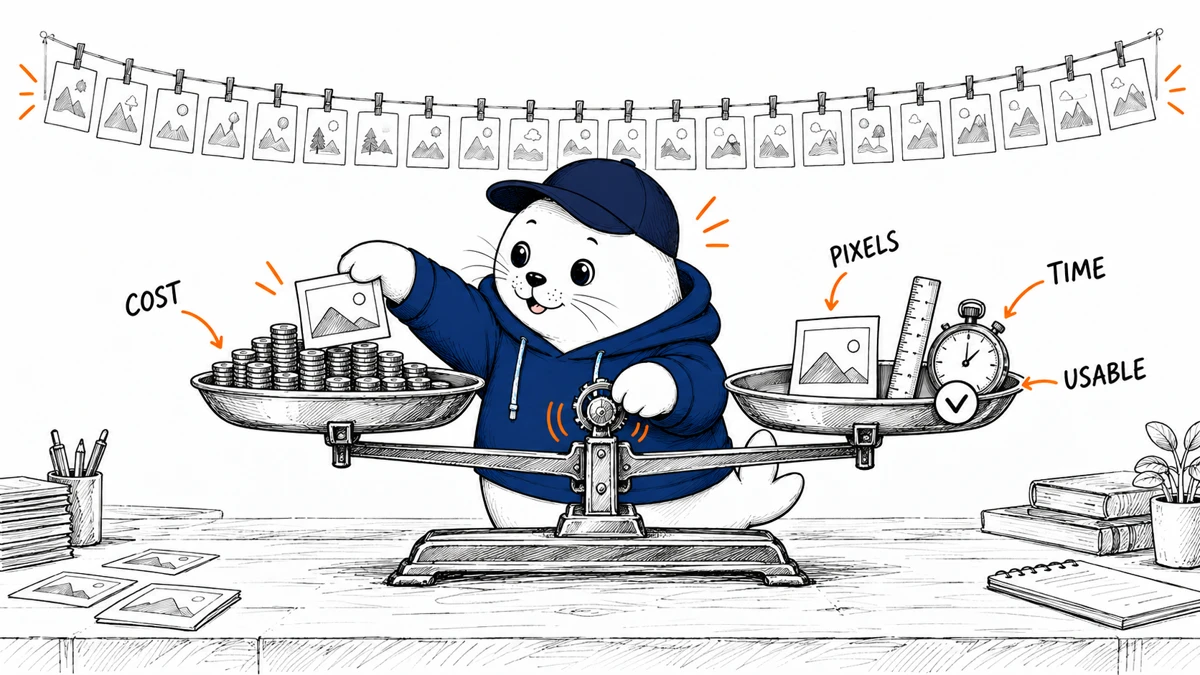
Effective cost per accepted image = total billed cost for all attempts / number of outputs that pass the acceptance rubric.
If a $0.01 model needs six attempts to produce one acceptable result, its effective cost is $0.06 before review time. A $0.04 model that passes on the first attempt can be cheaper in practice.
Normalize five variables before comparing providers
- Pixels: record width, height and number of returned images.
- Request settings: save quality, format, aspect ratio, seed and safety options.
- Latency: measure median and slow-tail completion times.
- Retries: count transport failures, moderation blocks and unusable generations.
- Acceptance: score the same rubric without showing reviewers the model name.
A small reproducible comparison beats a giant screenshot grid
Select three prompts that represent the intended work: one easy, one typical and one failure-prone. Run each prompt three times per model. That creates nine observations per model without turning the experiment into an unaffordable benchmark.
| Field to save | Reason |
|---|---|
| Model and provider route | A gateway can offer several providers behind one model ID. |
| Prompt and parameters | Small changes can affect both cost and quality. |
| Billed usage cost | This is the observed spend, not an assumed list price. |
| Output dimensions and format | JPEG, PNG and WebP files are not directly equivalent. |
| Latency and error | A low-cost route can be slow or unstable. |
| Blind reviewer score | Prevents model reputation from deciding the result. |
Choose by workload, not by one overall winner
- High-volume drafts: prioritize effective cost and latency, then reserve expensive settings for selected images.
- Product photography: prioritize geometry, prompt adherence and repeatability.
- Text-heavy graphics: score exact spelling and layout separately.
- Creative exploration: allow more variance but cap attempts and total spend.
- Automated pipelines: require stable dimensions, error handling and a pinned route when available.
Our ChatGPT Images guide explains how settings affect product behavior. The AI agent cost-controls guide provides spend caps and routing controls that also apply to automated image pipelines.
The practical verdict
OpenRouter’s experiment is valuable because it measures billed cost across many live routes instead of copying a collection of list prices. Its 22-fold spread is a starting signal, not a final ranking. The reference comparison readers need is cost per accepted output under fixed dimensions, settings and review rules.
Primary source
Checked September 19, 2026. Prices and observations describe OpenRouter’s published test and can change. MustHave.ai has not independently rerun all 20 routes.