
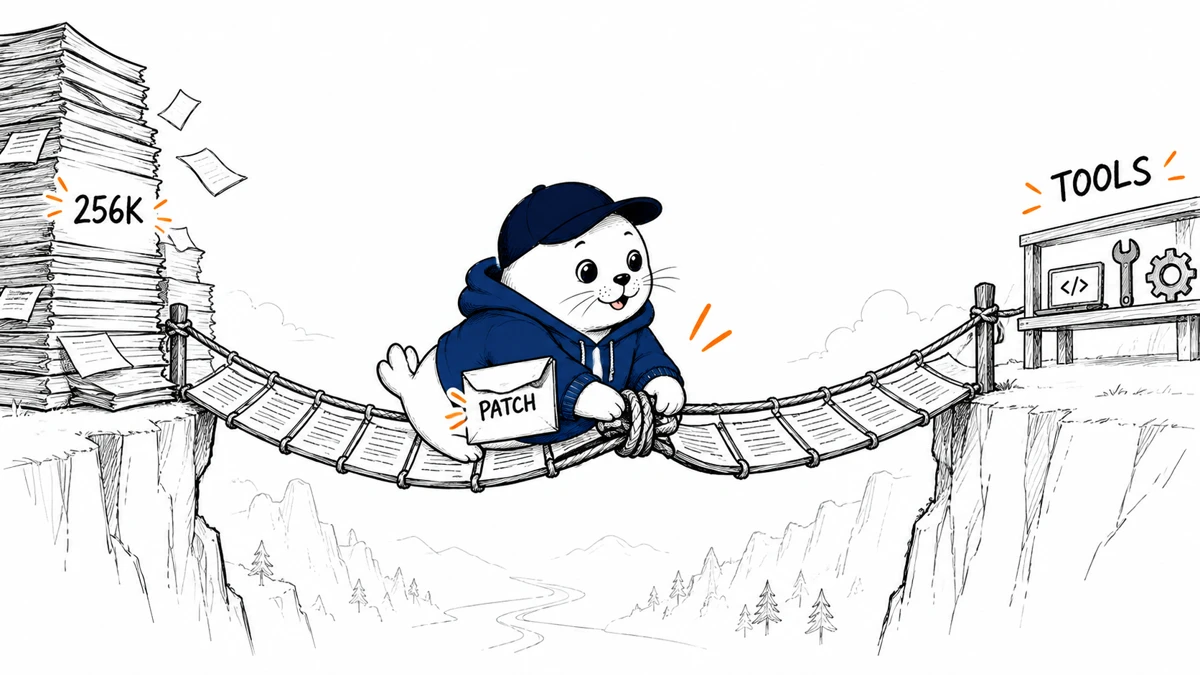
A very large context window can carry an entire repository into one conversation. It cannot guarantee that the model edits the right file, calls the right tool or produces a patch worth merging.
Atria Dawn Preview is a new text-only model from Shanghai AI Laboratory with a published 256K context window and configuration examples for Codex, Claude Code and Kimi Code. The release combines downloadable artifacts, hosted access and a paper about how people use advanced models for difficult work.
The important facts, separated
| Question | Published answer | What not to assume |
|---|---|---|
| What is the foundation? | The project describes a 744B-parameter MoE GLM-5.2 foundation. | Do not silently replace this with the artifact display value. |
| How large is the artifact? | Hugging Face displays approximately 753B parameters. | The two numbers can reflect different counting scopes. |
| How much context? | 256K tokens. | Maximum context is not proof of accurate retrieval across 256K. |
| Which modalities? | Text only. | Coding-agent support does not add image understanding. |
| Which license? | MIT is listed on the model card. | Hosted service terms remain separate from model licensing. |
| How can it be used? | Local guidance and hosted access are published. | Local operation is not practical on ordinary workstations. |
Why 744B and 753B should both appear in coverage
The project describes a 744B-parameter mixture-of-experts foundation, while the Hugging Face interface displays an artifact near 753B parameters. Those figures should not be averaged or treated as a contradiction without a parameter-count definition. Model packaging, auxiliary components and display conventions can change the number shown by a hub.
The safe wording is straightforward: report the foundation description and the artifact display separately. For deployment, the exact files, tensor formats, active parameters and runtime implementation matter more than the rounded headline count.
Most teams will evaluate the hosted route first
A model with hundreds of billions of parameters demands multi-GPU or multi-node planning even before the KV cache for a long request is included. Quantization can reduce weight memory, but it does not turn this into a laptop model. Hosted access therefore becomes the practical evaluation route for most developers.
- Confirm the exact hosted model ID rather than relying on a moving alias.
- Record input, output and cache pricing if the service exposes them.
- Measure time to first token at 8K, 64K and 200K input lengths.
- Check data retention, training use, region and provider subprocessors.
- Verify whether tool schemas and system prompts count against the context limit.
A coding-agent harness is more than a model endpoint
The published setup examples for Codex, Claude Code and Kimi Code are operationally important. They show how the model can enter an agent loop. The harness still owns repository discovery, tool permissions, shell execution, patch application, test selection and user approval.
- Read: give the agent a bounded repository and ask it to explain relevant files before editing.
- Plan: require a change plan with tests and rollback conditions.
- Patch: allow edits only inside the named scope.
- Verify: run project tests and inspect the diff independently.
- Approve: keep merge, deployment and external actions behind a human gate.
Our Codex versus Claude Code guide compares the surrounding agent workflows. The AI GitHub repositories reference includes harnesses and evaluation tools for repeatable coding tests.
Three experiments matter more than a leaderboard
Experiment 1: repository retrieval
Hide an answer-bearing implementation in a large repository and ask the model to identify the correct files and dependencies. Repeat with the critical file near the beginning, middle and end of the supplied context.
Experiment 2: patch correctness
Use issues with deterministic tests. Score whether the patch fixes the target without weakening assertions, changing unrelated behavior or adding hidden dependencies.
Experiment 3: tool recovery
Return one failed command, one rejected tool argument and one stale file. Measure whether the agent recovers, loops or edits around the control.
What the paper adds
The authors report leading results on five of 16 listed benchmarks. Their companion analysis covers 769 task records from 56 participants and says roughly one-third of completed AI-assisted tasks were rated infeasible without AI. These are author-reported results from a preprint, not peer-reviewed consensus or an independent product audit.
The practical verdict
Atria Dawn Preview is notable because it pairs a very large open artifact with explicit coding-agent integration guidance. The 256K window makes ambitious repository tests possible. For most teams, the decision still rests on hosted cost, latency, data handling and patch reliability. Treat the model as one component of the agent, not as the entire engineering system.
Primary sources
Checked September 19, 2026. Benchmark and participant findings are author-reported. MustHave.ai has not independently reproduced them.