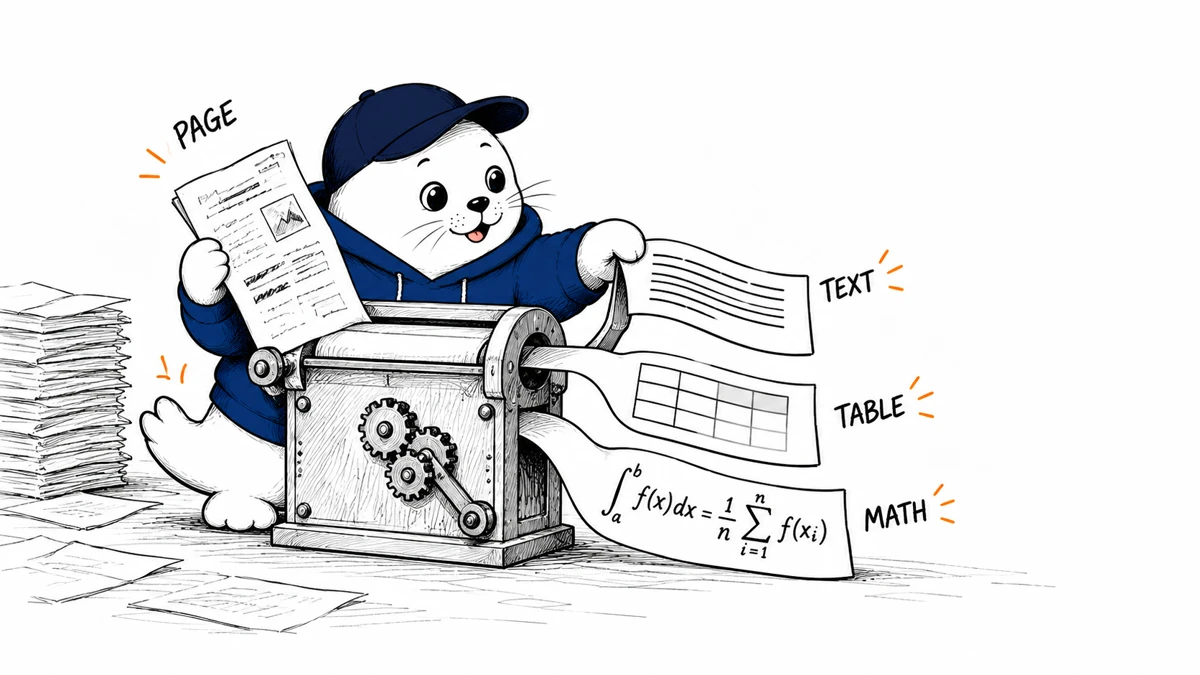
Document AI is moving beyond plain OCR. Tencent WeVisDoc tries to recover the structure of an entire page, including text order, tables and equations, in one model response.
Tencent WeVisDoc is a new family of 2B and 4B end-to-end document parsers. Give the model a page image and it can produce structured Markdown, LaTeX for equations and HTML for tables. Tencent published the checkpoints, code and technical paper, which makes this more useful than a benchmark-only announcement.
What Tencent released
| Artifact | Published detail | Practical implication |
|---|---|---|
| WeVisDoc-2B | Fine-tuned from a Qwen3-VL 2B-class model | Lower deployment cost, with accuracy to verify on complex pages. |
| WeVisDoc-4B | Fine-tuned from a Qwen3-VL 4B-class model | The stronger published benchmark option. |
| Input | PNG, JPEG and WebP page images | PDFs must be rendered into pages before inference. |
| Output | Markdown, LaTeX and HTML table structure | The result can feed search, editing and extraction pipelines. |
| Inference | Transformers and vLLM examples | Developers can test locally or build a serving endpoint. |
| License | Published with the official model artifacts | Review the exact repository and checkpoint terms before production. |
A page parser has to solve several problems at once
Traditional OCR can recognize characters while losing the relationships that make a document usable. A page parser also has to identify reading order, distinguish headings from body text, preserve lists, rebuild tables and express equations. One clean-looking output can still contain a silent structural error.
- Text recognition: were characters and words copied correctly?
- Layout: did columns, captions and side notes appear in the right order?
- Tables: were merged cells and headers reconstructed correctly?
- Mathematics: does the LaTeX preserve symbols, indices and alignment?
- Document boundaries: did the model invent a heading, row or paragraph that was not present?
How to read Tencent’s benchmark claims
Tencent reports an overall score of 95.38 for WeVisDoc-4B on OmniDocBench v1.6. The repository also reports a 75.54 mean across the listed PureDocBench tracks and says inference results are averaged over three runs. These are company-reported results from the authors’ selected configuration, not an independent MustHave.ai reproduction.
A single aggregate should not decide a deployment. A model can score well overall and still fail the exact pages a business processes, such as low-resolution invoices, dense scientific papers or rotated forms. Keep results separated by page type and error severity.
Five page sets reveal different failure modes
- Clean digital reports: test reading order, headings, links and footnotes.
- Scanned forms: add blur, shadows, skew, stamps and handwriting.
- Financial tables: verify every row, column, unit, subtotal and merged header.
- Scientific pages: compare equations token by token and render the generated LaTeX.
- Mixed-language pages: test scripts, punctuation, line wrapping and text direction separately.
For each set, keep the original image, expected structured output, model output and a machine-readable diff. A reviewer should classify errors as cosmetic, searchable, calculation-changing or legally material. That produces a more useful acceptance threshold than visual inspection alone.
Deployment needs a memory and resolution budget
The official examples use a default maximum model length of 32,768 tokens, while larger contexts depend on available hardware. Page resolution affects both recognition and visual-token cost. Rendering every PDF at maximum resolution can waste memory, but shrinking small text too aggressively removes the evidence the model needs.
- Record the render DPI and final pixel dimensions for every test.
- Measure peak VRAM, time to first token and total page latency.
- Batch only after single-page accuracy is stable.
- Reject malformed HTML or LaTeX before it reaches downstream systems.
- Keep the source page linked to every extracted field for human review.
WeVisDoc and EVIE solve different document jobs
WeVisDoc parses a page into structured content. Tencent’s EVIE visual document retriever instead helps find the page that best matches a query while preserving visual details. A production knowledge system may use retrieval first, then parse only the selected pages.
Developers can also use the evaluation and serving projects in our 50 AI GitHub repositories reference to build a repeatable document test harness.
The practical verdict
Tencent WeVisDoc is worth testing because it combines open checkpoints, serving examples and structured outputs in relatively compact models. The release does not eliminate OCR validation. Its real value depends on whether the 2B or 4B checkpoint preserves the structures that drive a specific workflow, under the resolution and hardware budget that workflow can afford.
Primary sources
Checked September 19, 2026. Benchmark figures are reported by Tencent and have not been independently reproduced by MustHave.ai.