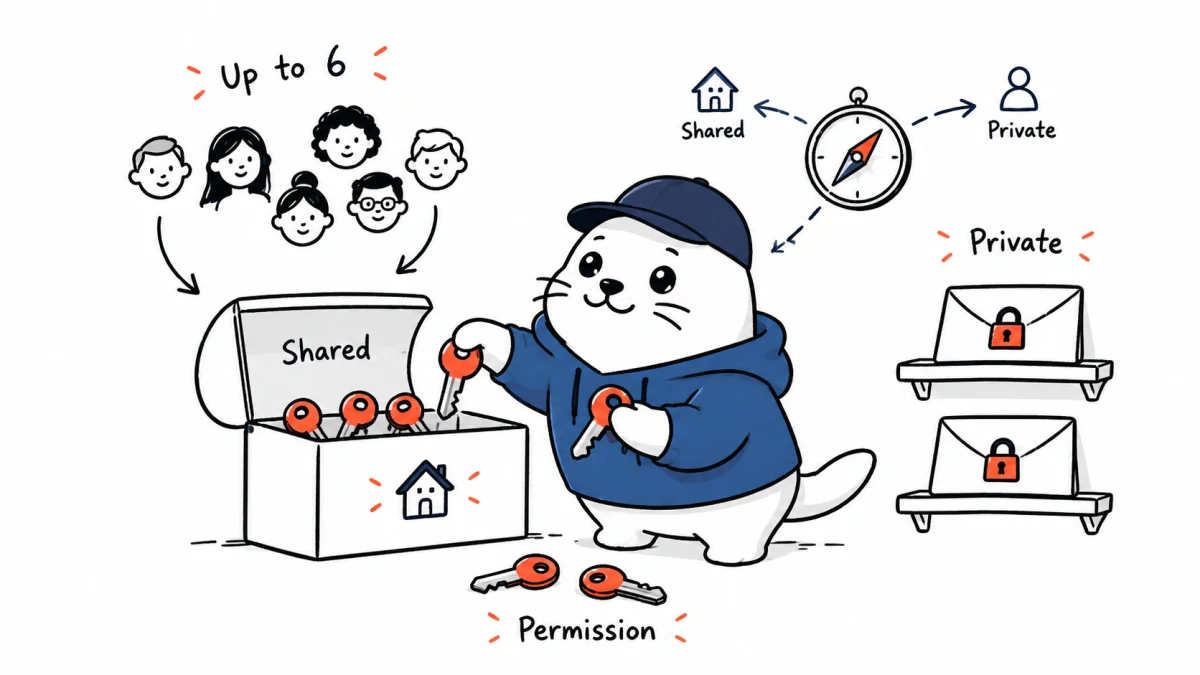
A personal assistant can assume one person controls the context. A household assistant cannot. Google’s CC experiment is now testing what happens when up to six people share an agent but not the same inbox, calendar or preferences.
The Google CC agent is expanding to groups of up to six members. Each person joins with a verified Google account and keeps an individual identity and permissions. Google says the agent sees only items a member has shared with it, while shared memory distinguishes household facts from personal preferences.
The household data map
| Data or action | Who controls it | Question to test |
|---|---|---|
| Gmail message | The account holder who shares it | Can another member infer an unshared sender or subject? |
| Calendar event | The member or calendar owner | Does the agent reveal private title, guest or location details? |
| Household preference | The group memory boundary | Who can correct or delete it? |
| Personal preference | The individual identity | Can it influence answers to other members? |
| Created Doc or Sheet | The destination owner and sharing settings | Who receives access after creation? |
CC connects communication and planning tools
Google lists Gmail, Chat, Docs and Calendar among the connected services. The agent can also prefill PDFs, use Maps travel times and create Docs or Sheets. It runs in an isolated cloud computer powered by Antigravity and current Gemini technology, according to Google.
Those capabilities turn a summary assistant into an action system. A wrong answer is inconvenient; a wrong calendar edit, shared document or form field can affect other people. Permission checks should occur at the action, not only when the group is created.
Shared memory needs visible ownership
Google says CC can tell the difference between information that belongs to the household and preferences that belong to one person. That separation is essential, but users also need controls to inspect, correct and remove memories. A hidden shared memory can make one person’s old choice look like a permanent household rule.
- Household fact: school pickup is at a shared location.
- Personal preference: one member avoids morning appointments.
- Sensitive personal fact: should not become group memory merely because it appeared in a shared thread.
- Temporary plan: should expire after the trip or event instead of shaping future answers indefinitely.
A safe first-week setup
- Invite only the intended adults. The preview is for users 18 and older.
- Start with a low-risk shared task. Use a grocery list or itinerary before email-heavy planning.
- Review every permission. Connect the minimum account and service scope needed.
- Test cross-member leakage. Ask one member about another’s unshared mail and calendar.
- Confirm before consequential actions. Require a person to approve sends, bookings and document sharing.
Availability is narrow
Google says the group experience is available by waitlist in the United States for adults using personal Google accounts. That makes this a controlled preview rather than a general Workspace family product. Features, limits and permission behavior can change during the experiment.
Households should not assume enterprise administration exists around the preview. Decide who removes members, what happens after a relationship changes and how shared memory is handled when someone leaves.
Departure is a core permission event
When a member leaves, the group needs more than an invite revocation. It needs a decision about documents that person created, preferences they contributed and memories derived from their private material. Google’s public description does not fully specify that lifecycle, so early users should avoid placing irreplaceable or highly sensitive household records into the preview.
Why this is different from a shared chat
A shared chat shows participants the same visible thread. CC can combine private inputs that different members choose to contribute, maintain memory and take actions across connected tools. The system must answer not only “may the agent see this?” but also “may the agent reveal or act on this for this member now?”
Our report on Google Antigravity controls explains the execution layer. The signed-in browser permission guide offers a practical way to limit the blast radius of agents acting through personal accounts.
The bottom line
Google CC is an important test of multi-person agent design. Separate identities and shared-versus-personal memory are the right primitives. The product will earn trust only if those boundaries remain visible at retrieval, memory and action time, with clear correction and removal controls for every member.
Read the primary record
Checked September 18, 2026. Product details and reported results come from the linked first-party sources. Interpretation, limitations and implementation advice are MustHave.ai analysis.