NVIDIA Isaac Sim 6.1 became generally available on September 15 with 11 agent skills for data-generation workflows, ROS 2 Control, physics changes and 1,533 simulation assets. The release adds useful automation, but existing projects should treat it as a migration rather than a routine package update.
The safest sequence is to inventory dependencies, run a representative scene on a clean 6.1 environment, repair compile-time changes, verify units and physics, then compare outputs before changing production images or shared workstations.
What NVIDIA Isaac Sim 6.1 adds
| Area | Release change | Why it matters |
|---|---|---|
| Agent workflows | 11 Action and Event Data Generation skills | Natural-language agents can operate repeatable simulation tasks |
| Model choice | User-supplied endpoints, OpenAI-compatible services and NIM | Teams can choose deployment and governance boundaries |
| Robot control | ROS 2 Control support | Simulation can align more closely with established controller workflows |
| Physics | Newton and PhysX updates | Existing scenes need behavioral comparison, not only a launch test |
| Development | Container hot reload | Extension iteration can be faster inside containerized setups |
| Assets | 1,533 assets | Teams gain broader building blocks but still need license and quality checks |
The agent skills do not lock teams to one model
NVIDIA describes support for user-supplied models and endpoints, including OpenAI-compatible APIs and NVIDIA NIM. That architecture can separate the simulation skill from the inference provider. It also moves responsibility to the operator: credentials, retention, rate limits, prompt behavior and output logging depend on the selected endpoint.
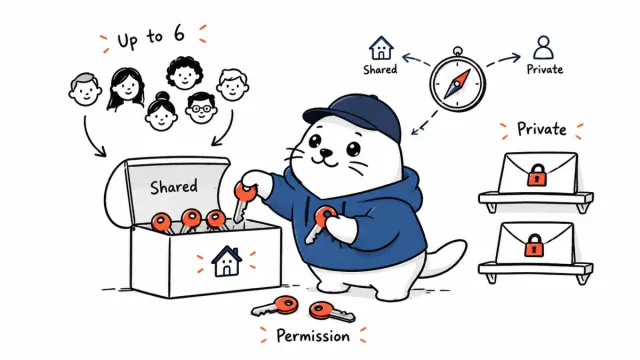
An agent that can change a simulation should start with narrow permissions. Restrict asset paths, cap job duration, record every action and make destructive changes reversible. The permission-and-trace questions in our agent anomaly detection analysis also apply to robotics workflows, even when the underlying platform differs.
Breaking changes to search for first
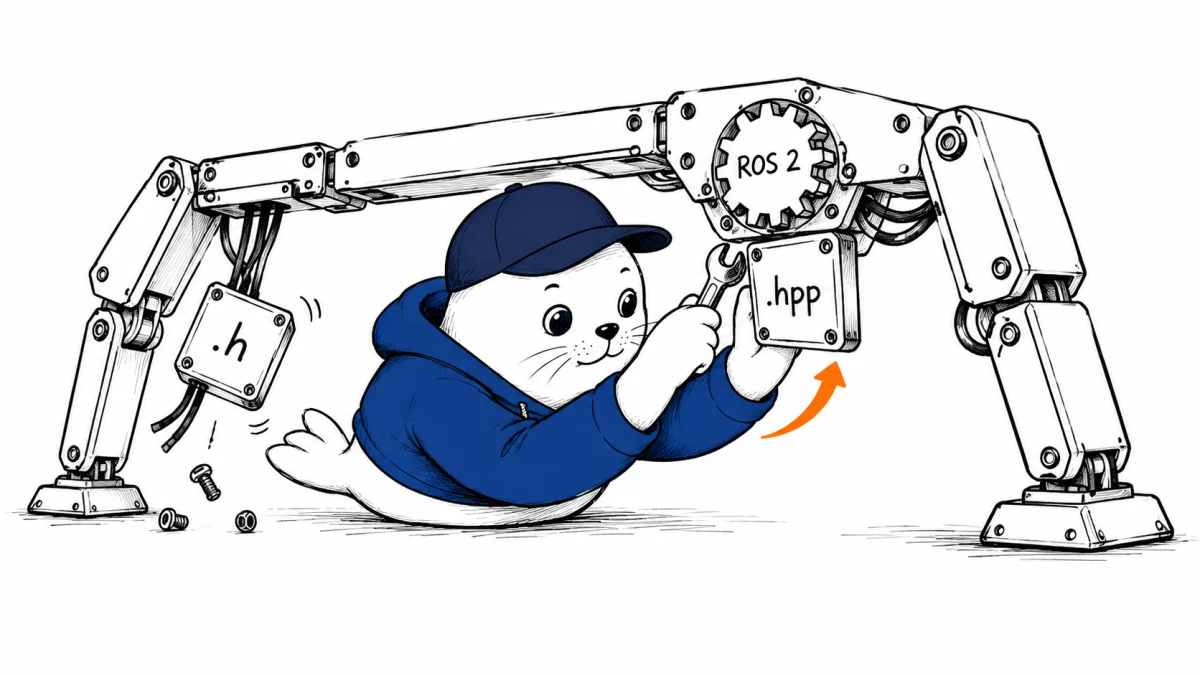
- Header extensions: C++ includes that used
.hmay now require.hpp. - Moved or removed APIs: extensions can import names that no longer exist at the same location.
- Grasp target units: target values described in radians may need conversion to degrees.
- Solver fields: removed configuration fields can silently disappear from old project assumptions.
- Physics behavior: Newton and PhysX changes require output comparison for contacts, joints and stability.
The unit change deserves special attention because a project can load while behaving incorrectly. A compile failure is visible. A valid number interpreted in the wrong unit may produce a plausible but unsafe result.
A reversible migration order
- Freeze the current environment. Save the container digest, extension list, assets, configuration and known-good outputs.
- Create a parallel 6.1 environment. Do not overwrite the only working installation.
- Compile before testing behavior. Repair header and API changes while the failure surface is small.
- Audit units and removed fields. Search configuration and authored assets, not only source code.
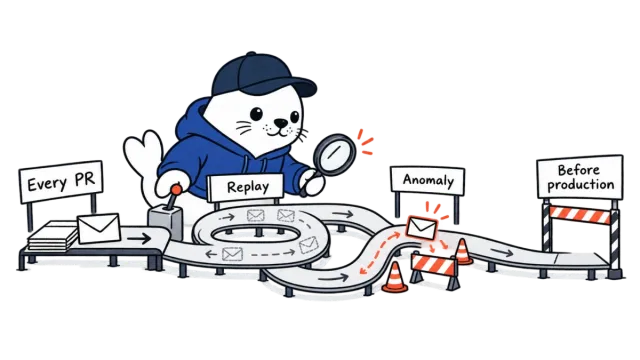
- Replay representative scenes. Include contacts, sensors, controllers and long-running simulations.
- Compare outputs. Track trajectories, timing, collisions, control stability and generated data.
- Test agent permissions separately. Introduce model endpoints only after deterministic simulations pass.
- Promote with rollback. Keep the old image and project snapshot until production workloads complete.
How to validate ROS 2 Control
Start with one robot, one controller and a short deterministic trajectory. Record command frequency, joint states, latency and limits in the old and new workflows. Then introduce resets, dropped messages and controller restarts. A successful happy-path motion does not prove recovery behavior.
Keep simulation time and wall-clock time distinct in logs. Containerized development, accelerated rendering and external model calls can create timing assumptions that are not visible in a visual replay.
Agent-generated simulation data needs provenance
Action and Event Data Generation can speed up dataset production, but each sample should carry enough provenance to reproduce it: scene and asset versions, random seed, physics backend, agent skill version, model endpoint, prompt or task specification and any rejected run. Without that record, a large dataset can hide a systematic agent mistake.
Developers evaluating related open-source infrastructure can use our AI GitHub repositories reference to check maintenance, licensing and practical deployment signals before adding another dependency.
The practical verdict
Isaac Sim 6.1 makes agent-driven data generation and ROS 2 integration more useful, while giving teams flexibility over model endpoints. The cost is migration work across code, configuration, units and physics. Upgrade in parallel, verify behavior numerically and add agent automation only after the deterministic foundation is stable.
Primary sources
- NVIDIA Isaac Sim release notes
- NVIDIA developer forum: Isaac Sim 6.1 general availability
- NVIDIA Isaac Sim 6.1 installation guide
Checked September 17, 2026. Migration details should be verified against the release notes for the exact extension and deployment method used by your project.