Mozilla has selected Mistral Small 4 for the Firefox Smart Window beta, giving the browser an AI model that can work with permitted tab and history context. The launch is as much about data flow as model choice: current retrieval, browser context, retention and user controls follow different paths.
The partnership covers the Smart Window beta in the United States and Canada, plus a French-language beta in France. Mozilla says users will still be able to choose among multiple AI providers. Mistral is therefore a selected partner, not an exclusive replacement for every model option inside Firefox.
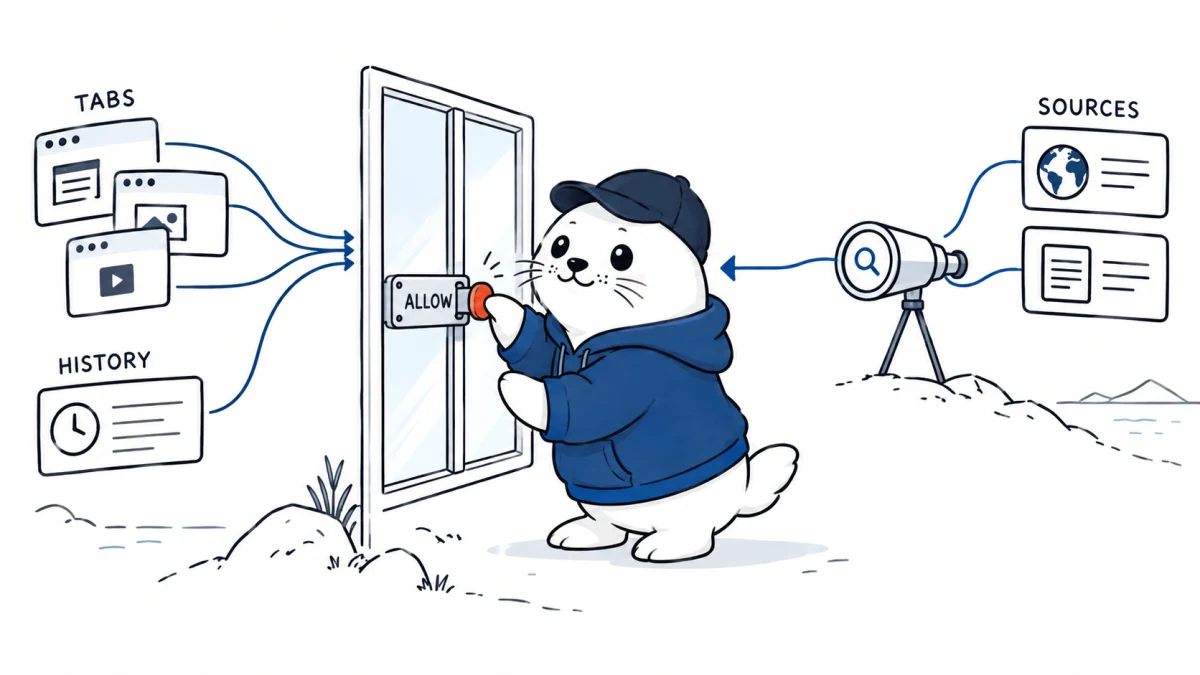
The browser has four distinct data paths
| Path | Purpose | Question to ask |
|---|---|---|
| Open tabs | Give the assistant immediate page context | Which tabs were included? |
| Browsing history | Recover earlier context when permitted | Was history access necessary? |
| Exa retrieval | Fetch current information and sources | Can the user inspect the cited pages? |
| Mistral inference | Interpret context and generate a response | What is retained after the request? |
Smart Window can use tabs and history with permission
Mozilla describes an assistant that can use open tabs and browsing history when the user grants access. That can make an answer more relevant, but it also means the permission prompt needs to be specific. Access to one shopping tab is different from access to an entire session that may include health, finance or work accounts.
- Show the exact tabs included in a request.
- Separate one-time access from continuing access.
- Let users remove individual tabs before sending.
- Explain whether history is local, summarized or transmitted.
- Provide a visible way to revoke the permission.
Exa supplies freshness and source links
The assistant uses Exa to retrieve current information and sources. That matters because Mistral Small 4’s trained knowledge and a live web result are not the same evidence. A useful browser answer should make the distinction visible by linking the pages used for time-sensitive claims.
Retrieval also expands the trust boundary. The model can encounter instructions embedded in webpages, misleading snippets or stale content. Mozilla’s browser layer should treat retrieved text as evidence to analyze, not as higher-priority instructions. The incident patterns in our OpenAI model-misalignment analysis show why artifact provenance matters.
Mistral promises zero retention for Mozilla requests
Mistral says requests from Mozilla are not saved by default and operate with zero data retention. That is a meaningful product commitment, but it should not be confused with a claim that no data is ever transmitted. Remote inference still requires request data to reach the service unless a particular operation runs locally.
Users evaluating sensitive workflows should look for documentation on diagnostic logs, abuse monitoring, account metadata, regional processing and deletion. The checked announcements describe the retention posture at a high level, not a complete independent privacy audit.
Open weights do not mean the entire browser stack is open source
Mistral Small 4 is presented as an open-weights model. That gives developers more inspection and deployment options than a closed API alone, but the phrase does not automatically disclose the full training data, training code or every production component. The Firefox experience also includes Mozilla orchestration and Exa retrieval, so the system should be assessed as a stack.
For readers comparing model licenses and deployment choices, our AI GitHub repository guide separates code availability, model weights and practical usability.
Availability is limited by country and stage
| Market | Status described on September 17 |
|---|---|
| United States | Smart Window beta |
| Canada | Smart Window beta |
| France | French-language beta |
| United Kingdom | Planned later in 2026 |
| Germany | Planned later in 2026 |
Planned expansion should not be described as current availability. Browser version, invitation status and region can all affect access during a beta.
A five-minute privacy test before regular use
- Open one harmless page and one sensitive page.
- Ask Smart Window to summarize only the harmless page.
- Inspect which context was included and which sources were retrieved.
- Revoke history access and repeat the request.
- Switch the selected model and compare disclosures and citations.
The test does not prove the entire privacy architecture, but it reveals whether the user can understand and control the context sent for an ordinary task.
The practical verdict
Firefox Smart Window combines a capable model, live retrieval and browser context without removing model choice. Its success will depend less on the brand of the default model than on whether users can see, limit and revoke the data flows that make browser-aware assistance useful.
Primary sources
Checked September 17, 2026. Availability, feature and retention descriptions come from Mozilla and Mistral. Privacy tests and stack analysis are MustHave.ai recommendations.