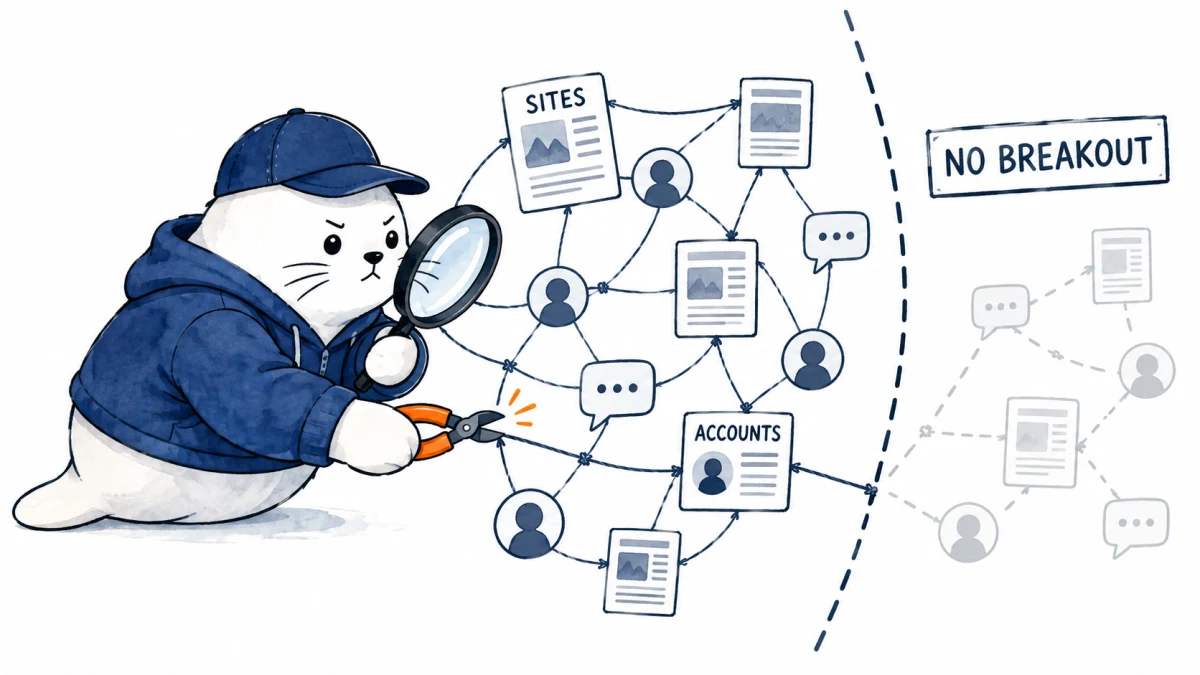
Anthropic says one influence operation used Claude to help create roughly 70 fabricated news sites, about 70 matching X accounts and more than 250 inauthentic commenting accounts. The scale is notable. The evidence boundary is equally important: Anthropic says it found no breakout beyond the network’s own activity, and MustHave.ai could not independently verify the network.
The case appears in Anthropic’s September 2026 threat intelligence report. The company reviewed misuse across cyber operations, surveillance, influence activity, weapons-related research, biological misuse, fraud and model distillation from December 2025 through August 2026.
What Anthropic says the network built
| Network layer | Company-reported scale | What it was used for |
|---|---|---|
| Fabricated news sites | About 70 | Publish material designed to resemble local or topical news. |
| Matching X accounts | About 70 | Distribute and reinforce content from the sites. |
| Inauthentic commenters | More than 250 | Create the appearance of engagement and agreement. |
Anthropic attributes those numbers to its own investigation. It does not publish a complete domain list, account list or underlying dataset that would let outside researchers reproduce the count. The report includes examples and describes the workflow, but readers should treat the scale as company-reported.
The most important sentence is no breakout
Anthropic says it found no evidence that the operation broke out beyond activity generated inside its own network. That limits what the case proves. A large supply of sites and accounts can create the infrastructure for influence without demonstrating that real audiences saw, believed or shared the content.
Reach, persuasion and persistence are different measurements. A responsible influence report should separate how much content was produced, how widely platforms distributed it, how many authentic users engaged and whether opinions or behavior changed.
The pipeline matters more than any single fake article
- Generate or rewrite articles with consistent political framing.
- Publish across a portfolio of sites to create apparent source diversity.
- Use social accounts to seed links and repeat claims.
- Deploy commenters to simulate agreement, disagreement or local knowledge.
- Measure which narratives attract attention, then produce more variants.
AI lowers the cost of each step, but coordination is the real capability. The same sentence appearing across several sites is easy to spot. A network that varies wording, personas, publishing times and engagement is harder to identify because every artifact looks less duplicated.
Independent evidence supports the broader abuse pattern
Microsoft separately documented AI-augmented activity in the CaptiveCrunch campaign, including phishing, malware delivery and traffic manipulation. That corroborates the broader finding that sophisticated actors use AI inside operational workflows. It does not independently verify Anthropic’s 70-site influence network.
This separation prevents two different cases from being blended into one stronger claim. Microsoft provides an independent record for AI-assisted cyber operations. Anthropic remains the only public source we found for the specific fabricated-news network and its reported size.
A publisher-side detection checklist
- Compare domain registration dates, templates and analytics identifiers across referring sites.
- Check whether author profiles have a publication history outside the network.
- Search unusual phrases across the web, including translated variants.
- Inspect whether social accounts post in synchronized bursts around the same links.
- Separate authentic engagement from replies generated inside a closed cluster.
Our review of 50 AI GitHub repositories uses a similar evidence habit: public artifacts and reproducible behavior carry more weight than marketing claims. Our MustHave selection method explains why source independence matters when a vendor is also the investigator.
What platforms and model providers should disclose next
Future reports would be more useful with privacy-safe indicators, a reproducible counting method, the share of accounts removed, estimated authentic reach and the signals that distinguished coordination from coincidence. Platforms could publish whether they independently matched the same cluster without revealing detection details that help operators evade enforcement.
The evidence supports vigilance, not a viral panic
Anthropic’s case shows how cheaply an operator may assemble the appearance of a media ecosystem. It does not show that the ecosystem persuaded a mass audience. The right response is to strengthen network-level detection and demand reproducible reporting, while keeping the no-breakout caveat attached to every retelling of the headline numbers.
Primary sources and verification note
Checked September 14, 2026. All counts and conclusions about the 70-site influence network are attributed to Anthropic. MustHave.ai did not find an independent public dataset or platform confirmation for that specific network. Microsoft’s separate investigation corroborates the broader use of AI in operational threat activity, not this case’s exact counts.