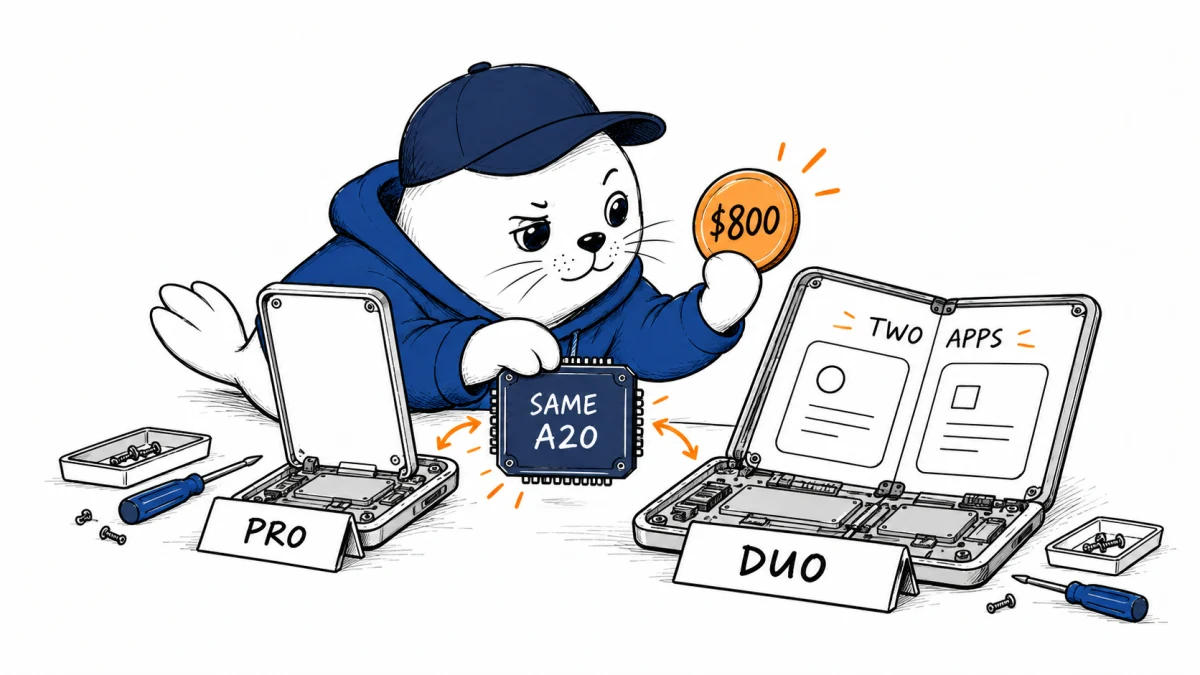
Apple’s first foldable iPhone creates an unusual AI buying decision. The $1,999 iPhone Duo and the $1,199 iPhone 18 Pro use the same named A20 Pro chip and the same Dual 16-core Neural Engine. The extra $800 buys a folding workspace around the AI, not a more powerful tier of AI silicon.
Apple announced iPhone Duo on September 9, 2026. Preorders begin October 16, and availability starts October 23 in more than 70 countries and regions. The phone opens to a 7.6-inch inner display, closes around a 5.4-inch outer display, and arrives with iOS 27.1.
The useful question is not whether the iPhone Duo AI story sounds impressive. It is whether its two-screen layout will change enough of your daily work to justify an $800 premium over iPhone 18 Pro, or $700 over iPhone 18 Pro Max.
The iPhone Duo AI premium starts with a simple calculation
| Model | Starting U.S. price | Starting storage | AI chip | Display advantage |
|---|---|---|---|---|
| iPhone 18 Pro | $1,199 | 256GB | A20 Pro, Dual 16-core Neural Engine | Conventional single display |
| iPhone 18 Pro Max | $1,299 | 256GB | A20 Pro, Dual 16-core Neural Engine | Larger conventional display |
| iPhone Duo | $1,999 | 256GB | A20 Pro, Dual 16-core Neural Engine | 5.4-inch outer and 7.6-inch inner displays |
The arithmetic is $1,999 minus $1,199, which produces an $800 premium over iPhone 18 Pro. Against the $1,299 Pro Max, the gap is $700. Those figures do not include cases, AppleCare, carrier offers, trade-ins, or future Apple Pencil support.
Apple is not charging more because Duo has a higher-numbered processor. Its own announcement says the foldable is powered by the same A20 Pro found in iPhone 18 Pro models. Buyers are paying for the folding hardware, two-display software, thermal design, and the workflows those parts make possible.
The same A20 Pro does not prove identical real-world speed
A20 Pro has a 6-core CPU, 7-core GPU, and a Dual 16-core Neural Engine with 32 total neural cores. Apple says the Neural Engine offers twice the AI compute of A19 Pro, while unified memory bandwidth rises by 50 percent. These are Apple-reported comparisons, not independent benchmarks.
The shared chip name also does not guarantee that every device will sustain the same performance in every workload. Duo has its own package, vapor chamber, dual-battery design, display engine, and thermal constraints. Apple says Duo delivers up to 35 percent better sustained performance than iPhone 17 Pro. That is a comparison with last year’s Pro, not with iPhone 18 Pro.
At launch, Apple has not published a task-level comparison showing that Siri AI, image generation, or a local Core AI model runs faster on Duo than on iPhone 18 Pro. Until independent testing arrives, the defensible conclusion is narrower: both phones have the same named AI processor, while Duo gives that processor a different screen and cooling environment.
Duo’s strongest AI advantage is keeping the source and assistant visible
The 7.6-inch inner display is where the Duo makes a distinct case. Apple says it is 50 percent larger than the iPhone 18 Pro Max display. Split View can place two apps side by side, save app pairs, or open two windows of the same app. Apple specifically shows Siri AI beside the content a user is discussing.
- Research: keep Safari or a PDF visible while questioning Siri about the material.
- Writing: retain the draft on one side and use Siri to revise selected text on the other.
- Meetings: view a call and shared content at the same time.
- Comparison shopping: open two Safari windows without repeatedly switching tabs.
- On-device creation: run a Core AI-enabled app beside notes, source material, or an export view.
This matters because assistant latency is not the only cost in an AI workflow. Context switching is a cost too. If Duo prevents four or five app swaps during a task, it may feel faster even when the underlying model runs at the same speed. That is a workflow advantage, not a processor benchmark.
Core AI can keep compatible third-party models on the device
Apple’s Core AI documentation says developers can load and run compatible models entirely on Apple devices through a Swift API. Apple describes zero server dependencies and zero token costs for inference. The iPhone Duo announcement names video creation app Detail as an early example.
That can improve privacy, offline behavior, and predictable per-request costs. It does not make commercial AI development free. Teams still pay for engineering, model preparation, testing, App Store distribution, support, and the device itself. Model size, memory pressure, battery use, and output quality will also determine which workloads are practical.
For builders, the interesting Duo experiment is not simply porting an iPhone app to a wider canvas. It is designing a two-pane interaction where the model’s input, evidence, controls, or preview remains visible beside the result.
Which AI features are actually tied to the Duo
Some features use AI but are not exclusive to the foldable. Siri AI, Spatial Reframing, Extend, upgraded Clean Up, photorealistic Image Playground, and Safari’s Notify Me belong to the broader Apple Intelligence and iOS 27 story. Duo changes how several of them can be arranged on screen.
iPhone 18 Pro also gets a capture-time authenticity feature that Duo does not list. Our Apple Reference Image guide explains what its signed sensor record can prove and where its evidence stops.
Smart Take is the clearer Duo-specific example. Apple says on-device models analyze a scene and automatically take a photo when subjects pose, allowing the person who set up the phone to join the picture. The foldable can stand on a surface without a tripod, while the outer display can help subjects frame themselves.
Apple has not provided an accuracy rate, a failure analysis, or a comparison with timer-based and gesture-based capture. Treat Smart Take as a promising camera mode that needs real testing, not as proof that the phone will always recognize the right moment.
Siri AI arrives as a beta with language and regional limits
Siri AI begins rolling out in beta with iOS 27 on September 14, 2026, for supported devices set to English. Apple plans French, Japanese, Korean, Portuguese, and Spanish support in October. It also warns that some features may not be available in every language or region.
The initial beta will not be available on iPhone in the European Union. Apple has separately said Siri AI is unavailable in China while it works through regulatory requirements. Features that depend on server-side models have daily limits that can vary by request complexity, demand, and system policy. Apple says expanded access will be sold for a fee in the future, but has not published the allowance or price.
Our updated Siri AI feature and device guide tracks the rollout rules. The separate Siri AI pricing guide explains what Apple has confirmed about future paid headroom.
A practical test for deciding whether the $800 premium is worth it
Count the tasks in a normal week where you genuinely need two live panes on a phone. Do not count situations where a tablet or laptop is already open beside you. The Duo case becomes stronger when the phone must be the only device.
- List five recurring mobile tasks. Name the two apps or views each task requires.
- Estimate switching friction. Note how often you jump between the source and the assistant, editor, call, or preview.
- Check regional eligibility. A headline feature has no value if its beta is unavailable in your region or language.
- Separate chip value from display value. If raw AI speed is the goal, wait for independent Duo versus 18 Pro tests.
- Price the full setup. Add the case, protection plan, storage tier, and any accessory you expect to use.
A buyer who completes ten source-and-assistant sessions each day may value the fold. Someone who mostly asks short questions, edits single photos, or runs one app at a time gets the same named A20 Pro for $800 less with iPhone 18 Pro.
What remains unproven before reviews arrive
- Whether Duo sustains local-model performance better or worse than iPhone 18 Pro in matched tests.
- How much Split View reduces completion time in real Siri AI and creator workflows.
- How third-party apps behave across the hinge, outer display, and two-window layout.
- How daily server-side AI limits affect heavy users.
- How the folding display, hinge, and battery system age after long-term use.
Apple’s durability, performance, and battery statements are first-party claims. They are useful specifications, but they are not a substitute for independent teardown, stress, battery, and sustained-workload testing.
My verdict: buy the workspace, not the AI label
iPhone Duo is not an iPhone 18 Pro with a superior AI chip. It is an A20 Pro phone built around a larger, folding workspace. That distinction makes the buying decision clearer.
If keeping Siri, a source, or a local AI app beside your main task solves a frequent mobile problem, the premium may buy something concrete. If your AI use remains one prompt, one image, or one app at a time, iPhone 18 Pro offers the same named neural hardware at a far lower starting price.
Primary sources
- Apple’s iPhone Duo launch announcement
- Apple’s iPhone Duo technical specifications
- Apple’s iPhone 18 Pro launch announcement
- Apple’s iPhone 18 Pro technical specifications
- Apple Core AI developer documentation
Checked September 10, 2026. Prices are starting U.S. prices for 256GB models. Performance comparisons are attributed to Apple until matched independent testing is available.