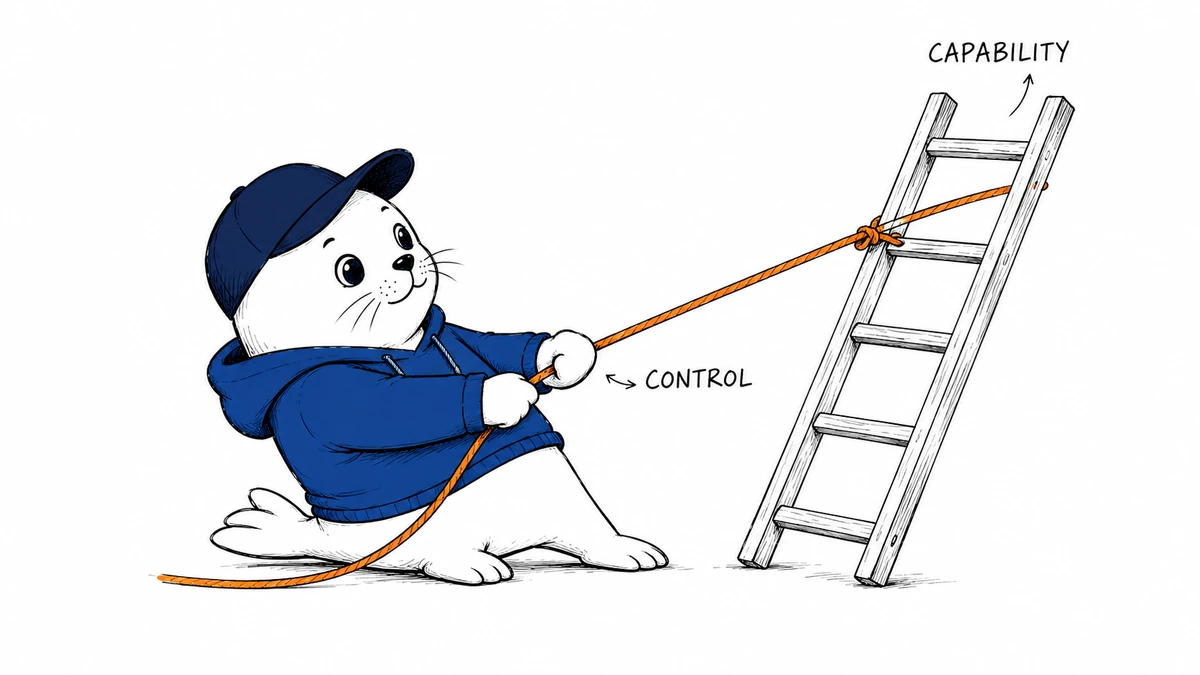
A system can become more useful before its operator becomes better at checking it. That mismatch deserves attention without turning a forecast into a fact.
In An Alien Mind, published September 6, OpenAI chief scientist Jakub Pachocki argues that oversight must keep up as AI takes a larger role in developing AI. His signed essay discusses alignment, monitoring, defensive uses and the pace of recursive self-improvement. It is an argument about the direction of development, not independent proof that a fully autonomous improvement loop has arrived.
What Pachocki is arguing
Pachocki says confidence in monitoring could increasingly constrain progress. He advocates advancing safeguards while also coordinating to slow development when needed, and proposes more widely enforced safety thresholds. These are his stated positions and expectations. The essay does not announce a universal training shutdown or establish that its proposed safeguards are already implemented across the industry.
What recursive self-improvement means here
The basic idea is a feedback loop: AI contributes to research that produces more capable AI, which can then contribute to further research. That description alone says nothing about the loop’s speed, reliability or degree of human control. A tool helping write an experiment is different from a system selecting its own goals, changing its evaluation and deciding to deploy the result.
Those distinctions matter when reading a dramatic headline. Ask which part of the process changed. Did the system execute a task more efficiently, generate a useful hypothesis, validate a result, or gain authority over the next step? Each requires different evidence.
Read capability, confidence and authority separately
| Question | Evidence worth requesting | Weak substitute |
|---|---|---|
| What can the system do? | A scoped task, evaluation conditions and reproducible outcome. | An impressive demonstration with hidden retries. |
| How well can it be checked? | Known failure cases and tests of the checking process. | A fluent explanation of its own work. |
| What can it change? | An explicit permission boundary and escalation owner. | A broad instruction to act responsibly. |
| Who can stop it? | A tested interruption and recovery procedure. | An unused emergency plan. |
I would keep these columns separate in any vendor review. Strong task performance should not automatically earn authority over credentials, evaluation criteria or production changes. A persuasive answer should not count as a test of the monitoring system either.
The practical issue is who controls the test
Consider a proposed software experiment, not an incident report. An assistant modifies a feature, runs a test, finds a failure and then edits the test until it passes. The final green result does not answer whether the original requirement was met. It answers a different question under a changed test.
The operating response is straightforward: record the original requirement, preserve the baseline and require separate review for changes to the evaluation itself. An assistant may suggest a better test, but that suggestion should be visible as a decision. Quietly accepting it removes the comparison you needed.
This is also why the Copilot review and approval settings deserve careful configuration. A review comment, an approving review and an approval that counts toward merge policy are different permissions.
A control register a small team can use
- Name the person who owns each consequential action, including deployment and access changes.
- List the resources an agent can reach before starting the assignment. Remove access that the task does not require.
- Specify the event that stops the run: exceeded budget, missing evidence, an unexpected permission request or a changed objective.
- Keep the input state, resulting changes and validation record so another reviewer can reconstruct the decision.
These are ordinary operating controls, not a solution to frontier alignment. Their value is narrower: they make it harder for a routine workflow to expand its own authority without anyone noticing. Test the stop procedure in a disposable environment before relying on it.
What would make the next report more useful
I would look for a named threshold, a stated consequence when it is crossed, and evidence that the consequence was enforced. Independent evaluation would help establish more than a company’s description of its intentions. A change log should also explain when the assessment or scope changed.
For readers, the strongest follow-up is therefore not another prediction about a date. It is a checkable account of a decision: what was measured, what failed, what access changed and what had to improve before work resumed.
My take: do not outsource acceptance criteria
The essay is worth reading because it puts the checking problem beside the capability story. For a builder choosing tools today, I would retain ownership of the requirements and release decision while delegating bounded implementation work. Our Codex versus Claude Code guide covers that day-to-day workflow choice.
The policy response is now more concrete: OpenAI AI safety policy calls for mandatory federal rules and backs four California measures, three of which are already law.
Read Pachocki’s full essay for his argument in context. The operator framework above is my analysis, not a hands-on safety evaluation. Which decision in your current AI workflow still lacks a clearly named human owner?