

GLM-5.3 is open enough to download, large enough to make that decision expensive, and now simple enough to call through Cloudflare that most builders can postpone the hardware question.
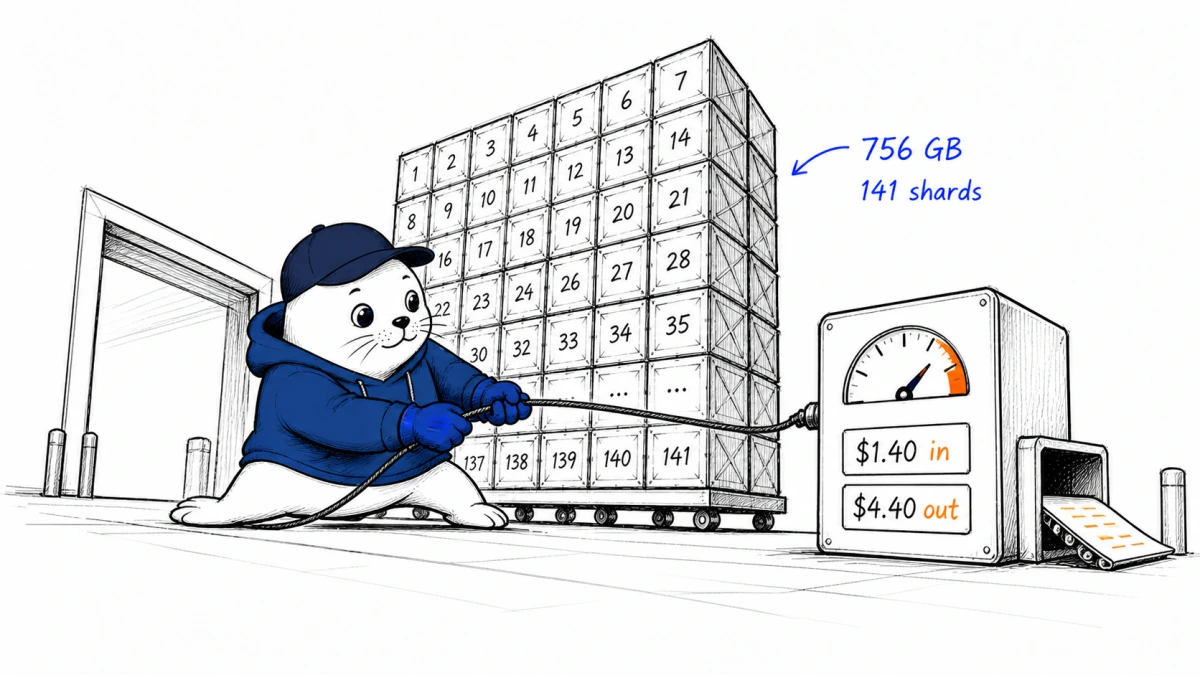
Z.ai published GLM-5.3 as a 756 GB weight repository split across 141 shards. Cloudflare then added the same model to Workers AI at $1.40 per million input tokens and $4.40 per million output tokens. That pairing creates a useful fork: evaluate the model through an API first, then decide whether control, privacy, or steady volume justifies operating a very large model yourself.
September 18 update: FlashX adds a faster hosted route
Vercel has added zai/glm-5.3-flashx to AI Gateway as a high-speed serving option for Z.ai’s multimodal coding model. Vercel describes throughput of roughly 200 output tokens per second in its launch note. The live model page showed a 1 million-token context window, a 131,072-token maximum output, and provider pricing of $0.37 per million input tokens, $1.25 per million output tokens, and $0.08 per million cache-read tokens when checked.
FlashX does not change the 756 GB self-hosting calculation for the full GLM-5.3 weights discussed below. It changes the first evaluation decision. A team can now benchmark a low-latency hosted route before deciding whether ownership, privacy, predictable throughput, or custom serving work justifies operating weights directly.
| Route | What to measure | Decision it informs |
|---|---|---|
| FlashX through AI Gateway | Time to first token, streamed throughput, total task time, retries and provider availability | Whether a hosted route meets interactive coding-agent needs |
| Full GLM-5.3 on Workers AI | Task quality, context handling, token cost and gateway controls | Whether the flagship model earns its higher inference cost |
| Self-hosted weights | Accelerator memory, concurrency, utilization, operations and compliance | Whether control and sustained volume justify infrastructure ownership |
The throughput figure is vendor-reported and is not a complete agent benchmark. Measure prompt processing, tool latency, model output, retries, cache behavior and accepted task completion on the same workload. Read Vercel’s FlashX launch note and live model page.
Update checked September 21, 2026. Pricing and live gateway metrics can change. Marker: glm-5-3-flashx-gateway-20260918.
The weights are available, but they are not light
The official GLM-5.3 model card describes a foundation model that keeps the same base model as GLM-5.2. Z.ai says the gains come from post-training rather than a new pretraining run. The repository file list shows 756 GB across 141 model shards.
That 756 GB figure is only the download. A production deployment still needs memory for weights, runtime overhead, attention cache, concurrency, and the serving stack. Quantization may reduce the footprint, but it also creates another evaluation job. If your mental model of open weights is “download and run on one rented GPU,” GLM-5.3 is the wrong example.
Our earlier guide to open weights versus closed APIs gives the broader tradeoff. GLM-5.3 makes the cost of the self-hosted side unusually visible.
Cloudflare turns the first test into a small bill
Cloudflare added @cf/zai-org/glm-5.3 to Workers AI on August 28. Its model page lists an OpenAI-compatible endpoint and three usage prices: $1.40 per million input tokens, $0.26 per million cached input tokens, and $4.40 per million output tokens. Access requires a paid Workers plan or prepaid AI Gateway credits.
| Test workload | Published rate | Calculated cost |
|---|---|---|
| 1M input + 250K output | $1.40 in + $1.10 out | $2.50 |
| 10M input + 2M output | $14.00 in + $8.80 out | $22.80 |
| 1M cached input | $0.26 per 1M | $0.26 |
A $2.50 test is cheap enough to answer a real question. Give the model one representative repository task, one long-context synthesis job, and one tool-using workflow. Record tokens, latency, corrections, and human review time. Do not begin with a benchmark screenshot and a hardware quote.
The benchmark claims need their labels attached
Z.ai reports a 50% improvement on its internal coding benchmark and stronger cybersecurity results. Those are company-reported measurements. The model card supplies more context than a launch graphic, including named benchmarks and some harness details, but it does not turn an internal comparison into independent proof for your workload.
The model card also says cyber capability grew faster than expected during post-training. That is worth reading before connecting the model to credentials, networks, or public infrastructure. Capability is not the same as permission. A capable model behind a narrow tool boundary has a different risk profile from the same model with a shell, reusable tokens, and open egress.
The license is permissive with one unusual ceiling
The repository uses Z.ai’s custom GLM-5.3 license, not a standard open-source software license. It allows use, modification, distribution, deployment, fine-tuning, and sale. One clause applies to very large Model-as-a-Service operators: if the operator and its affiliates exceed $10 billion in annual aggregate revenue, commercial use requires passing Z.ai’s security review first.
Most Musthave.ai readers will never reach that threshold. Procurement teams should still record the license version instead of writing “open source” in an inventory and moving on. Downloadable weights answer the access question. They do not answer every commercial or governance question.
Use a three-gate deployment test
- Quality gate: run five tasks that look like paid work, not toy prompts. Compare the accepted result, not the first result.
- Boundary gate: decide whether prompts, code, and outputs can leave your environment. Check Cloudflare and Z.ai terms against that decision.
- Economics gate: measure monthly tokens and concurrency. Compare the hosted bill with the full serving cost, including idle capacity and engineering time.
The hardware calculation matters only after the model earns a place in the workflow. The Tencent Hy4 deployment analysis shows why an active-parameter label can hide a much larger memory bill. GLM-5.3 makes that lesson even harder to ignore.
My verdict
I would test GLM-5.3 through Cloudflare before pricing any self-hosted cluster. The API makes failure cheap. If the model cannot beat your current route on accepted work, the 756 GB repository is trivia. If it does win and your usage becomes steady, then privacy, latency, and volume can justify a serious deployment study.
Read the official model card, inspect the weight files, and confirm the current Workers AI pricing before you run the test.
Pricing and repository size were verified on September 1, 2026. Benchmark gains are attributed to Z.ai. Cost examples are Musthave.ai calculations from Cloudflare’s published rates.