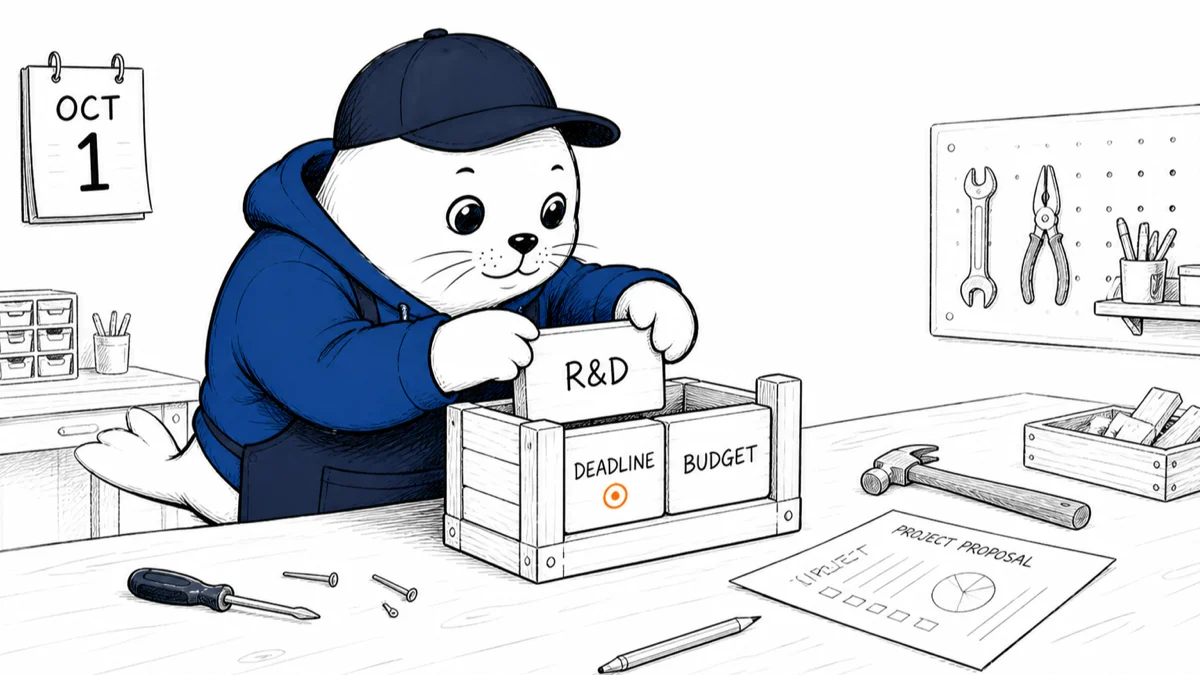
A £10 million ceiling sounds like a funding headline. The more useful detail is that this is procurement: a qualifying UK AI company must deliver R&D against a named public problem, and the first batch closes on October 1.
What the £100 million competition actually buys
The UK government has opened a Sovereign AI Unit competition worth up to £100 million over the life of the scheme. UK-registered startups and small or medium-sized businesses can compete for contracts between £250,000 and £10 million. The guidance says most awards are expected to land between £1 million and £3 million.
This is not a general startup grant and it is not a promise to reimburse a company’s existing product roadmap. The project must be based in the UK, answer one of the published challenges, and contain a substantial R&D component.
The four opening problems are unusually concrete
| Challenge | The operating problem | A credible evidence package |
|---|---|---|
| Compute efficiency | Get more useful AI work from constrained compute | Measured throughput, energy, latency, and quality under fixed hardware |
| Defence edge AI | Run capable systems where bandwidth and infrastructure are limited | Offline behavior, hardware limits, robustness, and recovery tests |
| Safe agent adoption for CISOs | Use AI agents without losing security control | Permission boundaries, monitoring, rollback, and incident evidence |
| NHS productivity | Reduce operational burden without weakening care or governance | Workflow timing, error analysis, human review, privacy, and adoption results |
A generic model demo will struggle here. Each challenge needs an operating claim with a measurable baseline. If your proposal says an agent will save time, show the current time, the expected reduction, who checks the work, and what happens when the agent is wrong.
The 50% R&D rule can break a weak budget
At least 50% of the contract value must be directly and exclusively attributable to R&D services. For a £2 million contract, that means at least £1 million needs a defensible R&D allocation. Sales activity, routine deployment, ordinary hosting, and work that merely supports R&D should not be quietly relabeled as research.
I would split the budget into three ledgers before writing the narrative:
- Direct R&D work tied to a technical uncertainty or experiment.
- Delivery work required to place the result in the target environment.
- Commercial or operational overhead that the scheme may not treat as qualifying R&D.
If the first ledger cannot clear 50% without generous interpretation, the proposal is not ready. Fix the work plan before polishing the application.
Eligibility is friendlier than the cash-flow problem
The formal guidance does not impose a minimum annual turnover, trading history, net asset level, or cash reserve. That opens the door to younger companies. It does not remove payroll, procurement, insurance, data access, or delivery risk.
Upfront payments may be available for eligible cash-constrained suppliers. Treat that as an option to justify, not an assumption. Build a monthly cash-flow schedule showing when people, compute, subcontractors, testing, and security work must be paid. Then map those costs to the contract’s expected payment events.
The intellectual-property terms deserve a careful read
The supplier retains background and foreground intellectual property, while government receives a license for public-sector use. That is more startup-friendly than a full transfer of ownership, but the practical value depends on the license scope, security restrictions, data rights, and any challenge-specific terms.
Separate what you bring into the project from what the contract funds. List pre-existing models, code, datasets, evaluation harnesses, and trade secrets as background IP. Keep a clean record of new foreground IP created during delivery. This is the sort of boring documentation that becomes very valuable during due diligence.
The deadline starts before October 1
| Batch | Competition deadline | Expected decision |
|---|---|---|
| 1 | October 1, 2026 | October 31, 2026 |
| 2 | December 1, 2026 | December 31, 2026 |
| 3 | February 1, 2027 | February 28, 2027 |
For the first batch, the operational deadline is therefore around September 17, not October 1. The supplier briefing on September 7 is open to all. Use it to resolve questions about challenge fit, R&D allocation, security, data, and payment structure before the expression of interest becomes urgent.
A seven-question bid gate
- Is the company registered in the UK and is the project based in the UK?
- Which single published challenge does the proposal answer?
- What baseline will prove that the result is better?
- Can at least 50% of contract value be traced to qualifying R&D services?
- Is the technology between readiness levels 4 and 8?
- Can the company finance delivery under the likely payment schedule?
- Are background IP, foreground IP, data rights, and the public-sector license documented?
Six confident answers and one vague answer is still a no. The vague one usually becomes the issue that procurement or technical assessors find first.
My verdict: apply only with a measurable public-service result
This competition is attractive because the contract sizes are meaningful and the guidance leaves room for younger companies. It is also designed to buy evidence, not AI theatre. The strongest proposal will define a narrow public problem, a credible trial, and a result that can survive operational scrutiny.
For context, our analysis of the €387.8 million LUMI-AI contract shows why signed procurement facts should be separated from future capacity. Our guide to the NSF AI infrastructure hubs makes the same point from the US side: a large headline number does not tell you what your team can actually buy.
Read the official documents
- Read the UK government announcement.
- Open the Sovereign AI Unit competition page and formal guidance.
Maroc IA 2030 offers another sovereign-AI model built around national research institutes, shared government software, public-service assistants and a sovereign marketplace.
Which part would stop your application today: challenge fit, the R&D allocation, or cash flow?