

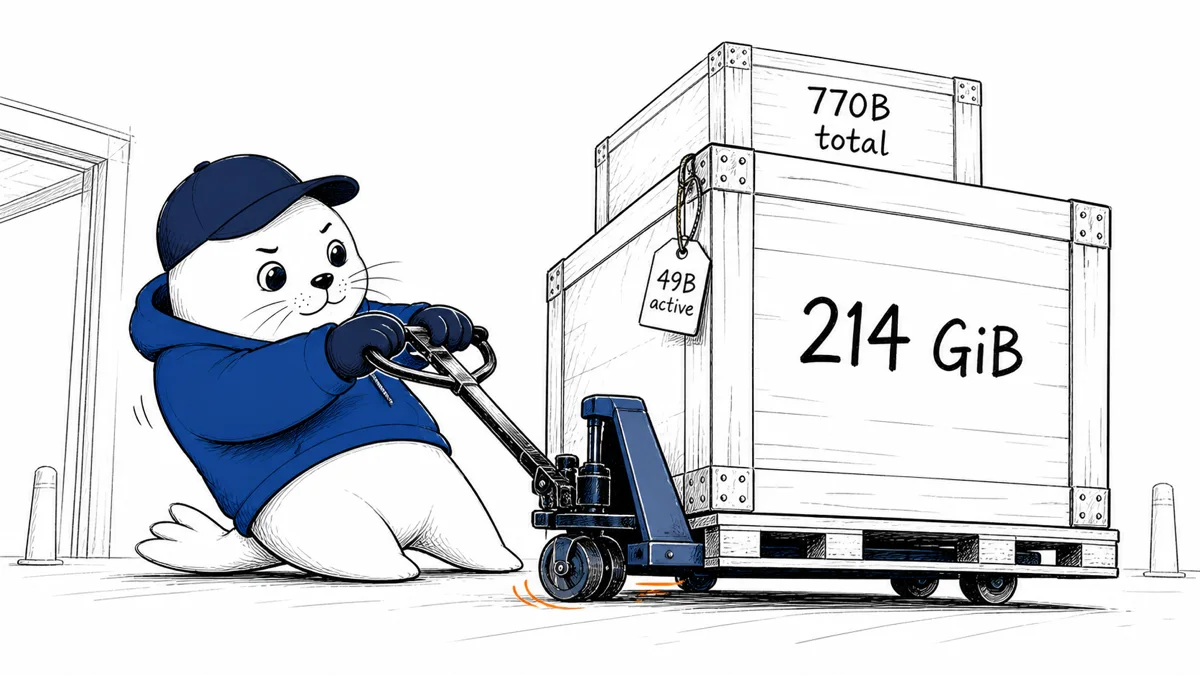
Tencent Hy4 activates 49 billion parameters for each token. The smallest official low-bit package still weighs 213.66 GiB. Those numbers describe different parts of the deployment, and confusing them can ruin a hardware plan.
Tencent Hy4 is an Apache-2.0 open-weight mixture-of-experts model with 770 billion total parameters, 49 billion active parameters per token, and a context window of up to one million tokens. Tencent released the preview on August 28 for coding, office work, analysis, and scientific tasks.
The open license is useful. The phrase “49B active” is also easy to misread. It describes how much of the expert network participates in a token’s computation. It does not mean the complete model occupies the memory of a normal 49B dense model.
The deployment starts at 214 GiB, not 49B
| Build | Published size | Practical reading |
|---|---|---|
| BF16 | Roughly 1.5 TB | Full-precision deployment belongs on a large multi-GPU or accelerator system |
| Q4_K_M GGUF | 435.20 GiB | Still far beyond a conventional single consumer GPU |
| Mixed STQ1_0 GGUF | 213.66 GiB | Smallest official low-bit package, but it requires a patched runtime |
A system also needs memory for the key-value cache, runtime buffers, batching, the operating environment, and any speculative or parallel execution strategy. A one-million-token context can make the cache a serious capacity decision even after the weights fit.
This is the same trap we found in Qwen3.8-Flash-Next’s active-parameter label. Active experts lower the computation required for a token. The inactive experts still exist in the checkpoint and must remain reachable when the router selects them.
Why active parameters and resident weights diverge
Hy4 has 256 routed experts and selects eight of them, plus a shared expert, according to the official model card. Routing allows each token to use only a fraction of the full network’s compute. Different tokens can select different experts.
The deployment therefore needs access to the complete expert pool even though one token does not execute every expert. Quantization compresses that pool. It does not erase it.
“49B active” is a compute description. “213.66 GiB” is the smaller official weight package you still have to place somewhere.
That distinction also affects cost estimates. A team can save arithmetic per token and still need expensive memory capacity, fast interconnects, and enough bandwidth to keep the experts fed.
The low-bit build is not plug-and-play
Tencent’s AngelSlim repository warns that the Hy4 GGUF packages do not run on stock llama.cpp at publication time. The Q4_K_M build requires Tencent’s Hy4 patch. The mixed STQ1_0 build also needs the separate STQ1_0 patch.
That is a meaningful operational constraint. A file ending in GGUF can look familiar, but the format extension does not guarantee that an existing Ollama, LM Studio, llama.cpp, or managed local stack supports the model correctly.
- Pin the exact runtime commit and patch set.
- Validate tokenizer, routing, chat template, and long-context behavior.
- Keep a small accepted-output set before upgrading the runtime.
- Measure startup time, prompt ingestion, decode speed, and memory headroom separately.
- Do not expose the service until failed loads and out-of-memory behavior are recoverable.
Tencent’s own examples assume eight-way parallelism
The official vLLM and SGLang deployment examples use tensor parallelism across eight GPUs. That does not prove eight GPUs are the only possible configuration, but it reveals the operating class Tencent expects for a serious deployment.
The AngelSlim repository reports about 20.47 decode tokens per second for its STQ1_0 build on eight H20 GPUs. Treat that as a publisher measurement, not an independent benchmark. Hardware topology, prompt length, concurrency, quantization, runtime patches, and cache settings can all move the result.
A builder deciding between local inference and an API should measure accepted work per dollar, not tokens per second in isolation. Our review of Kimi K3’s production rollout shows why reliability, permissions, and failure recovery can matter more than another leaderboard screenshot.
The benchmark headline comes from Tencent
Tencent says 163 internal experts blindly evaluated 203 engineering tasks. Hy4 averaged 2.99 out of 4.00, compared with 2.92 for GLM-5.3 and 2.94 for Kimi K3.
The experiment is more useful than a vague claim of superiority because Tencent publishes the evaluator and task counts. It is still an internal test. The company selected the tasks, ran the evaluation, and reported the result. It is not an independent ranking of the three models.
Tencent also lists known limitations: the preview can reason longer than necessary and can over-verify its work. Both behaviors can raise latency and token cost even when the final answer is strong.
The API creates a cheaper first experiment
Tencent lists API prices of $0.834 per million input tokens, $2.501 per million output tokens, and $0.042 per million cache-hit tokens. A task using one million fresh input tokens and 200,000 output tokens would cost about $1.334 before retries, tools, hosting, or provider differences. That is a Musthave.ai calculation using Tencent’s published rates.
The API route lets a team test task quality before committing to a patched 214-GiB local stack. It also transfers some infrastructure work to the provider. The trade is continued variable cost, provider dependence, and a different privacy boundary.
| Situation | Sensible first move | Evidence to collect |
|---|---|---|
| Evaluating task quality | Use an API or hosted product | Acceptance rate, latency, retry cost, and failure modes |
| Existing eight-GPU inference team | Test the official runtime and one quantization | Resident memory, throughput, patch stability, and long-context behavior |
| Single workstation or ordinary homelab | Wait for upstream runtime support or use a smaller model | Real memory headroom and an accepted-output comparison |
| Data cannot leave the environment | Price the complete local stack | Hardware, power, support, patch maintenance, monitoring, and recovery |
My verdict: open enough to inspect, large enough to plan carefully
Tencent Hy4 is an interesting open-weight release because the license, model card, repository, quantizations, and known limitations are public. That gives builders more evidence than a closed demo.
I would not call it a 49B local model. I would call it a 770B mixture-of-experts model with 49B active compute and a smallest official weight package of 213.66 GiB. Start with the API unless your team already knows why eight-way parallelism, patched runtimes, and hundreds of gigabytes of weights are acceptable operational choices.
Read the primary sources
- Read Tencent’s Hy4 preview release announcement.
- Inspect the official Hy4 model card and weights.
- Review the official Hy4 repository and serving instructions.
- Check Tencent AngelSlim’s GGUF sizes, patches, and publisher measurements.
Checked August 31, 2026. Architecture, sizes, prices, internal evaluation results, limitations, and deployment examples are reported by Tencent or its official repositories. The $1.334 example is a Musthave.ai calculation.