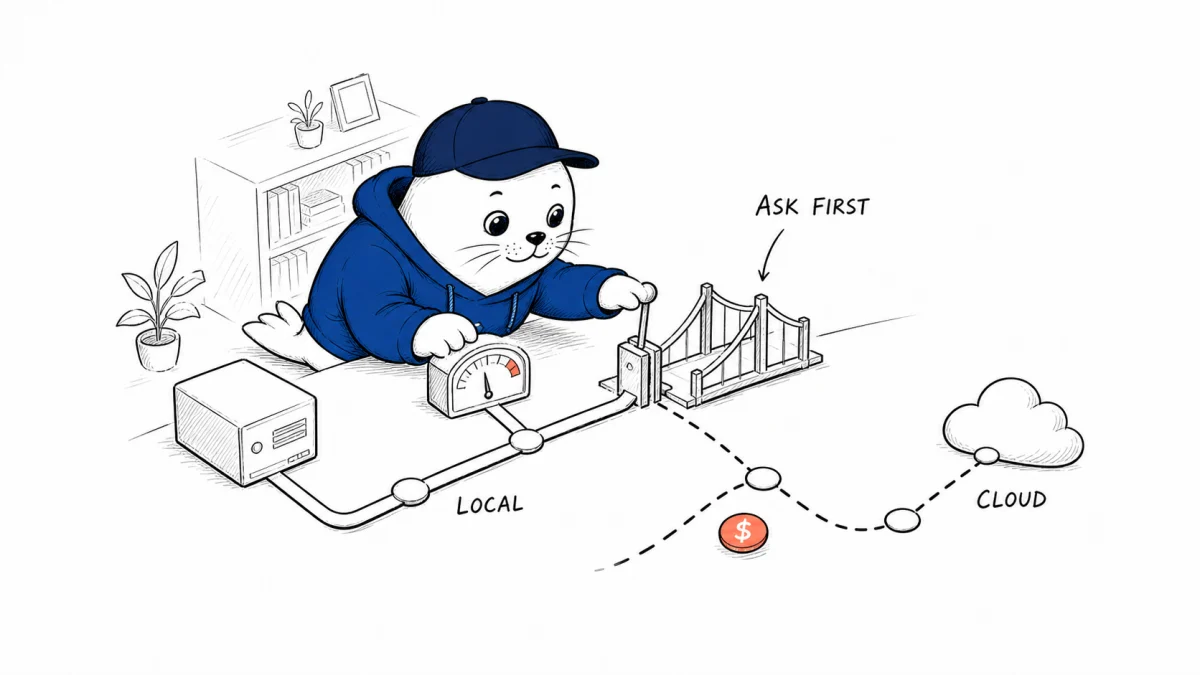
A local agent can run all night without a per-token invoice. It still has a bill: hardware, electricity, idle time, maintenance and the cloud calls it makes when the local model is not good enough.
The new local AI agent products make that tradeoff concrete. Perplexity has introduced Portable Computer for NVIDIA DGX Spark. Apple has announced an M5 Ultra Mac Studio with up to 512 GB of unified memory. Both point toward agents that keep more planning, retrieval and execution on hardware the customer controls.
Neither announcement proves that local execution is cheaper. The result depends on utilization, model quality and how often the workflow asks a cloud model to take over.
Portable Computer keeps the control loop local
Perplexity says Portable Computer runs its orchestrator, planner, tool router, scheduler, durable queue and local search index on DGX Spark. The local model can be Qwen 3.8 27B or Perplexity’s PPLX 27B.
Work completed locally does not consume Perplexity credits. When the system wants web access, connected apps or one of more than 15 frontier models, it asks the user for authorization before escalating to the cloud.
The initial release is for Pro and Max subscribers on Linux and DGX Spark. Windows and RTX PC support are planned later. That is a narrow first market, not a general local-agent layer for every laptop.
Apple is selling memory capacity, not an agent stack
Apple’s M5 Ultra Mac Studio announcement goes after a different layer. The system supports up to 512 GB of unified memory, Thunderbolt 5 and RDMA clustering. It starts at $5,499, while the 512 GB configuration is not expected until late October.
Do not pair the $5,499 base price with the 512 GB maximum as if they describe the same configuration. Apple has not said the largest-memory machine costs $5,499. It says the product line starts there.
Apple also reports that four Mac Studios can deliver up to three times the inference performance of one. That is a company claim, not a cost-normalized result. Four base systems alone would start at $21,996 before memory upgrades, storage, networking, power or administration.
Turn the purchase into a monthly floor
A simple three-year allocation puts a $5,499 base system at $152.75 per month. Four base systems start at $611 per month over the same period. Those figures are only the capital floor.
Local monthly cost = hardware allocation + electricity + support time + software + failed work + cloud escalation.
Now divide by useful work. A $300 monthly local stack completing 3,000 accepted tasks costs ten cents per accepted task before labor. If it completes only 300, the same fixed cost becomes one dollar. Idle hardware changes the economics faster than a modest cloud-token discount.
The comparison needs seven columns
| Cost area | Local question | Cloud question |
|---|---|---|
| Capacity | Does the model fit at the needed context? | Are quotas and latency stable? |
| Quality | What share of tasks need escalation? | Does the hosted model improve acceptance? |
| Utilization | How many useful hours is hardware active? | Do charges track actual demand? |
| Data | Which inputs and logs stay on the machine? | Which content leaves through APIs or connectors? |
| Operations | Who patches models, runtimes and drivers? | Who manages provider changes and outages? |
| Energy | What are measured wall watts per accepted task? | What cost and emissions are embedded in price? |
| Fallback | What happens when local quality is insufficient? | What happens when the provider is unavailable? |
NVIDIA describes a growing local AI stack around open models and agents on RTX systems and DGX Spark. That ecosystem can reduce setup work. It does not remove the need to test tool calling, memory use and task success on the exact machine.
Local does not mean no data movement
A planner may run locally while a browser reaches public websites, a connector reads a cloud drive and an escalation sends the problem to a hosted model. The system is local-first, not sealed.
- Log every cloud escalation and its reason.
- Show the user which data will leave before approval.
- Separate local files from connector credentials.
- Provide a mode that refuses cloud use rather than silently degrading.
- Test whether a local failure can widen permissions during retry.
The access controls in our AI cyber-test incident analysis remain relevant: a local process can still act on remote systems if its network and credentials allow it.
A 30-day pilot can settle the argument
- Select one repeated workflow with a known cloud bill and review process.
- Run a local model at a fixed context and record completed tasks, latency and wall power.
- Escalate only when a named quality or capability gate fails.
- Price reviewer time, maintenance and idle capacity.
- Compare accepted-task cost and data exposure with the existing cloud route.
Our Granite 4.2 deployment test adds a useful warning: the model file can fit while long-context cache exceeds the memory budget. Buy hardware for the workload, not the parameter label.
My verdict: approve cloud calls and measure utilization
Local-first agents are becoming real products, not weekend scripts. Their best feature may be the explicit boundary: do ordinary work locally, then ask before using a more capable remote system.
That boundary only pays if the machine stays busy and the local model completes enough work. Track cloud-escalation rate and accepted tasks per hardware dollar. Those two numbers will tell you more than a memory maximum or a no-credit claim.
Read the source record
- Read Perplexity’s Portable Computer announcement.
- Review NVIDIA’s local AI stack overview.
- Check Apple’s M5 Ultra Mac Studio specifications.
- Compare Tom’s Guide’s independent context.
Checked August 29, 2026. Product behavior and availability come from Perplexity, NVIDIA and Apple. The three-year monthly hardware figures are Musthave.ai calculations from Apple’s starting price; they do not represent the price of the 512 GB configuration.