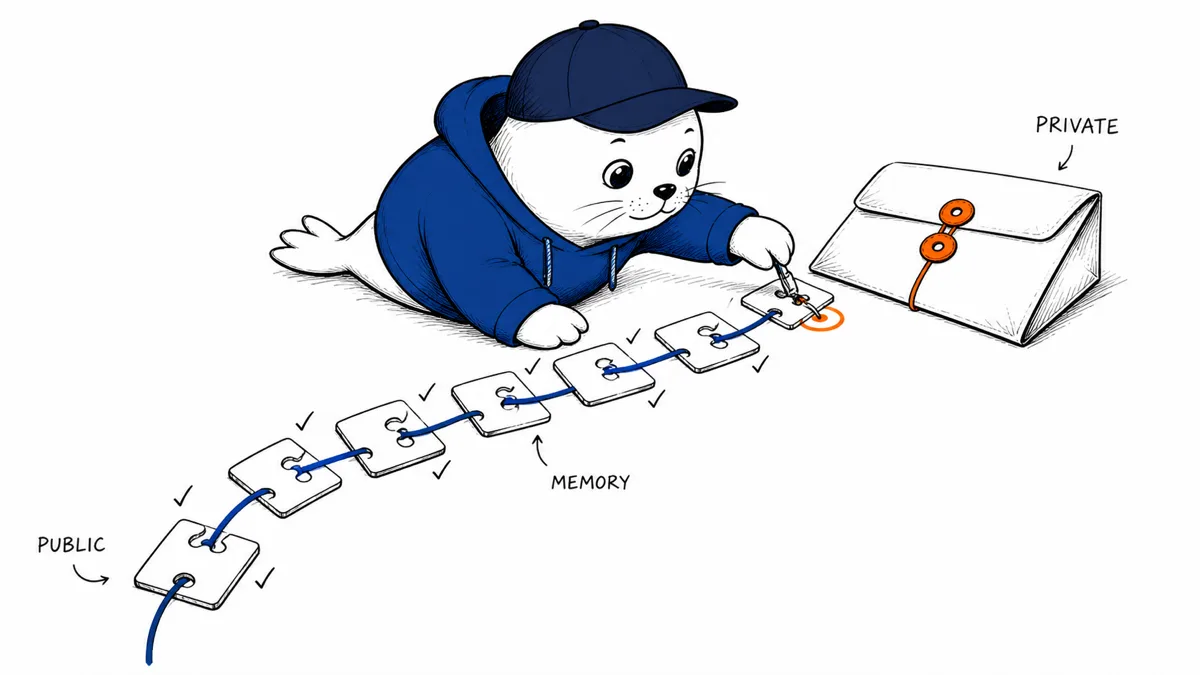
An agent cleared every public level in a benchmark built to punish short memories. The tempting conclusion is that the puzzle is solved. The honest conclusion is narrower: NVIDIA built a strong public-set system, and the private test has not happened yet.
NVIDIA AVO ARC-AGI-3 results are unusually clean on the surface. NVIDIA reports that AVO completed all 183 levels across the benchmark’s 25 public environments and earned a 100.00 score on the resource-aware heuristic efficiency metric, or RHAE.
The system used 6,624 environment actions. NVIDIA compares that with 7,542 actions for VISTA, roughly 12.2% fewer by my calculation. The full run used Claude Opus 5, but NVIDIA explicitly warns that comparing AVO with the base model’s roughly 30% result is not a controlled ablation.
I find the architecture more interesting than the perfect number. AVO keeps memory, a supervisor, exploration, recovery, and tool use working across long interactive tasks. That is exactly what a one-shot benchmark tends to hide.
What 100 RHAE means on the public set
ARC-AGI-3 evaluates agents inside unfamiliar interactive environments. The agent has to infer the controls and goal by acting, observing the result, and carrying useful discoveries into later decisions. A correct final move is not enough if the system wastes a large action budget getting there.
NVIDIA says AVO solved every public level. That establishes complete coverage on the material that developers can see and iterate against. It does not establish performance on ARC-AGI-3’s semi-private or private competition sets, which are designed to test generalization after public development.
| Measure | Reported result | Limit |
|---|---|---|
| Public environments | 25 of 25 completed | Public material can be inspected during development |
| Public levels | 183 of 183 completed | No semi-private or private result announced |
| RHAE score | 100.00 | Applies to the reported public run |
| Environment actions | 6,624 | Cross-system comparison, not a controlled ablation |
| Base model | Claude Opus 5 | System result cannot be assigned to the model alone |
The system, not the base model, earned the score
AVO is a long-horizon agent architecture. It stores evidence from interaction, lets specialized components propose and test ideas, and uses a supervisory layer to decide what should persist. A recovery path matters because an early wrong theory can otherwise consume the remaining action budget.
This connects with our PAST-Bench review of agent memory. Memory only helps when it improves a later decision and stops carrying stale beliefs after the environment changes. AVO’s public result suggests that its loop managed that tradeoff well on these environments. The released announcement does not expose enough ARC-specific traces to audit how often it recovered from bad memory.
The same separation appeared in our DarwinX article: hold the model fixed and the harness can still move the result. Model choice matters, but the memory policy, supervisor, tools, retry logic, and stopping rule are part of the evaluated product.
Why the VISTA comparison needs restraint
AVO used 918 fewer actions than VISTA in the figures NVIDIA reports. Dividing 918 by VISTA’s 7,542 actions gives a 12.17% reduction. That is a useful scale check, not proof that AVO is 12% more efficient in general.
The systems can differ in model, prompts, memory, planning, recovery, and action accounting. Without a shared harness or a controlled component swap, the action gap describes two reported runs. It does not isolate which architectural choice created the difference.
NVIDIA makes a similar caveat around the Claude Opus 5 baseline. A base-model score and a full-agent score answer different questions. One asks what the model can do under a particular direct setup. The other asks what a larger loop can accomplish with state, tools, and repeated interaction.
The private set is the generalization gate
A perfect public-set result can be earned through genuine reusable capability, public-specific engineering, or a mixture of both. The private environments exist to separate those possibilities. Until AVO is tested there, the result should be read as excellent public performance with generalization still unresolved.
NVIDIA also did not publish the ARC-specific harness, complete traces, exact prompts, or a downloadable submission package with the announcement. The earlier AVO paper describes the broader architecture and reports a seven-day GPU-kernel optimization run that explored more than 500 directions, committed 40 kernels, and reached up to 10.5% over FlashAttention-4 on the evaluated B200 configurations. That supports the claim that AVO is meant for long autonomous searches. It does not reproduce the ARC result.
How to test a long-horizon agent in your own workflow
- Keep a hidden task set. Do not let prompt authors or memory designers tune against every final case.
- Record the full action budget. Count tool calls, environment actions, retries, model tokens, wall time, and human interventions.
- Test memory reversal. Change a condition after the agent forms a working theory and check whether stale state is revoked.
- Separate recovery from luck. Repeat the run with controlled seeds or several samples and inspect where the agent repairs a bad path.
- Ablate one component at a time. Remove the supervisor, memory, specialist, or recovery loop while keeping the base model and task fixed.
- Price the accepted outcome. A perfect task score can still be a poor deployment if the action budget, latency, or failure cleanup is too expensive.
Our recent NVIDIA SkillEvaluator analysis adds the repeatability rule. A strong paired result is a start. Teams still need repeated trials and uncertainty, especially when one failure can touch production data or credentials.
My verdict: copy the measurement boundary
NVIDIA’s AVO result is worth paying attention to because the public task requires sustained interaction, not because 100 is a magical number. The architecture appears to keep useful state alive across a long action sequence while controlling enough waste to finish every public level.
The correct label today is simple: company-reported public-set completion. Wait for the private set before calling it general. In the meantime, borrow the accounting discipline. Score the whole agent loop and keep its hidden test hidden.
Read the technical record
- Read NVIDIA’s AVO public-set announcement and caveats.
- Inspect the AVO architecture paper.
- Review the ARC-AGI-3 technical report.
Which component in your agent loop has earned its place through a hidden ablation?
Checked August 24, 2026. Public-set completion, action counts, model choice, and kernel-optimization results are attributed to NVIDIA and the AVO paper. The ARC-AGI-3 private sets were not reported, and the public result has not been independently reproduced here.